Can You Replace an SDR with an AI Agent? An Honest 2026 Answer
October 5, 2025 · 5 min read · by Ahmet Faruk Yilmaz, Founder of Asphia
TL;DR
An AI agent can handle prospecting, signal research, copy generation, and inbox triage at scale, but a human still owns the judgment call before every send. The honest answer: you can replace the mechanical work of an SDR, not the strategic relationship layer.
Short answer: an AI agent can replace the mechanical work of an SDR. It cannot replace the judgment layer. Here is why that distinction matters more than the headline.
What an SDR Actually Does (and Which Parts AI Handles)
A traditional SDR spends roughly half their time on tasks that are purely mechanical: pulling lead lists, researching companies, writing variations of the same email, logging activity in the CRM, and sorting through replies. All of that is automatable today.
The other half involves judgment calls: reading tone in a reply, deciding whether a prospect is worth a second sequence, knowing when a deal is warm enough to hand to an AE. That half is where humans still add clear value.
Modern AI outbound systems, including what we build at Asphia, handle the mechanical half at a scale no single human can match. Signals like new funding, an open SDR job post, a tech stack change, or a recent LinkedIn post get pulled automatically. Copy gets generated per lead with a specific opening tied to that signal. Emails get verified before they send. Replies get classified so the human only sees the ones that need a response.
The result is that one person with a well-built system can run a volume of outreach that would previously require a team.
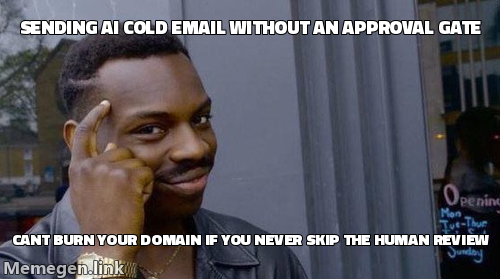 The approval gate is not overhead. It is what keeps your domain out of spam folders.
Where AI Agents Fall Short
There are three places where pure automation still struggles.
First, nuance in replies. A prospect who says “not now, try me in Q2” is not a no. An AI classifier can flag it as “future interest,” but deciding whether to nurture that contact, and how, takes judgment that depends on context the system does not always have.
Second, complex multi-stakeholder deals. If you are selling to enterprise accounts where six people need to be touched over three months, the sequencing and relationship logic gets complicated fast. AI handles the first touch well. The follow-up choreography at that level still benefits from a human orchestrating it.
Third, brand-sensitive categories. If your market is small (a few hundred target accounts) and reputation matters enormously, every touchpoint reflects on you personally. Automated volume is not always the right motion. For most B2B cases with hundreds or thousands of addressable accounts, this is not the constraint.
What a Realistic AI Outbound Stack Looks Like
A working system in 2026 typically combines:
- A data layer (Apollo for company and contact discovery, Clay for enrichment and signal logic)
- A copy layer (LLM generating email body and subject per lead, tuned to your ICP and voice)
- A verification gate (email address checked before spend)
- A sending layer (cold email platform with proper deliverability setup)
- An approval gate (a human reviews or spot-checks before send, especially early)
- A reply layer (inbox classification, suppression of unsubscribes, escalation of positives)
If you want to see how signal-based sourcing plugs into this, the Clay enrichment workflow is a good starting point. For the question of whether to build this yourself or have someone run it for you, the done-with-you outbound model covers the tradeoffs directly.
One thing worth saying clearly: the approval gate matters. Every AI system makes errors. A human reviewing a sample of sends before they go out catches the edge cases that would otherwise hurt deliverability or embarrass you. That gate is not overhead. It is quality control.
The Cost Comparison You Actually Need to Make
The honest comparison is not “AI agent vs. one SDR salary.” It is “what does it cost to build and run this system vs. what does it cost to hire, train, ramp, and manage an SDR over 12 months?”
A new SDR typically takes three to four months to reach full productivity. Ramp costs, manager time, and turnover risk are real. An AI system takes one to two weeks to set up, runs continuously without ramp time, and the marginal cost of sending to 500 vs. 5,000 leads is minimal.
That said, neither replaces a go-to-market strategy. If your ICP is wrong, your positioning is unclear, or your offer does not resonate, more volume just means more fast rejections. The system is a multiplier, not a substitute for product-market fit.
When to Hire an SDR vs. Build the System
Build the AI system first if: you have product-market fit, a defined ICP, and you want to run outbound at volume before committing to headcount. This is the right sequence for most early-stage companies. For a more detailed look at this specific case, AI SDR for startups walks through the decision framework.
Hire an SDR if: you are selling complex, high-ACV deals where the relationship and strategic account management matter as much as pipeline creation, and you want someone who can also take calls and run discovery.
The two are not mutually exclusive. Many teams run an AI system for top-of-funnel volume and use an SDR or AE to work the warm replies. That combination tends to outperform either alone.
The Practical Answer
Replace an SDR with an AI agent for the repeatable, scalable parts of outbound: sourcing, copy, verification, sending, inbox triage. Keep a human in the loop for reply handling, strategy, and any touchpoint where judgment and relationship matter.
If you want to see what this looks like in practice, book a call with us and we will walk through whether a system-first or hybrid approach fits your market.
Get the signal tier list in your inbox.
We rank signals from S to D to decide who gets a cold email and who does not. You get the list once. No follow-up emails.
Request received. The list lands in your inbox within 24 hours.
One more step: send the prepared request to [email protected]
FAQ
Can an AI agent fully replace a human SDR?
For high-volume, repeatable prospecting tasks, yes. An AI agent can source leads, write personalized emails, verify addresses, and triage replies without fatigue. The gap is relationship nuance: knowing when to slow down, escalate, or walk away still benefits from a human in the loop.
What tasks can an AI SDR agent handle today?
Signal research (funding rounds, job changes, intent data), lead sourcing via Apollo or Clay, email copy generation with per-lead personalization, email verification, inbox classification (interested, OOO, unsubscribe), and CRM logging. All of this runs automatically with current tooling.
How long does it take to set up an AI outbound system?
A focused setup takes around five to seven days: ICP definition, data sourcing, copy prompt tuning, deliverability warm-up, and approval workflow. The first emails typically go out in the first week.
Is AI-generated cold email compliant with GDPR?
It can be, but the system must be designed for it. That means sourcing contacts from legitimate B2B data providers, honoring unsubscribes immediately, using business email addresses only, and keeping audit logs. Compliance is architecture, not an afterthought.
What is the difference between done-for-you and done-with-you outbound?
Done-for-you means the agency runs the system end-to-end in their stack. Done-with-you means they build the system inside your tools so your team owns and operates it after handoff. Both can use AI agents; the difference is who holds the keys long-term.
Do AI SDR agents work for LinkedIn outreach too?
Yes. The same signal-research and copy-generation logic applies to LinkedIn connection requests and follow-up messages. The main constraint is that LinkedIn rate-limits activity per account, so volume is lower than email, but personalization quality can be higher.

Ahmet Faruk Yilmaz
Founder of Asphia. He builds and runs signal-based B2B outbound engines for lean teams, and has booked meetings with teams at companies across five markets. Writes about cold email, Clay, deliverability, and GTM engineering.
Want this run for you?
Get a free GTM analysis. We show you the exact engine we would build.
Get your free GTM analysis →