Using Job Postings as Buying Signals: A Playbook for Outbound Prospecting
April 3, 2026 · 5 min read · by Ahmet Faruk Yilmaz, Founder of Asphia
TL;DR
A company posting for a Sales Director or Head of RevOps is signaling a budget decision in motion. Pull those postings via Apollo or Clay, filter by seniority and department, write copy that mirrors the pain behind the hire, and you convert cold outreach into warm timing.
A company posting for a Sales Director is not just hiring. They are signaling a budget decision, a growth bet, and a gap they need filled right now. That gap is your entry point.
Hiring signal outbound prospecting means building your pipeline around companies in motion, not static lists. It is one of the highest-converting trigger categories in B2B cold outreach because the timing is dictated by them, not by your arbitrary calendar.
Why Hiring Signals Convert Better Than Cold Lists
Most outbound fails because it is sent at the wrong time. The prospect has no active need, no budget cycle open, and no pressure to respond. A hiring signal changes all three.
When a company opens a Head of Revenue Operations role, they are telling you:
- They have a budget for headcount (which often means budget for tooling too).
- Someone senior owns the problem you solve.
- They are in a building phase where new vendors get evaluated.
Compare that to a static list of companies in your target vertical with zero context. The hiring signal list wins on timing alone. And timing is the variable that outbound teams underestimate most.
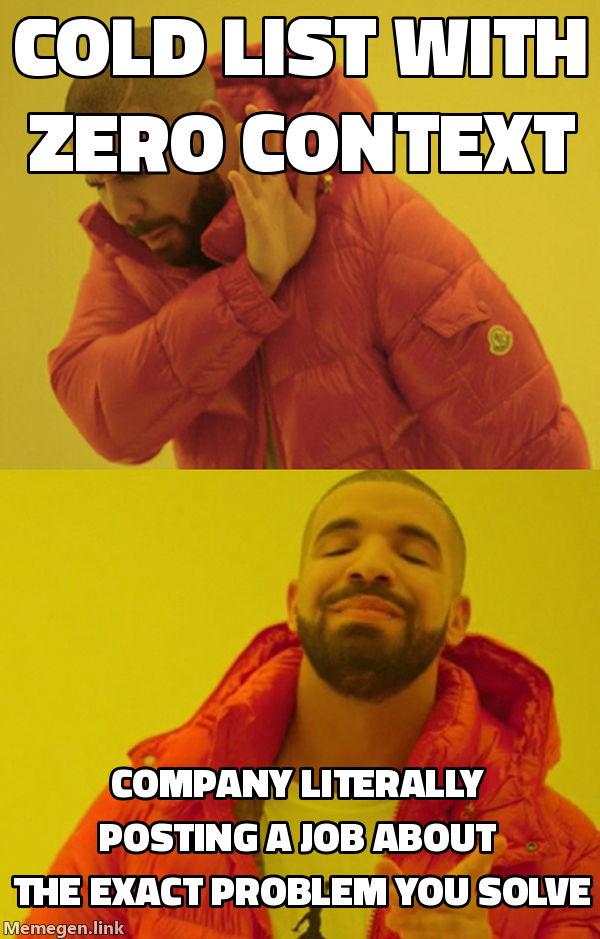 They literally filed the job post. Read the room.
Building a Signal-Triggered Prospect List
The workflow has three steps: pull, filter, enrich.
Pull live postings from Apollo, Clay, or a LinkedIn data partner. Clay in particular lets you set up a table that refreshes automatically, pulling new postings that match your criteria on a schedule. Clay enrichment service makes this operationally clean because the data lands in the same pipeline as your email tooling.
Filter by role relevance, seniority, company size, and posting date. Do not over-filter. If you sell to sales teams, pull any company posting for an SDR, AE, or VP of Sales. You can narrow later. Set a date cutoff of 30 days so you are always working fresh signals.
Enrich each account with contact data for the decision-maker. The person writing the job post is rarely the right outbound target. Find the person one level above the role being hired: if they are hiring an SDR Manager, you want the VP of Sales. If they are hiring a data analyst, you want the Head of BI or CRO. Apollo and Clay both let you pull that contact in the same workflow.
Writing Copy That Mirrors the Hiring Pain
The signal tells you what they are building. Your copy should speak to why it is hard.
A company hiring a VP of Sales is usually dealing with one of these: inconsistent pipeline, a founder still doing most of the selling, or a transition from product-led growth to sales-led. You do not know which one. So you pick the highest-probability pain and write to it.
Bad version: “I saw you are hiring a VP of Sales. We help companies scale their sales teams.”
Good version: “Bringing in a VP of Sales usually means the founder-led selling phase is over and repeatability becomes the priority. We build the outbound engine so your new hire walks into a system, not a blank slate.”
The second version shows you understand the moment they are in. It does not require you to quote the job posting. It just requires you to have thought about what that hire means for the business.
For agencies and consulting firms, this pattern applies directly. Outbound for professional services works best when the trigger is contextual, and a hiring signal is as contextual as it gets.
Sequencing and Timing
Do not send one email and move on. Hiring signals give you a natural multi-touch window because the company is in an active evaluation phase for weeks.
A simple sequence:
- Day 1: Cold email referencing the hire indirectly and connecting it to your offer.
- Day 4: LinkedIn connection request from a relevant person on your team, no note.
- Day 8: Follow-up email with a different angle (a result, a question, a short relevant resource).
- Day 14: Final email, short, direct, leaves the door open.
The entire sequence should run inside the 30-day window while the posting is still live. After that, the moment has passed.
If you want to run this without building the tooling yourself, done-for-you cold email services that specialize in signal-based outreach will already have the Apollo and Clay infrastructure connected. If you want to own the system, done-with-you outbound means you build it in your stack and keep it after engagement ends.
What to Measure
Track two things: signal-to-meeting rate and signal lag.
Signal-to-meeting rate tells you how well your copy converts a hiring trigger into a booked call. Benchmark against your non-signal cold list. If hiring signals do not outperform by a meaningful margin, the copy is not mirroring the pain correctly.
Signal lag is the gap between when a posting goes live and when you make first contact. Shorter is almost always better. If your workflow takes two weeks to get a signal into an email, you are leaving the best window untouched.
Hiring signals are one of several intent categories worth tracking. Other strong signals include funding announcements, leadership changes, and technology stack shifts. For a broader view of how signals connect to pipeline, see signals in our resource library.
The companies worth reaching out to are almost always telling you something. Job postings are one of the clearest messages they send.
Get the signal tier list in your inbox.
We rank signals from S to D to decide who gets a cold email and who does not. You get the list once. No follow-up emails.
Request received. The list lands in your inbox within 24 hours.
One more step: send the prepared request to [email protected]
FAQ
What is hiring signal outbound prospecting?
It means using a company's active job postings as a trigger to start outbound outreach. A relevant hire signals budget, headcount decisions, and a problem the company is actively trying to solve, making your timing far more relevant than a cold list with no context.
Which job postings make the best buying signals?
Postings for roles that own the problem your product or service solves. If you sell sales tooling, a VP of Sales or SDR Manager posting is ideal. If you sell finance automation, a Controller or Head of FP&A posting indicates active budget work. Match the role to the pain you fix.
How do I find companies posting for specific roles at scale?
Apollo, Clay, and LinkedIn Recruiter all let you filter job postings by title, location, seniority, and date posted. Clay's enrichment layer can pull live posting data and append it to your prospect list automatically, so your CRM stays current without manual scraping.
What should my cold email say when using a hiring signal?
Reference the hire indirectly rather than quoting the job post verbatim. Say something like: 'Noticed you are building out your RevOps function' instead of 'I saw your RevOps Manager job on LinkedIn.' The first shows insight, the second feels like surveillance. Then connect their likely pain to your offer in two sentences.
How fresh does a hiring signal need to be?
Within 30 days is ideal. A posting older than 60 days may already be filled, or the budget cycle has moved on. Filter your pulls by date and prioritize the freshest postings. Stale signals convert at a fraction of the rate.
Is using job postings for outbound GDPR compliant?
Job postings are public information, and reaching out to a professional about a relevant business offer on their work email is generally within legitimate interest under GDPR. Include a clear opt-out, do not store personal data beyond what is needed, and process only work email addresses. When in doubt, consult your legal team or a GDPR-compliant outbound partner.

Ahmet Faruk Yilmaz
Founder of Asphia. He builds and runs signal-based B2B outbound engines for lean teams, and has booked meetings with teams at companies across five markets. Writes about cold email, Clay, deliverability, and GTM engineering.
Want this run for you?
Get a free GTM analysis. We show you the exact engine we would build.
Get your free GTM analysis →