Trigger-Based Outbound vs Spray and Pray: Why Signal Sequences Get Materially Higher Reply Rates
April 22, 2026 · 5 min read · by Ahmet Faruk Yilmaz, Founder of Asphia
TL;DR
Trigger-based outbound email times every message to a buying signal: a new hire, a funding round, a job post, a tech-stack change. Because the message arrives when the prospect has a live problem, reply rates run well ahead of batch-and-blast lists. The signal is the timing, and the timing is the edge.
Spray-and-pray outbound is easy to describe: build a list, send the same email to everyone, hope something sticks. Trigger-based outbound email is the opposite. You watch for a specific event that signals a live problem, then send a message that speaks directly to that moment.
The reply rate difference is not marginal. Messages timed to a real signal arrive when the prospect is already thinking about the problem. That changes the conversion math entirely.
What Makes a Signal Worth Acting On
A signal is any observable event that shifts a prospect from “probably fine” to “actively trying to solve something.” The most actionable ones in B2B are:
- A new executive hire (new VP of Sales means new vendor review cycle)
- A funding announcement (capital creates urgency to build out headcount or infrastructure)
- A job post for a role your product replaces or supports
- A technology change detected via tools like BuiltWith or Datanyze
- An expansion into a new geography or vertical
The key word is observable. Public signals, ones you can pull from LinkedIn, Crunchbase, job boards, or tech databases, are the foundation of a compliant and scalable trigger-based outbound email program. See Clay enrichment service for how to automate the signal pull across sources.
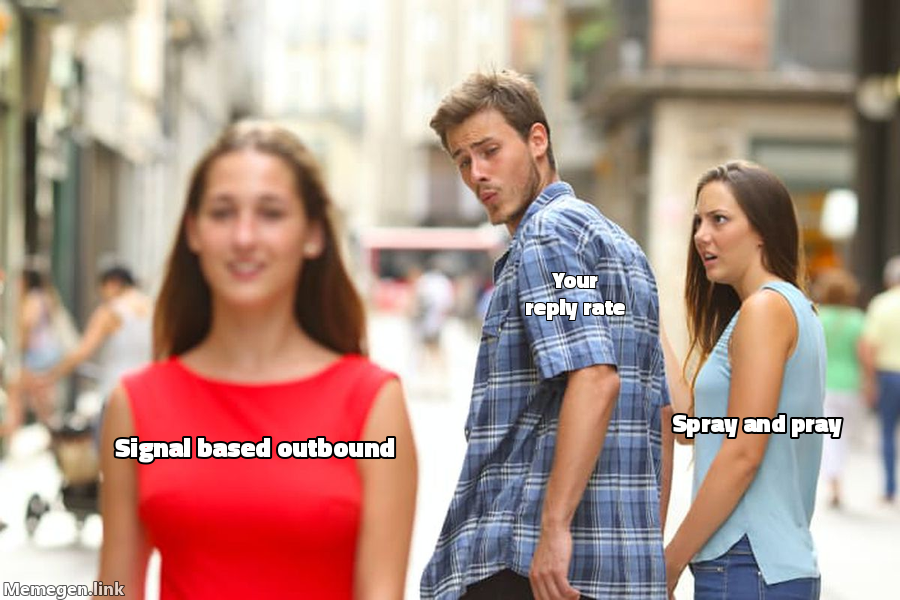 Your reply rate already knows which one to choose.
Why Spray and Pray Fails on Two Levels
Spray-and-pray fails on timing and on relevance.
Timing first: a static list built in January is cold data by March. The person you emailed may have changed roles, already bought a competitor, or just gone through a funding round that makes them a perfect target. You have no way to know because you are not watching.
Relevance second: a generic pitch to the whole list treats a 10-person startup the same as a 400-person growth-stage company. The problems are different, the budget cycles are different, and the decision process is different. A message that tries to speak to everyone speaks to no one.
Signal sequences solve both. The trigger fires when the event happens, so timing is built in. The signal itself informs the hook, so relevance is built in.
How a Signal Sequence Actually Works
A simple trigger-based workflow looks like this.
Step one: a data layer (Apollo, Clay, LinkedIn, or job board APIs) monitors your ICP for defined events. You set the filter: companies between 50 and 500 employees in your target industry that just posted a Head of Revenue Operations job.
Step two: when the event fires, the record is enriched. You pull the hiring manager’s name, the LinkedIn profile of the person they are trying to hire, and any recent press the company has published.
Step three: a personalized email is assembled using the enriched data. The subject line references the job post. The opening line connects it to the problem that role typically owns. The offer frames how you solve exactly that problem.
Step four: the sequence runs: email one on day one, a LinkedIn touch on day three, a follow-up on day seven. Each step is informed by the original signal.
The whole motion can be automated so the only human touch is approving the copy before it sends. If you want to see how this looks in practice, the done-with-you outbound model is built around exactly this flow.
Building the Signal Layer Without a Data Team
The barrier most teams hit is data infrastructure. Monitoring dozens of signal types across thousands of companies sounds like a data engineering project. With modern enrichment tooling, it is not.
Clay connects to a wide range of data providers through a single interface. You build a table, define the trigger logic with formulas, and let the waterfall find the right data. The output is a live feed of prospects who just hit your trigger condition, enriched and ready to sequence.
Apollo covers company and contact data at scale and feeds cleanly into most sequencers. Together they cover the majority of signal types without custom code. For a direct comparison of how the two fit together, see Clay vs Apollo.
The sequencer (Smartlead, Manyreach, Lemlist) takes the enriched record and fires the sequence. Deliverability is its own topic, but the short version is that signal-based email tends to perform better on spam metrics too, because smaller, targeted sends with high engagement signal quality to inbox providers.
The Compliance Point That Gets Missed
Trigger-based outbound is not just more effective, it is easier to defend under GDPR when done correctly. Legitimate interest as a lawful basis requires you to show that your outreach is relevant to the recipient’s professional role and that you have balanced their interests against yours.
Reaching out to a VP of Sales the week their company posts a job for a demand generation manager, with a message about how you generate pipeline, is a straightforward case for relevance. Reaching out to the same person months later with no connection to their current situation is harder to defend.
Public signal sources (press releases, job boards, LinkedIn activity) are already in the public domain. For GDPR guidance on business-to-business email, the official resource is gdpr.eu, which covers lawful basis requirements clearly.
When to Switch from Static Lists
If your current outbound runs on a list that has gone stale and your reply rate has plateaued, the list is the problem. Trigger-based outbound email is the fix, not more volume.
The transition does not require replacing everything at once. Start with one signal type, the one most directly connected to your offer, and run a parallel test. Compare reply rates over four weeks. The signal sequence will win.
For teams that want the system built and running inside their own stack, the outbound engine builder service covers the full build from data layer to deliverability.
Get the signal tier list in your inbox.
We rank signals from S to D to decide who gets a cold email and who does not. You get the list once. No follow-up emails.
Request received. The list lands in your inbox within 24 hours.
One more step: send the prepared request to [email protected]
FAQ
What is trigger-based outbound email?
Trigger-based outbound email sends a cold message only when a data signal suggests the prospect has a live problem: a new hire, a funding announcement, a technology change, or a job post. The trigger gives the message immediate relevance, which is why reply rates are higher than with static lists.
What counts as a buying signal for B2B outbound?
Common buying signals include hiring for a role your product replaces, opening a new market, raising a funding round, switching a key tool, posting a job that reveals a gap, or losing a senior leader. Each of these signals a moment when a prospect is actively trying to solve something, which is when cold outreach lands best.
How does signal-based email differ from spray-and-pray?
Spray-and-pray builds a static list and sends the same message to everyone on a schedule. Signal-based email monitors live data sources and fires a personalized sequence only when a specific event occurs. The result is a smaller volume of messages with a much higher hit rate per contact.
Does trigger-based outbound work at scale?
Yes, when the signal detection and personalization are automated. Tools like Clay pull signals from LinkedIn, Crunchbase, job boards, and technology databases. The message is assembled per record so you can run thousands of trigger sequences without writing each email manually.
Is trigger-based cold email GDPR compliant?
It can be, provided you use a lawful basis such as legitimate interest and target business contacts in a professional context. The European Data Protection Board guidance on legitimate interest applies. Using signals that are already public (job posts, press releases, LinkedIn activity) lowers risk compared to purchasing personal data without a clear basis.
How long does it take to set up a signal-based outbound system?
A focused setup with a defined ICP, one or two trigger types, and a sequencer like Smartlead or Manyreach typically takes one to two weeks to go live. The first week covers data sourcing and signal logic; the second covers copy, deliverability, and testing before volume ramp.

Ahmet Faruk Yilmaz
Founder of Asphia. He builds and runs signal-based B2B outbound engines for lean teams, and has booked meetings with teams at companies across five markets. Writes about cold email, Clay, deliverability, and GTM engineering.
Want this run for you?
Get a free GTM analysis. We show you the exact engine we would build.
Get your free GTM analysis →