LinkedIn Connection Request Messages That Get Accepted (Plus 12 Templates)
October 16, 2025 · 5 min read · by Ahmet Faruk Yilmaz, Founder of Asphia
TL;DR
The best LinkedIn connection request messages are short (under 50 words), reference something specific about the recipient, and make the ask feel low-pressure. Personalization beats volume every time. Skip the pitch in the first message. These 12 templates cover the most common outreach scenarios for B2B sales and recruiting.
The best LinkedIn connection request messages are short, specific, and make the ask feel obvious. Under 50 words, one clear reason to connect, no pitch. That is the whole formula.
Here is why this works, how to build your own, and 12 copy-paste templates you can use today.
Why Most Connection Requests Get Ignored
Generic messages fail for one reason: they look like broadcasts. When someone reads “Hi, I’d like to add you to my professional network” (LinkedIn’s default) or a templated opener that could apply to anyone, they assume you sent it to five hundred people that morning. Because you probably did.
The fix is not clever wordsmithing. It is specificity. One real detail (a post they wrote, a role change, a company you both know) signals that you actually looked at their profile. That changes the calculus from “this is spam” to “this person noticed something.”
The other common mistake is pitching in the connection note. LinkedIn connection requests are not cold emails. The note exists to explain why you want to connect, not to sell. Save the ask for after they accept.
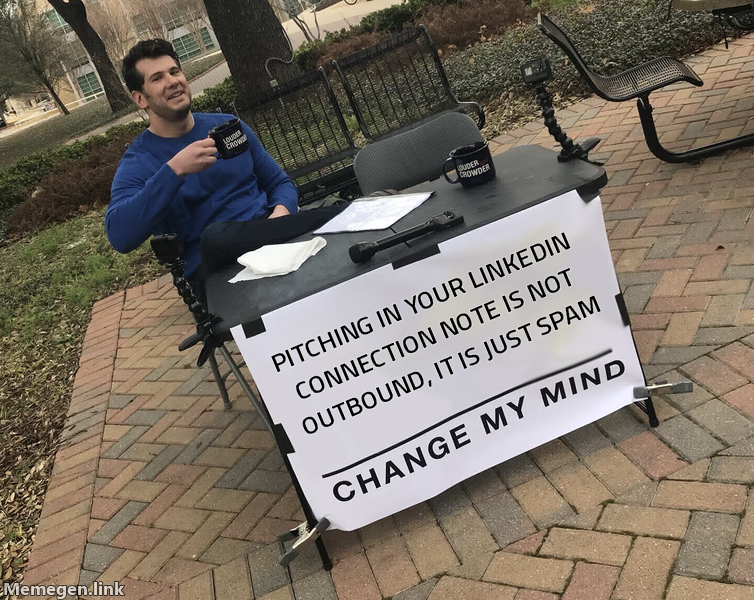 The note gets you connected. The pitch comes after they accept, not during.
The Structure of a High-Acceptance Request
Every effective connection request message has three parts, each optional depending on context:
Hook: one specific observation. A post they wrote, a company milestone, a mutual connection, a podcast they appeared on. Something that proves you saw them specifically.
Bridge: one sentence connecting that observation to why it makes sense for you to connect. Keep it about them, not about you.
Ask: low-pressure and obvious. “Would love to connect” or “happy to be in each other’s networks” works. No question marks, no calls to action, no requests for a call.
12 LinkedIn Connection Request Templates
After reading their content
-
“Saw your post on [topic]. Your point about [specific detail] is something I have been thinking about too. Would love to be connected.”
-
“Your piece on [topic] came up in our team standup this week. Great perspective. Happy to connect.”
Mutual connection or event
-
“We have [mutual connection name] in common. They mentioned you when we talked about [relevant topic]. Would love to connect.”
-
“Saw you were at [event name]. Did not get a chance to say hello there. Happy to be connected here.”
Shared role or industry context
-
“I also work in [industry/function]. I follow a few people in this space closely and your work keeps coming up. Worth connecting.”
-
“Running outbound for [company type] too. Always good to know others doing the same. Happy to connect.”
Referencing a company signal
-
“Noticed [their company] just [opened a London office / launched X / raised a round]. Congrats. Would love to be connected.”
-
“Your team seems to be doing interesting work on [topic]. Following along and would love to connect.”
Direct and honest
-
“I reach out to [their role] professionals as part of my work. Figured being connected here is a better starting point than a cold email. Happy to connect either way.”
-
“I will be honest: I think what we do at [your company] could be relevant to you. No pitch here, just want to be connected first.”
Recruiting context
-
“I work with [role] professionals who are open to the right opportunity. Not assuming anything about your situation, just expanding my network in this space.”
-
“I recruit in the [industry] space. Your background caught my attention. Would love to be connected even if the timing is not right.”
How to Personalize These at Scale
Personalization at scale is not manual. The approach that works is building a signal layer first, then generating the hook from that signal.
For example: pull a list of prospects from Apollo or Clay, filter by those who have posted on LinkedIn in the last 30 days, and use the post content as the input for a templated hook. The result is a personalized-feeling message for each person that took seconds to produce per lead.
This is the same pattern used in signal-based cold email and it transfers directly to LinkedIn. The mechanic is: find a real signal, use that signal as the personalization hook, keep the rest of the message structurally identical.
If you are running LinkedIn outreach at volume alongside cold email, it helps to have both channels pulling from the same data and the same ICP definition. Running them separately creates inconsistency in messaging and wastes enrichment spend. Our managed outbound service handles both from a single data layer.
What to Do After They Accept
The connection request is not the campaign. It is the first gate.
Once someone accepts, you have a warm signal. They looked at your profile and decided to let you in. That is worth something. The mistake is waiting too long or hitting them immediately with a pitch.
A good follow-up after acceptance: one or two sentences referencing why you connected, and a single soft ask. Not “can we book 30 minutes?” but “happy to share more if it is ever relevant” or “let me know if you want to compare notes sometime.”
The goal of LinkedIn outreach at this stage is to move from stranger to known quantity. The meeting comes later.
For teams running LinkedIn outreach alongside cold email as a coordinated sequence, the economics improve significantly when both channels reinforce each other. Same person, same message angle, two touchpoints instead of one.
Keep the connection note short. Keep it specific. Do not pitch. The templates above give you the raw material. The personalization is what turns them into results.
Get the signal tier list in your inbox.
We rank signals from S to D to decide who gets a cold email and who does not. You get the list once. No follow-up emails.
Request received. The list lands in your inbox within 24 hours.
One more step: send the prepared request to [email protected]
FAQ
How long should a LinkedIn connection request message be?
Keep it under 50 words. LinkedIn caps connection notes at 300 characters, but shorter messages get accepted more often. One sentence of context and one sentence of reason is usually enough. Long messages signal a pitch is coming and hurt acceptance rates.
Should I include a pitch in my LinkedIn connection request?
No. The connection note is not the place to pitch. Your only goal is to get connected. Save the actual value proposition for your first message after they accept. Pitching in the connection note is the single fastest way to get ignored.
What is the LinkedIn connection request character limit?
LinkedIn allows up to 300 characters in a connection request note. That is roughly 40 to 60 words. Most high-performing messages use fewer than 200 characters. Treat the limit as a ceiling, not a target.
Do LinkedIn connection requests get accepted more if they are personalized?
Yes. Personalized connection requests consistently outperform blank or generic ones. Referencing a specific post the person wrote, a mutual connection, a recent company milestone, or a shared professional interest all improve acceptance. Generic copy-paste notes perform the worst.
How many LinkedIn connection requests can I send per week?
LinkedIn enforces informal limits, and accounts that send too many requests too fast get restricted. As a general rule, staying under 100 per week is commonly cited as a safe threshold. Quality matters more than volume here. A high acceptance rate on a small, targeted list typically produces better outcomes than a low acceptance rate on a large spray-and-pray list.
What is the difference between a LinkedIn connection request and an InMail?
A connection request is free and goes to 1st-degree connections or anyone in your network who allows open connection requests. InMail is a paid LinkedIn feature that lets you message people outside your network directly. Connection requests with a note tend to feel less intrusive than InMails when personalized well.

Ahmet Faruk Yilmaz
Founder of Asphia. He builds and runs signal-based B2B outbound engines for lean teams, and has booked meetings with teams at companies across five markets. Writes about cold email, Clay, deliverability, and GTM engineering.
Want this run for you?
Get a free GTM analysis. We show you the exact engine we would build.
Get your free GTM analysis →