How to Book 10 Meetings Per Week With Cold Outbound (Real Numbers, No BS)
May 10, 2026 · 5 min read · by Ahmet Faruk Yilmaz, Founder of Asphia
TL;DR
To book 10 meetings per week with cold outbound, you need roughly 500 to 800 targeted prospects contacted weekly, signal-based personalization that earns replies, a verified email list (bounce rate under 2 percent), and a two-step follow-up sequence. Volume without targeting produces noise. Targeting without volume produces nothing.
You can book 10 qualified meetings per week with cold outbound. Not by sending 10,000 emails a day to a scraped list, but by building a system where targeting, copy, and infrastructure all work together. This post breaks down exactly how.
The Math Behind 10 Meetings Per Week
Start with the outcome and work backwards.
If your sequence earns a positive reply rate in the 4 percent range (a commonly cited benchmark for well-targeted B2B outbound), and roughly 60 to 70 percent of those replies convert to a booked call, you need somewhere around 400 to 700 targeted prospects contacted each week to hit 10 meetings. The exact number shifts with your list quality, copy, and ICP fit.
That number is achievable without burning your domain. The key word is targeted. A broad list of 2,000 barely-relevant contacts will typically produce fewer meetings than a precise list of 650 prospects who match your ICP exactly, contacted at the right moment.
The variables you control:
- List quality: verified emails, low bounce rate (under 2 percent), right personas
- Signal timing: contacting someone when they have a reason to care (new role, recent funding, hiring for a relevant function)
- Copy: one clear problem, one relevant reason you reached out, one low-friction ask
- Follow-up: two or three touches over two weeks, each adding a new angle
If your reply rate is currently below 2 percent, the issue is almost always list quality or copy, not volume.
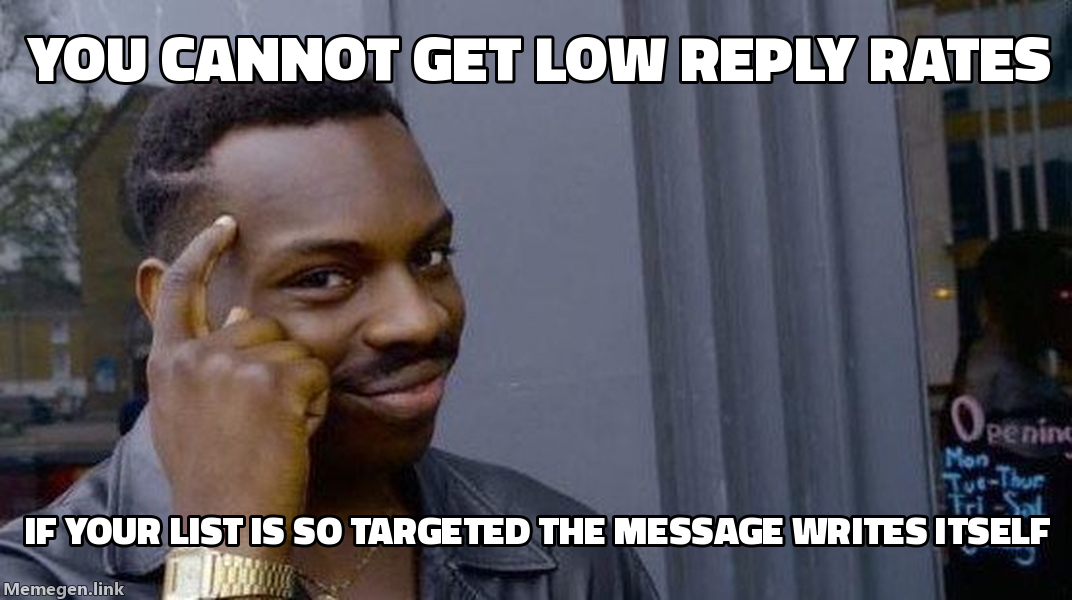 Targeting is the cheat code. Volume is the distraction.
Build a List That Actually Converts
Most outbound lists are built wrong. Companies pull 5,000 contacts from Apollo, export them, and start sending. Bounce rates climb. Domains get flagged. Reply rates stay flat.
A list that produces meetings has three properties:
Verified emails. Every email address should pass a real-time verification check before it enters your sequence. A bounce rate above 2 to 3 percent will trigger spam filters and damage your sender reputation over time. Tools like LeadMagic or ZeroBounce catch invalid addresses before they cause damage.
Signal-based selection. Pull contacts who have a reason to be receptive right now. Examples: a VP of Sales who joined a company in the last 90 days and is building their outbound motion. A Head of Engineering at a company that just raised a Series A and is hiring. A consulting firm that recently expanded to a new market. These signals are available through tools like Clay or Apollo and turn a cold email into a timely, relevant message rather than noise.
Right personas. You are not targeting “everyone at companies with 50 to 500 employees.” You are targeting the specific title that feels the pain your offer solves and has authority to act on it. One tight persona outperforms three broad ones every time.
For a deeper look at how to build enriched lead lists efficiently, see our Clay enrichment service and Apollo lead list service.
Write Copy That Earns a Reply
The goal of a cold email is not to sell. It is to earn a reply. That changes how you write.
A first line that works references something real and specific: a recent hire, a product launch, a market move. It tells the prospect you actually looked at their company, not that you ran a mail merge.
A body that works states one problem your prospect recognizes. Not a feature list. Not a capabilities overview. One problem, described in language your prospect would use.
A CTA that works asks for something small. Not a 30-minute demo. Not a commitment to buy. A yes/no question or an invitation to reply if the problem resonates.
Subject lines that perform well are short (four to six words), specific, and do not use exclamation points or trigger words like “quick question” or “just following up.”
The second email in your sequence should not be a bump. It should add something: a different angle on the problem, a relevant example, or a question that invites a real response.
If you want to explore how AI-assisted copy scales this without sacrificing quality, see our post on AI cold email that avoids spam filters.
Infrastructure: The Part Most People Skip
You can have a perfect list and great copy and still land in spam if your sending infrastructure is broken.
A few non-negotiables:
Domain setup. Send from a secondary domain, not your primary. SPF, DKIM, and DMARC must be configured correctly. Google and Microsoft both publish their sender guidelines, and failing these checks results in bulk filtering regardless of content quality.
Inbox warmup. New mailboxes need three to four weeks of warmup before you send cold outbound at volume. Skipping this is the fastest way to get your domain blacklisted.
Sending limits. Even fully warmed inboxes are commonly advised to stay under 50 to 80 cold sends per day per mailbox. To reach several hundred weekly sends, you typically need multiple warmed inboxes across your secondary domains.
Human approval. Automated sequences can draft and queue every email, but someone should review a sample of outgoing messages, especially early in a campaign, to catch personalization errors before they reach prospects.
This infrastructure layer is what separates a managed outbound service from a tool subscription. The tool does not build the system. The system takes deliberate construction.
From 10 Meetings to a Repeatable Machine
Hitting 10 meetings in one week is a milestone. Hitting it consistently requires treating outbound as a system with feedback loops, not a one-time campaign.
What to track weekly:
- Positive reply rate by persona and sequence
- Bounce rate by domain and list source
- Meeting show rate and quality
- Which signals or first-line angles generate the most replies
Adjust one variable at a time. If reply rate drops, look at copy first, then list quality. If bounce rate climbs, check your verification step. If meeting quality is low, revisit ICP definition.
Teams that reach consistent outbound output typically run this system themselves with internal tools, or work with a partner who builds and runs it in their stack. If you want to explore both paths, see our done-with-you outbound and done-for-you cold email options.
Booking 10 meetings per week is an engineering problem. The inputs are known, the levers are clear, and the output is predictable once the system is built correctly.
Get the signal tier list in your inbox.
We rank signals from S to D to decide who gets a cold email and who does not. You get the list once. No follow-up emails.
Request received. The list lands in your inbox within 24 hours.
One more step: send the prepared request to [email protected]
FAQ
How many cold emails do you need to send to book 10 meetings per week?
It depends on your reply rate and conversion from reply to booked call. At a commonly cited positive reply rate of 3 to 5 percent and a conversion to meeting that typically lands around 60 to 70 percent, you need roughly 500 to 800 targeted emails sent per week. Untargeted blasts require far more volume and damage sender reputation.
What is a realistic cold email reply rate for B2B outreach?
A well-built sequence targeting the right ICP with personalized first lines is generally considered capable of earning a 3 to 6 percent positive reply rate. Generic templates to scraped lists often sit below 1 percent. Signal-based personalization (recent funding, hiring, tech stack changes) tends to outperform generic approaches consistently.
How long does it take to start booking meetings from cold outbound?
Most campaigns start seeing replies within 5 to 10 business days of first sends. Meeting volume builds over weeks 2 to 4 as follow-ups land and warmup reputation stabilizes. Campaigns built on verified, warmed inboxes with clean lists tend to reach consistent output faster than those that skip infrastructure.
Do you need a dedicated SDR to book 10 meetings per week?
No. A well-structured outbound system with Clay-enriched data, automated sequencing, and a human approval layer can produce that volume without a full-time SDR. The bottleneck is usually list quality and personalization depth, not headcount.
What is the biggest reason cold email campaigns fail to book meetings?
Poor list quality is the most common reason. Invalid emails inflate bounce rate, which kills sender reputation. The second most common reason is generic copy that gives the prospect no reason to reply. Signal-based outreach (a hiring change, a new product, a funding round) is widely cited as converting at a multiple of generic volume-play emails.
Is cold email legal under GDPR for B2B outreach?
B2B cold email to business addresses is generally permitted under GDPR when there is a legitimate interest basis and the email is relevant to the recipient's role. Every email must include a clear opt-out, and contact data must be handled under a lawful basis. For detailed guidance, refer to gdpr.eu.

Ahmet Faruk Yilmaz
Founder of Asphia. He builds and runs signal-based B2B outbound engines for lean teams, and has booked meetings with teams at companies across five markets. Writes about cold email, Clay, deliverability, and GTM engineering.
Want this run for you?
Get a free GTM analysis. We show you the exact engine we would build.
Get your free GTM analysis →