Positive Reply Rate vs Open Rate: Which Cold Email Metric Should You Optimize?
June 11, 2026 · 5 min read · by Ahmet Faruk Yilmaz, Founder of Asphia
TL;DR
Optimize positive reply rate, not open rate. Opens measure curiosity; positive replies measure intent to buy. A high open rate with a negligible positive reply rate produces zero meetings. Target positive replies as your north-star metric and work backward to subject lines, copy, and targeting from there.
Open rate is easy to game. Positive reply rate is hard to fake.
If you are running cold email and optimizing toward opens, you are measuring the wrong thing. The only metric that predicts booked meetings is whether a real human replied with genuine interest.
Why Open Rate Became the Default (and Why That Is a Problem)
Open rate got popular because it was measurable long before reply tracking was reliable. It feels like progress. You send five hundred emails, see a healthy open rate, and feel like the campaign is working.
The problem is what open rate actually measures: inbox placement plus subject line curiosity. That is all. A prospect can open your email while deleting it. Apple Mail Privacy Protection prefetches images and fires your tracking pixel before the person ever sees the message. Many email security tools do the same.
This means your open rate is systematically inflated by non-human opens, and the opens that are human tell you only that your subject line was not immediately boring. Neither of those facts tells you whether anyone wants to buy what you sell.
What Positive Reply Rate Actually Measures
Positive reply rate counts replies that show real intent: a question about your offer, a request for a call, a “send me more information,” or a forward to the right person internally. Out of office messages, unsubscribes, and “not interested” replies are noise, not signal.
This metric is hard to inflate. A human has to read your email, feel some relevance to their situation, and take the friction-full step of composing a reply. That is intent. Every positive reply is a qualified hand-raise.
When you track positive reply rate as your north star, the entire campaign architecture changes. You stop asking “how do I get more opens?” and start asking “who actually has the problem I solve, and what would make them raise their hand right now?”
That shift forces better targeting, better personalization, and a more honest offer. See how signal-based prospecting with Clay enrichment changes this equation at scale.
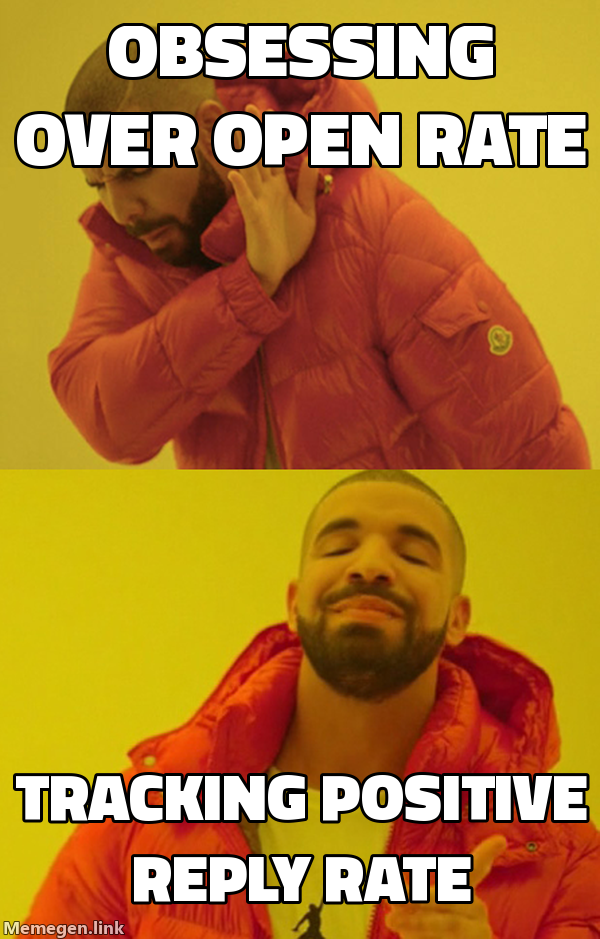 Open rate tells you if your subject line worked. Positive reply rate tells you if your campaign worked.
How to Diagnose Your Campaign Using Both Metrics Together
The two metrics are useful together as a diagnostic pair, just not as co-equal goals.
High open rate, low positive reply rate. Your subject lines are working but your copy or offer is not landing. The reader opens, scans, and moves on. Check whether your opening line is about you or about them. Check whether your call to action asks for too much commitment too early. Check whether you are emailing the right person for the offer you are making.
Low open rate, decent positive reply rate. Your deliverability may be soft, or your subject lines are filtering out the wrong people. The people who do open are genuinely interested. This is actually a recoverable situation. Fix inbox placement first, then scale what is already working.
Low open rate, low positive reply rate. This is a targeting or deliverability problem. Your emails may be landing in spam, or you may be emailing a list that has no reason to care. Start with deliverability diagnostics before touching copy.
High open rate, high positive reply rate. This is the only combination worth celebrating. Scale it carefully.
For teams running outbound without an in-house SDR function, a fractional SDR service that reports on positive reply rate rather than vanity metrics is a better accountability structure.
What to Optimize First: Targeting Over Copy
Most campaigns with low positive reply rates have a targeting problem, not a copy problem. Rewriting subject lines is faster and feels more actionable, which is why people reach for it first. But if you are emailing a list of people who have no pressing reason to care about your offer right now, the best subject line in the world will not save you.
Signal-based targeting changes the baseline. When you identify prospects who are actively hiring for roles your service eliminates, or who just raised a round and are building their go-to-market motion, or who recently switched tech stack in a way that creates the pain you solve, the relevance of your outreach goes up before you write a single word.
That is the logic behind building outbound around buying signals rather than demographic filters. The email does not have to do all the work when the timing is already right.
Once targeting is dialed in, optimize in this order: offer clarity, opening line personalization, call to action friction, and subject line last. Most improvement in positive reply rate comes from the first two.
Agencies serious about this approach, including how we structure campaigns at Asphia, instrument every sequence against positive reply rate from day one and treat open rate as a health check, not a KPI.
The Reporting Shift That Changes Accountability
When you report open rate to a client or an executive, you create an incentive to maximize opens. That means clickbait subject lines, broad lists, and shallow personalization, all of which hurt positive reply rate.
When you report positive reply rate, everything that gets rewarded is the thing that actually generates pipeline. The question in every review becomes “are the right people responding?” rather than “did enough people see it?”
For B2B cold email agencies and in-house teams alike, switching your reporting north star is often the single fastest way to improve campaign output without changing any of the underlying tools.
Positive reply rate is not easy to hit. But it is the only metric that actually means something is working.
Get the signal tier list in your inbox.
We rank signals from S to D to decide who gets a cold email and who does not. You get the list once. No follow-up emails.
Request received. The list lands in your inbox within 24 hours.
One more step: send the prepared request to [email protected]
FAQ
What is a good positive reply rate for cold email?
A strong positive reply rate looks materially higher than the average campaign. Highly targeted, signal-based campaigns with well-researched lists outperform broad spray-and-pray approaches by a wide margin. A very low positive reply rate almost always signals a targeting or messaging problem, not a deliverability problem.
What is a good open rate for cold email?
Open rates vary widely depending on inbox warmth, sending infrastructure, and how much prefetching email clients do automatically. A healthy range exists, but open rate alone tells you nothing about interest. Aggressive subject line tactics can inflate opens while hurting reply rates downstream.
Why is open rate a misleading metric in cold email?
Open rate is inflated by email clients that prefetch images or trigger tracking pixels automatically, including Apple Mail Privacy Protection. It measures inbox placement and subject line curiosity, not intent. A prospect can open your email and never read a word.
How do I increase my positive reply rate in cold email?
Sharpen your targeting first. Narrow your ICP, add a buying signal (hiring, funding, tech change), and personalize the opening line to that signal. Then tighten your offer to one specific outcome. Most campaigns fail on targeting before they fail on copy.
What counts as a positive reply in cold email?
A positive reply is any response showing genuine interest: asking for more information, requesting a call, forwarding to a colleague, or asking for pricing. Out of office, unsubscribe, and not interested replies are not positive. Tracking only positive replies filters the noise.
Should I stop tracking open rate entirely?
Track it as a diagnostic, not a goal. If open rate drops sharply, investigate deliverability or subject lines. If open rate is high but positive reply rate is low, your copy or offer is the problem. Never report open rate to a client or executive as a success metric.

Ahmet Faruk Yilmaz
Founder of Asphia. He builds and runs signal-based B2B outbound engines for lean teams, and has booked meetings with teams at companies across five markets. Writes about cold email, Clay, deliverability, and GTM engineering.
Want this run for you?
Get a free GTM analysis. We show you the exact engine we would build.
Get your free GTM analysis →