Cold Email Sequence Design for SaaS: Steps, Timing, and Messaging That Books Demos
June 17, 2026 · 5 min read · by Ahmet Faruk Yilmaz, Founder of Asphia
TL;DR
A SaaS cold email sequence that books demos runs 3 to 5 steps over 10 to 14 days. Step one opens with a signal-based hook, steps two and three add value or reframe the offer, and the final step is a clean break-up. Timing matters more than volume.
A SaaS cold email sequence that actually books demos is not about volume or persistence. It is about structure: the right number of steps, the right spacing, and messaging that earns attention at each touchpoint rather than demanding it.
Here is what works in practice.
The Sequence Structure That Books Demos
Three to five steps over 10 to 14 days is the range where most booked meetings come from. Fewer steps leave pipeline unreached because a meaningful share of positive replies arrive on follow-ups, not the opener. More than five steps without a fresh reason to reach out damages deliverability and erodes trust.
A practical SaaS sequence looks like this:
Step 1 (Day 1): Signal-based opener. One sentence on why you are writing now (a hiring post, a product update, a funding round). One sentence on what you do. One low-friction ask (“worth a 20-minute conversation this week?”).
Step 2 (Day 3): A different angle on the same offer. Social proof framing or a reframe of the problem. Not a copy-paste of step one with “just following up” appended.
Step 3 (Day 6): Add value or reduce friction. A relevant resource, a case framing without invented metrics, or a shorter ask (“would it help if I sent over how we typically set this up?”).
Step 4 (Day 10, optional): Urgency or personalization bump. Only include this step if you have a genuine reason to send it.
Step 5 (Day 14): Break-up email. Keep it honest and short (“I will stop following up after this, but if the timing changes, here is how to reach me”). Break-up emails regularly generate the highest reply rate in the sequence.
Messaging Architecture: What to Say at Each Step
The biggest mistake in SaaS sequences is treating each email as a separate pitch. Every step should serve the same thesis: you solve a specific problem for this type of company, and you have evidence it works.
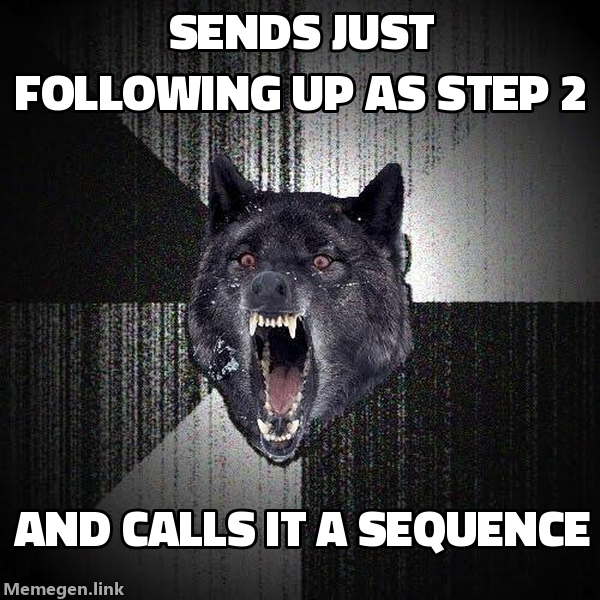 A follow-up is not a sequence. It is a confession that your first email had no reason to land.
Rotate the angle, not the argument:
Step one leads with relevance (the signal). Step two leads with credibility (how others in their position have engaged). Step three leads with simplicity (here is exactly what happens when we talk). The break-up leads with respect.
Avoid these patterns that kill reply rates: opening with your company name in the first sentence, asking for a call before establishing relevance, using “I hope this email finds you well,” and ending with open-ended questions that require work to answer (“What are your biggest challenges with outbound?”).
A strong opener for a SaaS company targeting RevOps leaders might read: “Saw you are hiring a RevOps Manager at [Company]. A lot of teams in that hiring phase are also rebuilding their outbound stack at the same time. We help SaaS teams set that up without adding headcount.”
That is a signal, a relevant observation, and a clear offer in three sentences.
Deliverability and Sending Setup
Your sequence design is only as good as your technical foundation. Google and Microsoft both publish sender guidelines (see Google’s Email Sender Guidelines) that set hard requirements: SPF, DKIM, DMARC, and low complaint rates. A well-written sequence sent from a burned domain books zero meetings.
Practical rules: warm domains before high-volume sending, keep daily sends per mailbox under reasonable limits for your provider, and monitor reply and spam rates weekly. If you are running cold email for SaaS companies at any meaningful scale, infrastructure is not optional to optimize later.
For teams building this in their own stack rather than outsourcing it, the done-with-you outbound model lets you get the sequence architecture and tooling set up properly from the start, rather than inheriting a deliverability problem six months in.
Personalization at Scale Without Fabricating Claims
Signal-based personalization means your first line references something real: a job post, a press release, a product launch, a LinkedIn post. This is not difficult to source at scale with the right data layer (Apollo for discovery, Clay for enrichment signals), and it is the single highest-leverage change you can make to sequence performance.
What you should not do is invent specificity. Made-up statistics (“companies like yours see 40% more demos”), invented mutual connections, or case-study numbers pulled from thin air all destroy trust when the prospect notices. And prospects notice.
If you do not have a strong case study yet, the credible alternative is category framing: “We work with SaaS teams at the Series A to C stage who are building outbound without a full SDR team.” That is specific enough to signal relevance and honest enough to hold up in a conversation.
The AI SDR for startups model takes this further by automating the signal lookup and first-line generation per lead, with a human approval gate before anything sends. That combination keeps quality high without slowing the motion down.
When a Sequence Is Not Performing
Before changing the messaging, check the data layer. A sequence failing to get replies is usually one of three things: the list is wrong (wrong titles, wrong company size, wrong buying stage), the deliverability is broken (check spam rates and inbox placement), or the offer is not sharp enough for this segment.
Change one variable at a time. Rewriting all five steps simultaneously makes it impossible to know what moved the needle.
The most common SaaS outbound mistake is running a technically correct sequence at the wrong segment. A lead generation for B2B SaaS motion only works when the list represents companies with the problem you solve and the budget to address it. Sequence design is the last thing to optimize. List quality and signal selection come first.
Get the signal tier list in your inbox.
We rank signals from S to D to decide who gets a cold email and who does not. You get the list once. No follow-up emails.
Request received. The list lands in your inbox within 24 hours.
One more step: send the prepared request to [email protected]
FAQ
How many emails should a SaaS cold email sequence have?
Three to five emails is the practical range. Fewer than three leaves pipeline on the table because most replies come on steps two and three. More than five without a genuine reason to follow up starts hurting deliverability and brand perception.
What is the best timing between cold email follow-ups for SaaS?
Send step one, wait two days, send step two, wait three days, send step three, then space remaining steps four to five days apart. Tighter spacing reads as spam to filters and to humans. Looser spacing loses momentum and context.
Should each email in a SaaS sequence be about a different pain point?
Not necessarily. It is more effective to hold the same core offer and rotate the angle: social proof on step two, a different framing of the problem on step three, a case for urgency or a clean break-up on the final step. Switching pain points entirely reads like you do not know why you reached out.
How long should a SaaS cold email be?
Under 100 words for the opening step, under 150 for follow-ups. Decision-makers scan, they do not read. One idea, one ask, one paragraph. If you need more words, your offer is not sharp enough yet.
What signals should trigger a SaaS cold outreach sequence?
Hiring signals (open SDR or RevOps roles), funding announcements, tool adoption signals from job descriptions, recent LinkedIn activity from a target, or technology change signals from data providers. Signal-based sequences consistently outperform list-blast approaches because relevance is baked in at the first line.
When should I stop a cold email sequence and try a different channel?
After the final email with no reply, move the prospect to a LinkedIn touchpoint or a short voicemail, not another email. Repeating the same channel with the same message is the definition of a dead sequence. Multi-channel follow-up after a sequence gives you new surface area without burning the email thread.

Ahmet Faruk Yilmaz
Founder of Asphia. He builds and runs signal-based B2B outbound engines for lean teams, and has booked meetings with teams at companies across five markets. Writes about cold email, Clay, deliverability, and GTM engineering.
Want this run for you?
Get a free GTM analysis. We show you the exact engine we would build.
Get your free GTM analysis →