What Is GTM Engineering and Why RevOps Teams Are Hiring for It in 2026
November 22, 2025 · 5 min read · by Ahmet Faruk Yilmaz, Founder of Asphia
TL;DR
GTM engineering is the practice of building and maintaining the technical systems that power go-to-market motions: data pipelines, enrichment workflows, sequencing logic, and signal routing. It sits at the intersection of RevOps, sales engineering, and growth infrastructure, and demand for the role is rising fast heading into 2026.
GTM engineering is the discipline of building the technical systems that power a go-to-market motion. If your sales team is the driver, GTM engineering is the engine: data pipelines that surface the right accounts, enrichment workflows that verify contact information, signal triggers that fire a sequence when a prospect changes jobs or raises a round, and the automation logic that connects every tool in your stack.
The role has been growing quietly for a few years, but 2025 and 2026 are when it moved from a niche title at hyper-growth startups to a recognized function across mid-market B2B companies.
What GTM Engineering Actually Covers
At its core, GTM engineering is about making outbound repeatable and measurable at the infrastructure level. That means:
Data layer. Who are we targeting, and is the data accurate? A GTM engineer builds ICP scoring models, pulls company lists from sources like Apollo, and runs waterfall enrichment (often through Clay enrichment) to find verified emails and direct phone numbers. Bad data burns deliverability and wastes rep time. The data layer is where campaigns win or lose before a single email goes out.
Signal routing. Static lists are dead. GTM engineers build workflows that detect real-time signals (a new CMO at a target account, a company posting ten sales roles, a funding announcement) and route those accounts to the right sequence automatically. Signal-based outbound converts at a meaningfully higher rate than list blasts because the timing is relevant.
Sequencing and tooling. Which message goes to which persona, in which channel, at which cadence? GTM engineers configure and often customize platforms like Smartlead, Lemlist, or HeyReach to execute the playbook reliably. They write the conditional logic: if no reply after step two, switch subject line; if reply contains “not now,” move to a nurture sequence.
CRM hygiene and reporting. Pipeline data is only useful if it is clean. GTM engineers build the sync logic between prospecting tools and CRM, define deal stages, and create the dashboards that let leadership see where pipeline is actually coming from.
Why RevOps Teams Are Hiring for It Now
RevOps as a function has matured. Most teams already have process alignment across marketing, sales, and customer success. What they have discovered is that strategy alignment is not enough. You need someone who can actually build the systems.
The tooling landscape also changed. Clay, Apollo, and modern sequencers have made it possible to build outbound infrastructure that was previously only accessible to companies with engineering teams. But those tools require someone who understands both the go-to-market motion and the technical layer. That is the GTM engineer.
Pressure from leadership is another driver. Boards and investors want predictable pipeline. Random acts of outbound do not produce predictable pipeline. An engineered system does. RevOps teams that can show “here is our ICP, here is the enrichment logic, here are the signals we track, here is the sequence architecture” are far better positioned to defend their numbers.
Build It In-House or Hire It Out
There are two practical paths. The first is hiring a full-time GTM engineer, which makes sense once you have product-market fit and a repeatable playbook to systematize. The second is working with a specialist to build the system for you, especially useful when you need speed or do not yet have the internal capacity.
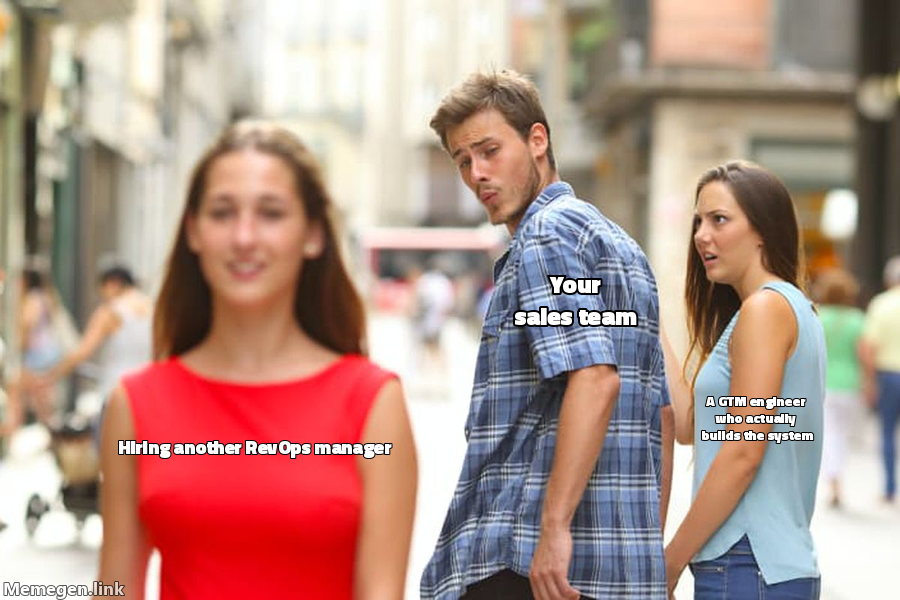 Another RevOps manager meeting. Still no pipeline system.
Asphia sits in that second category. We build and run signal-based outbound systems using Clay, Apollo, and dedicated sending infrastructure. The work is done in your stack, so you keep the asset when the engagement ends. Teams that want more control over the process can use our done-with-you outbound model, where we build alongside your team and transfer knowledge. Teams that want us to run the whole motion can opt for fully managed outbound.
Either way, the machine is yours to keep.
The Skill Set a GTM Engineer Needs
This is not a single profile. GTM engineers come from RevOps backgrounds, growth marketing, data engineering, and occasionally software engineering. What they share is:
- Comfort with data manipulation (spreadsheets at minimum, Python or SQL preferred)
- Working knowledge of the B2B tooling ecosystem
- Understanding of the full sales motion, not just the technical layer
- Ability to translate a sales strategy into a workflow with conditional logic
The best GTM engineers also think about measurement from the start. They do not just build the sequence. They define what success looks like, instrument the tracking, and use that data to iterate.
What This Means for Your Outbound Motion
If your team is still running outbound from manually built lists with no enrichment layer and no signal triggers, you are competing against teams that have already built the infrastructure. That gap compounds over time.
The good news is that the tooling to close the gap is accessible. You do not need a large engineering team. You need the right expertise and the right stack, wired together correctly. That is what GTM engineering produces, whether you build it in-house or bring in a specialist to do it for you.
For teams that want to understand how a modern outbound engine is structured before committing, our breakdown of how to book meetings without an SDR covers the practical architecture behind an automated pipeline.
Get the signal tier list in your inbox.
We rank signals from S to D to decide who gets a cold email and who does not. You get the list once. No follow-up emails.
Request received. The list lands in your inbox within 24 hours.
One more step: send the prepared request to [email protected]
FAQ
What does a GTM engineer actually do?
A GTM engineer builds the tooling and workflows that make outbound repeatable: enrichment pipelines, ICP scoring, signal-based triggers, CRM automations, and sequence logic. They translate a go-to-market strategy into running code and connected systems, often using tools like Clay, Apollo, and HubSpot.
Is GTM engineering the same as RevOps?
They overlap but are not the same. RevOps focuses on process alignment across revenue teams and reporting. GTM engineering is more hands-on with tooling and automation: building the pipelines, writing the logic, and connecting the stack. Many RevOps teams are now hiring GTM engineers as a dedicated function.
What tools does a GTM engineer use?
Common tools include Clay for data enrichment and waterfall lookups, Apollo or similar for lead discovery, HubSpot or Salesforce for CRM, Zapier or n8n for lightweight automation, and cold email platforms like Smartlead or Lemlist for sequencing. Python scripting is increasingly common for custom data work.
Do I need a GTM engineer or can an agency do this for me?
An agency can build and run the system for you, which makes sense when you need speed and do not have an internal hire yet. The trade-off is institutional knowledge. Many teams start with a done-for-you engagement to get the machine running, then transition to an internal GTM engineer who owns it long-term.
How is GTM engineering different from a sales engineer?
A sales engineer typically supports the sales cycle by doing technical demos and solution scoping for prospects. A GTM engineer operates before and behind the sales motion, building the infrastructure that generates pipeline in the first place.
What signals should a GTM engineer be routing?
High-value signals include job change alerts, hiring patterns, funding announcements, technology stack changes, and intent data. A good GTM engineer builds workflows that detect these events and route the right prospect to the right sequence at the right moment, rather than sending the same message to a static list.

Ahmet Faruk Yilmaz
Founder of Asphia. He builds and runs signal-based B2B outbound engines for lean teams, and has booked meetings with teams at companies across five markets. Writes about cold email, Clay, deliverability, and GTM engineering.
Want this run for you?
Get a free GTM analysis. We show you the exact engine we would build.
Get your free GTM analysis →