The RevOps Tech Stack for 2026: What to Keep, Cut, and Automate
November 25, 2025 · 5 min read · by Ahmet Faruk Yilmaz, Founder of Asphia
TL;DR
A modern revops tech stack for 2026 centers on a CRM, a signal-based enrichment layer (Clay or Apollo), a sequencing tool, and clear handoff rules between systems. Cut tools that duplicate enrichment or live outside your CRM. Automate lead routing, data entry, and follow-up triggers first.
The RevOps tech stack problem in 2026 is not a shortage of tools. It is too many tools doing overlapping things, with no clear owner and a CRM that everyone blames but nobody keeps clean.
A well-designed revops tech stack in 2026 looks like this: one CRM, one enrichment layer, one sequencing tool, and one reporting layer. The automation between them is what separates teams that scale from teams that add headcount to compensate for broken handoffs.
The Core Four Layers
CRM. HubSpot and Salesforce still dominate. HubSpot is faster to deploy and fits most sub-200 person GTM teams without heavy admin overhead. Salesforce wins when you need deep custom objects, complex territory rules, or a large ops team to maintain it. Pick one and enforce it as the system of record. Nothing should live only in a spreadsheet.
Enrichment. Clay has become the default enrichment orchestration layer for modern GTM teams because it runs waterfall logic across multiple providers rather than depending on a single database. Apollo remains strong for prospecting and company search, especially when you are building target account lists from scratch. The mistake most teams make is running both with no clear role separation. Use Apollo (or a similar database) for discovery and Clay for enrichment and personalization on the way into sequences. For a deeper look at how these two compare, see Clay vs Apollo.
Sequencing. Smartlead, Instantly, and Lemlist handle high-volume cold email. For LinkedIn-heavy motions, HeyReach handles scale. For teams that want a single tool that combines both channels without stitching together separate APIs, the answer usually depends on whether email volume or LinkedIn is the primary driver. What matters more than tool choice is that your sequences are genuinely personalized at the first line rather than mail-merged templates with a first name token.
Reporting. Most CRMs have enough native reporting to cover pipeline visibility, conversion rates by stage, and source attribution. Add a BI layer only if you have data from multiple sources that need joining (for example, CRM plus ad spend plus product usage). Before buying a reporting tool, exhaust what your CRM can already show you.
What to Cut in 2026
The clearest candidates for removal are tools that duplicate enrichment and tools that generate data nobody reads.
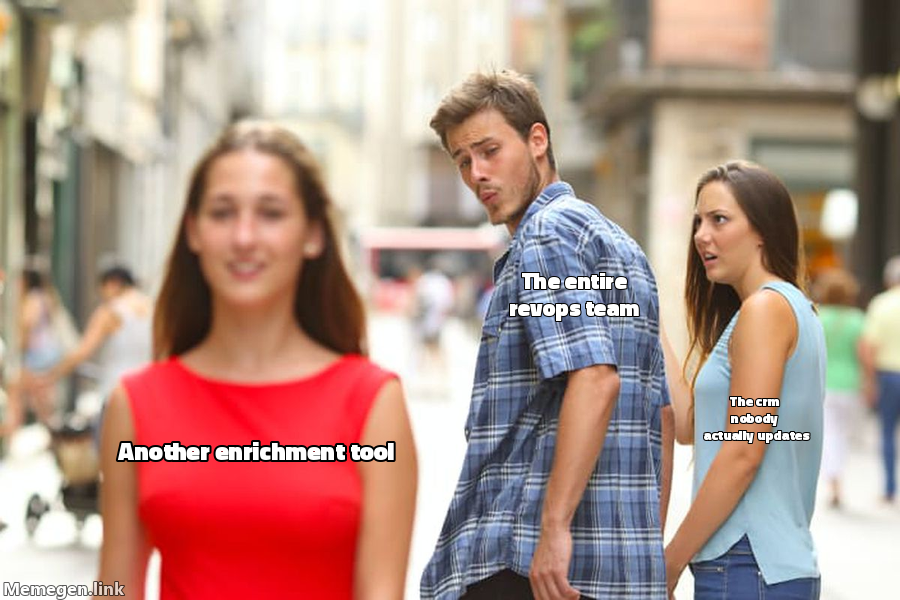 The real RevOps problem is not missing a tool. It is the CRM nobody opens.
Intent data platforms are the most frequently overpurchased category. Bombora and G2 Buyer Intent are genuinely useful when you have the operational process to act on signals within hours. Without that process, you are paying for signals that age out before anyone follows up. Cut the intent platform first, build the response process, then re-evaluate.
ZoomInfo is worth keeping only if it fills verified direct-dial phone numbers that your other enrichment sources cannot. If your motion is email-first and you already have Clay running a waterfall across multiple email providers, ZoomInfo is likely redundant for that workflow.
Conversation intelligence tools (Gong, Chorus) are worth keeping if your sales managers actively use call recordings to coach. If the tool is recording calls that nobody reviews, it is a compliance cost with no return.
What to Automate First
Automation in RevOps should target the three highest-friction handoffs: lead routing, data entry, and follow-up triggers.
Lead routing is the highest leverage starting point. When a lead comes in from your website or a cold outbound source, the routing logic (territory, account ownership, round robin, or AE assignment) should fire automatically. Manual routing in Slack threads is a sign the CRM is not doing its job.
Data entry on contact and account records is where enrichment automation pays for itself. When a new contact enters your CRM, a Clay workflow or native integration should fill company size, industry, tech stack, and relevant signals without a human touching it. This keeps your CRM clean and gives sequences better personalization data.
Follow-up triggers are the most underbuilt automation in most stacks. When a prospect opens an email three times but does not reply, that should trigger a task or a LinkedIn step automatically. When a deal goes dark for a defined number of days, the CRM should surface it. These are table-stakes automations that most teams configure manually and inconsistently.
The Outbound Layer
Cold outbound sits at the edge of your RevOps stack, but it feeds data back into the CRM and depends on clean enrichment to work. Teams that build signal-based outbound sequences (where triggers like job changes or hiring patterns fire personalization rather than static lists) consistently see higher reply rates than teams running the same template to a static CSV.
If you want to understand how this kind of outbound motion is built and run, the done-with-you outbound model lets your team own the workflow after it is built. The managed outbound service option makes sense when you want the pipeline without the setup time.
GDPR compliance is not optional if you are running outbound into the EU. Every tool in your stack that stores contact data needs to have a clear legal basis for processing. See gdpr.eu for the framework. Purpose limitation and data minimization rules apply to enrichment tools specifically, which is something most RevOps teams discover late.
How to Audit Your Current Stack
Run a simple audit before buying anything new. List every tool, its monthly cost, who owns it, and what CRM object it writes to or reads from. Any tool that does not have a clear owner and a clear CRM integration is a candidate for removal. Any tool that a single person could leave tomorrow and take their login with them is a governance gap.
The best revops tech stacks in 2026 are not the ones with the most integrations. They are the ones where every tool has a defined job, a clear owner, and clean data flowing in and out of a CRM that people actually trust.
Get the signal tier list in your inbox.
We rank signals from S to D to decide who gets a cold email and who does not. You get the list once. No follow-up emails.
Request received. The list lands in your inbox within 24 hours.
One more step: send the prepared request to [email protected]
FAQ
What tools belong in a modern revops tech stack?
The essentials are a CRM (HubSpot or Salesforce), an enrichment platform (Clay or Apollo), a sequencing tool for email and LinkedIn, and a reporting layer. Everything else should earn its place by solving a specific gap that your core tools cannot handle.
How much does a revops tech stack cost per year?
Costs vary widely by company size and vendor tier. Early-stage teams can run a capable stack for a few thousand dollars per year. Growth-stage companies with dedicated SDR motions often spend significantly more once sequencing, intent data, and enrichment credits are factored in.
What is the biggest waste in most revops tech stacks?
Duplicate enrichment tools are the most common waste. Many teams pay for Apollo, ZoomInfo, and a Clay workflow that all pull from overlapping data sources. Consolidate to one primary enrichment source and use a second only for waterfall fallback on fields the first cannot fill.
Should revops own the outbound tech stack or should sales own it?
RevOps should own configuration, data governance, and integration. Sales should own the day-to-day workflow inside those tools. A clear ownership split prevents shadow tools from appearing and keeps the CRM as the source of truth.
What does signal-based outbound mean for a revops stack?
Signal-based outbound means triggering sequences from buying signals rather than static lists. Job changes, funding announcements, new tech installs, or hiring patterns fire an enrichment and personalization step, then a sequence. Clay is the most common tool for wiring this logic.
When should a B2B team hire a revops agency versus building in-house?
Build in-house when you have at least one full-time revops resource and stable enough process to maintain tooling. Use an agency when you need the stack built fast, lack internal bandwidth, or want an already-proven workflow rather than months of experimentation.

Ahmet Faruk Yilmaz
Founder of Asphia. He builds and runs signal-based B2B outbound engines for lean teams, and has booked meetings with teams at companies across five markets. Writes about cold email, Clay, deliverability, and GTM engineering.
Want this run for you?
Get a free GTM analysis. We show you the exact engine we would build.
Get your free GTM analysis →