How to Test Email Deliverability Before You Launch a Cold Campaign
May 29, 2026 · 4 min read · by Ahmet Faruk Yilmaz, Founder of Asphia
TL;DR
Before launching, check your DNS records (SPF, DKIM, DMARC), warm your sending domain for at least two weeks, verify every address in your list, and run a seed test with a tool like Mail-Tester or GlockApps. Fixing these in order prevents the majority of inbox placement failures.
Run your email deliverability test before the first send, not after your campaign stalls. The short version: check DNS authentication, warm the domain, clean the list, then run a seed test. Doing this in that order eliminates the most common reasons cold campaigns land in spam.
Why Deliverability Breaks Before You Even Send
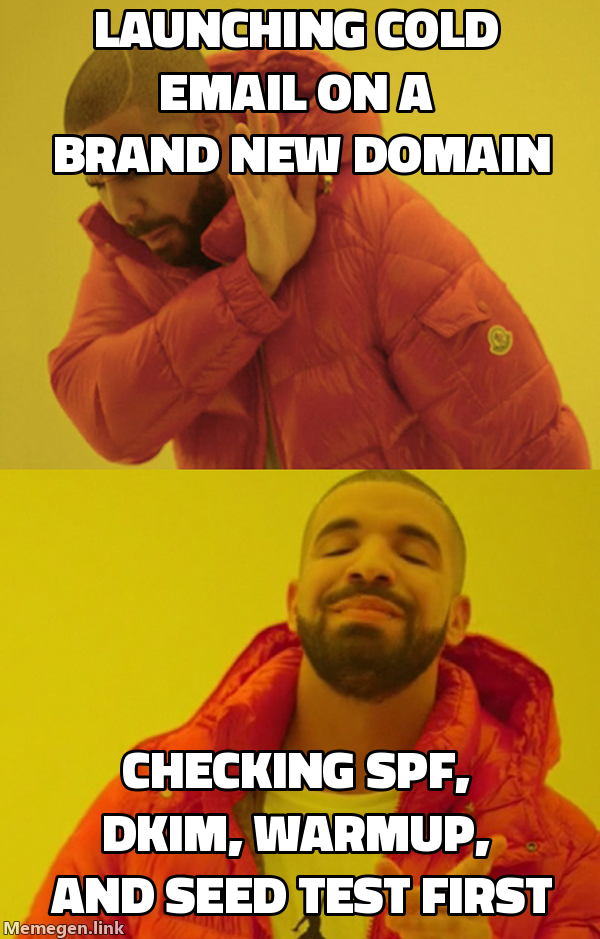 Your campaign copy is irrelevant if the domain never had a warmup.
Email providers make inbox placement decisions based on signals that exist before your message is written: your domain age, sending history, DNS configuration, and IP reputation. A campaign that launches from a two-week-old domain with no warm-up history will hit bulk folders on Gmail regardless of how good the copy is.
The technical floor is three DNS records. SPF tells receiving servers which IPs are authorized to send on behalf of your domain. DKIM adds a cryptographic signature that survives forwarding. DMARC ties them together and gives providers a policy to follow when something fails. Missing or misconfigured records cause silent failures: the email appears sent from your side but never arrives. Use MXToolbox to check all three in under a minute.
How to Warm Up a Sending Domain Correctly
Inbox providers build a reputation score for each sending domain over time. A new domain has no score, which means uncertainty, which means conservative placement (spam or bulk). Warm-up solves this by demonstrating normal human-like sending behavior before any volume hits.
Start with ten to twenty emails per day sent to real, engaged mailboxes. Increase by roughly fifty percent every three to five days. After two to four weeks of consistent sending with good open rates and no spam complaints, the domain is ready for cold outbound.
Several platforms automate this with seed-network warm-up (Instantly, Smartlead, and similar tools). If you work with a managed outbound service or an outbound engine builder, confirm that domain warm-up is included in the setup phase, because skipping it is the single most common cause of failed campaign launches.
List Verification: Remove Problems Before They Damage Your Sender Score
Every hard bounce tells inbox providers that you are not managing your list. High bounce rates compound over time and can trigger throttling or blocks that affect all mail from your domain, not just the campaign that caused the problem.
Verify every address before it enters your sequence:
- Syntax check (automated, catches typos)
- Domain MX record check (confirms the domain can receive email at all)
- Real-time mailbox check via an API (catches deactivated accounts)
- Catch-all flagging (domains that accept everything and bounce later)
Role-based addresses (info@, hello@, contact@) should be removed entirely. They route to groups, generate complaints, and rarely convert. If you are using Clay for enrichment before a campaign, the verification step fits naturally into the same workflow. See how Clay enrichment works in a campaign setup for a more detailed breakdown of where verification sits in the data pipeline.
Running an Actual Deliverability Test
After authentication and warm-up are in place, run a seed test with your real sending setup (your actual domain, your actual sending IP, a representative subject line and body).
Mail-Tester.com is the fastest free option. You send one email to their generated address and get a score with specific failure reasons. It covers authentication, blacklist status, and content issues.
GlockApps gives you inbox placement across real Gmail, Outlook, Yahoo, and other provider seed inboxes. You see exactly where your message lands, not just a score. This matters because Gmail and Outlook apply different filtering logic and a message can pass one and fail the other.
Check the results in this order: authentication failures first (fix these before anything else), blacklist hits second (require investigation and remediation), content score last (usually easy to address once the infrastructure is clean).
For teams building a done-for-you cold email program or a done-with-you outbound build, this test should run before any prospect receives a message, and again any time the sending domain, IP pool, or email copy changes significantly.
What to Fix If Your Score Is Low
Authentication failures are always fixable. Work with your domain registrar or DNS provider to add or correct SPF, DKIM, and DMARC records. Most sending platforms generate the exact records you need to publish.
Blacklist removal is slower. Most major blacklists have a self-service delisting form, but the underlying behavior (high bounces, complaints) must be corrected first or the domain will be re-listed. If the domain is newly blacklisted, it is often faster to retire it and start fresh with proper warm-up on a new domain.
Content issues (spam-trigger words, missing unsubscribe mechanisms, image-heavy HTML) are addressed in the message itself. Plain-text or minimal HTML outperforms visually complex templates in cold outbound across most B2B verticals.
Running this checklist as a pre-launch gate rather than a post-problem investigation is the practical difference between a campaign that books meetings and one that disappears into spam folders before anyone reads it. If you want to see how this fits into a complete outbound setup for your market, the b2b cold email agency process we follow for European teams walks through each layer in more detail.
Get the signal tier list in your inbox.
We rank signals from S to D to decide who gets a cold email and who does not. You get the list once. No follow-up emails.
Request received. The list lands in your inbox within 24 hours.
One more step: send the prepared request to [email protected]
FAQ
What is an email deliverability test?
An email deliverability test sends a sample message through your actual sending setup to a set of seed inboxes across major providers (Gmail, Outlook, Yahoo) and reports where it landed: inbox, spam, or missing. It reveals authentication gaps and content issues before your real prospects see anything.
How long should I warm up a new sending domain before a cold campaign?
Most practitioners recommend at least two to four weeks of gradual ramp-up, starting with ten to twenty emails per day and doubling volume every few days. Skipping warm-up on a fresh domain almost guarantees bulk or spam folder placement on providers like Gmail and Outlook.
Which DNS records do I need to check before sending cold email?
You need SPF (authorizes your sending server), DKIM (signs each message cryptographically), and DMARC (tells receivers what to do when SPF or DKIM fails). All three must be correctly published on the sending domain, not just the reply-to domain.
How do I know if my email domain is blacklisted?
Run your domain and sending IP through a multi-blacklist checker such as MXToolbox or the lookup built into GlockApps. A listing on Spamhaus or Barracuda kills inbox placement even if your DNS records are perfect. Check both IP and domain since many setups use shared IPs.
What list hygiene steps reduce bounces before a cold campaign?
Remove obvious syntax errors, strip role addresses (info@, support@), verify every address against a real-time validation API, and flag catch-all domains for separate treatment. A hard bounce rate above one to two percent signals to providers that your list is low quality and damages sender reputation quickly.
Can I test deliverability with free tools?
Yes. Mail-Tester.com gives you a score out of ten for a single test message at no cost. GlockApps has a free seed test tier. These cover authentication checks, content scoring, and basic inbox placement. Paid plans add more seed mailboxes and ongoing monitoring, which matters more at volume.

Ahmet Faruk Yilmaz
Founder of Asphia. He builds and runs signal-based B2B outbound engines for lean teams, and has booked meetings with teams at companies across five markets. Writes about cold email, Clay, deliverability, and GTM engineering.
Want this run for you?
Get a free GTM analysis. We show you the exact engine we would build.
Get your free GTM analysis →