Clay vs Apollo vs LeadIQ: Best B2B Data Enrichment Tool for Outbound
January 18, 2026 · 4 min read · by Ahmet Faruk Yilmaz, Founder of Asphia
TL;DR
Use Apollo for bulk prospecting and list-building on a budget. Use Clay for multi-source waterfall enrichment and custom signal logic. Use LeadIQ when SDRs enrich leads one by one inside the CRM. Most serious outbound teams source with Apollo and enrich with Clay.
Clay, Apollo, and LeadIQ are not direct competitors. They handle different parts of the outbound stack, which is why many teams use more than one.
Apollo is a prospecting database. Clay is an enrichment and automation layer. LeadIQ is a rep-level capture tool. Compare them by those jobs.
What Apollo Actually Does
Apollo gives you access to a large database of companies and contacts. You filter by industry, headcount, title, geography, tech stack, and dozens of other signals, then export a list. It also has built-in sequencing, so you can technically run outreach entirely inside Apollo.
Apollo’s strengths are speed and coverage. You can go from a search to a list of five hundred targeted contacts in under an hour. Email data quality is decent for US-based companies and large enterprises, though accuracy drops for smaller businesses and European contacts.
The limitation is that Apollo data is static. Every vendor pulls from the same finite set of sources. When you need a contact that Apollo does not have, or when you need to verify and enrich with fresh signals before writing a personalized email, Apollo alone is not enough. For more on building targeted lists with Apollo, see the Apollo lead list service guide.
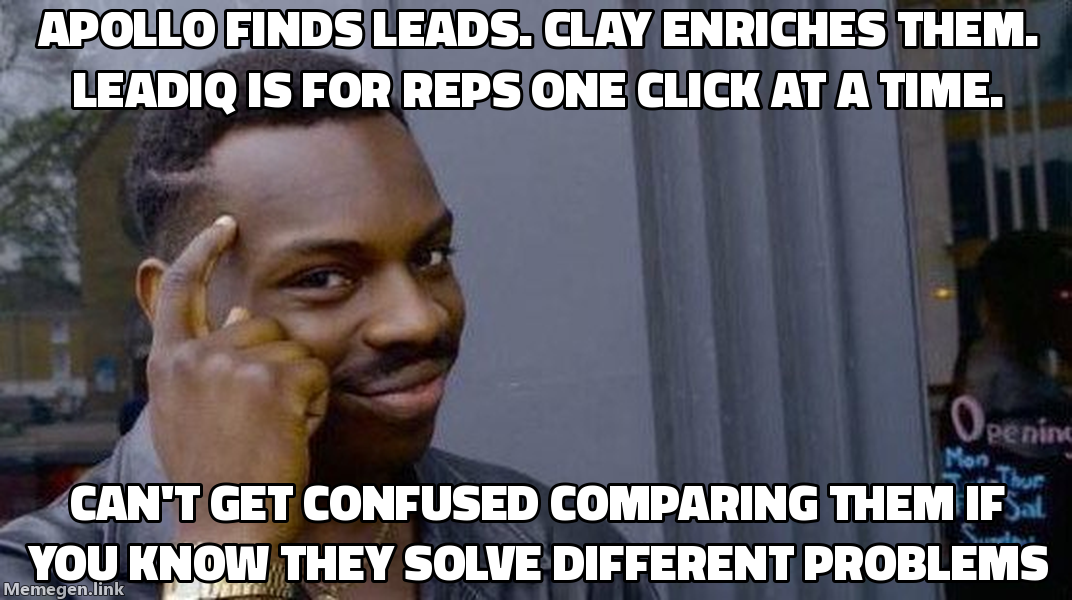 Not competitors. Adjacent tools solving different parts of the same problem.
What Clay Actually Does
Clay is not a database. It is a workflow tool that connects dozens of data providers and lets you build enrichment waterfalls. You bring leads in from anywhere (Apollo, a CSV, LinkedIn, a webhook) and then run them through a sequence of lookups: find the email via Prospeo, verify it with Millionverifier, pull company news from Perplexity, summarize it with an AI step, and drop the result into a personalization column.
The waterfall produces better output than a single data source. Instead of trusting one provider’s email record, you check two or three and take the first verified result. You can also anchor the copy to a signal from last week instead of sending generic outreach.
The cost is complexity and credit usage. Clay requires more setup than Apollo, and credits accumulate fast when each row runs many enrichment steps. You must also bring your own leads because Clay does not have a prospecting database.
If you want to see how Clay fits into a full outbound workflow, the Clay enrichment service page covers how we build and run these pipelines for clients. For a direct comparison of the two tools at the database level, see Clay vs Apollo.
What LeadIQ Actually Does
LeadIQ is designed for SDRs working in a CRM. A rep finds a relevant contact on LinkedIn and clicks the LeadIQ extension. LeadIQ enriches the contact and pushes it into Salesforce or HubSpot with the correct field mapping. The rep continues prospecting.
LeadIQ also has a team-level feature called Tracking, which monitors your saved contacts for job changes. This is useful for trigger-based outreach, for example when a champion at an old prospect moves to a new company.
LeadIQ does not scale well for bulk enrichment. If you need to enrich ten thousand contacts at once, it is the wrong tool. It is built for high-touch, rep-driven workflows where a human reviews each contact before adding it to a sequence.
When to Use Each Tool
Use Apollo to build a targeted list quickly. It also fits new campaigns that need coverage before the signal strategy is refined, or teams with a limited budget that need database and sequencing in one tool.
Use Clay when one data source is not enough. It can feed research such as recent funding rounds, hiring signals, and new website copy into personalization. It also fits high-volume campaigns that need a repeatable enrichment pipeline. Most teams running serious outbound eventually adopt it.
Use LeadIQ for a small, rep-driven team whose prospecting centers on LinkedIn browsing rather than bulk list exports. It also fits teams that value CRM hygiene and field mapping as much as raw coverage.
How the Best Outbound Teams Combine Them
The most common stack we see uses Apollo for initial list building, Clay for enrichment and signal layering, and Smartlead or Instantly for delivery. LeadIQ usually appears when an established SDR team runs account-based work alongside automated sequences.
The done-with-you outbound and done-for-you cold email pages explain how Asphia builds these systems for teams that want a handoff or full management. European teams can find our data compliance frameworks on the GDPR-compliant cold email agency page.
Most outbound does not fail at the data layer. Copy, targeting, and timing matter more. They still depend on sound data infrastructure.
Get the signal tier list in your inbox.
We rank signals from S to D to decide who gets a cold email and who does not. You get the list once. No follow-up emails.
Request received. The list lands in your inbox within 24 hours.
One more step: send the prepared request to [email protected]
FAQ
Is Clay better than Apollo for B2B outbound?
Clay and Apollo solve different problems. Apollo is a prospecting database: you search by filters and pull lists. Clay is an enrichment and workflow layer: you bring leads from any source and run them through multiple data providers. For outbound, most teams use both together.
What is LeadIQ used for?
LeadIQ is a browser extension and CRM integration built for SDR teams. It lets reps capture and enrich leads from LinkedIn or a company website and push them directly into Salesforce or HubSpot with one click. It is optimized for rep-level prospecting speed, not bulk list builds.
How accurate is Apollo data compared to LeadIQ?
Both tools pull from overlapping data sources. Apollo's email accuracy varies by industry and region. LeadIQ emphasizes real-time verification at the moment of capture. Neither is perfect, which is why waterfall enrichment through a tool like Clay (checking multiple providers) typically outperforms either alone.
Can you use Clay without Apollo?
Yes. Clay can pull leads from LinkedIn Sales Navigator, CSV imports, webhooks, or dozens of other sources. Apollo is just one of Clay's many enrichment providers. You do not need an Apollo subscription to use Clay, though many teams combine them.
Is Clay worth the price for small outbound teams?
Clay's pricing is credit-based and can add up quickly when running large enrichment waterfalls. For small teams sending under a few hundred emails a week, a single verified data source like Apollo may be sufficient. Clay becomes clearly worth it when you need multi-signal personalization at volume.
Which tool is best for GDPR-compliant outbound in Europe?
None of these tools guarantees GDPR compliance on its own: compliance depends on your legal basis, data handling, and opt-out processes. Apollo, Clay, and LeadIQ all process European personal data. Your agency or legal team needs to establish the lawful basis before using any of them for EU outreach.

Ahmet Faruk Yilmaz
Founder of Asphia. He builds and runs signal-based B2B outbound engines for lean teams, and has booked meetings with teams at companies across five markets. Writes about cold email, Clay, deliverability, and GTM engineering.
Want this run for you?
Get a free GTM analysis. We show you the exact engine we would build.
Get your free GTM analysis →