Waterfall Email Enrichment: How to Find More B2B Emails Without Paying for One Bad Provider
August 29, 2025 · 5 min read · by Ahmet Faruk Yilmaz, Founder of Asphia
TL;DR
Waterfall email enrichment runs your contact list through multiple data providers in sequence, using the next provider only when the previous one fails. This chains coverage across databases and is commonly cited as a way to reach 70 to 85 percent match rates, while paying only for what each provider actually finds.
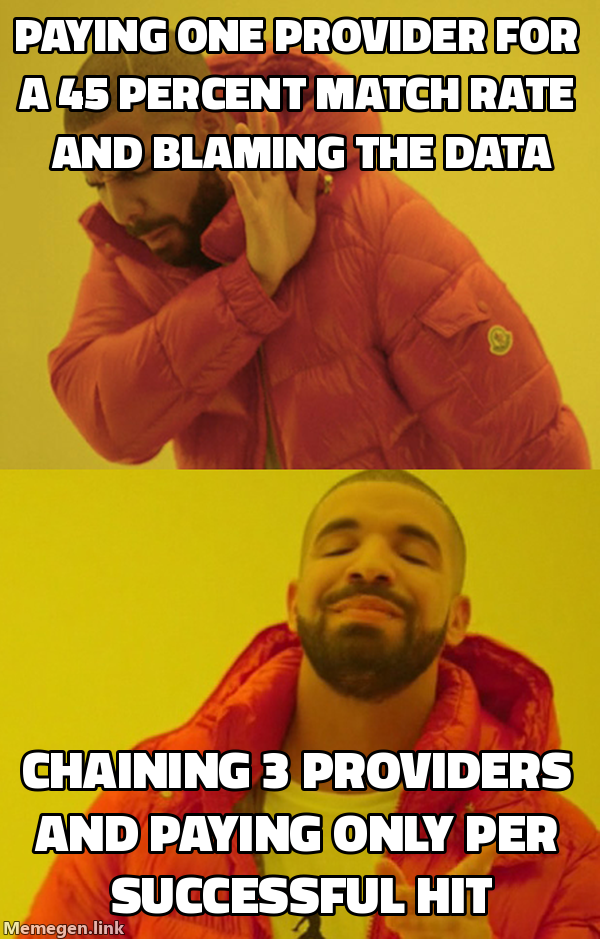
If you run outbound at any scale, you already know the problem. You pull a list of your ideal contacts from Apollo or LinkedIn, run it through one enrichment tool, and walk away with a 45 percent match rate. The rest are blanks. You either pay again for a second provider or send to an incomplete list.
Waterfall email enrichment solves this by chaining multiple providers in sequence, each one filling the gaps left by the one before it.
What a Waterfall Actually Looks Like
The concept is simple. You take a contact (name plus company domain) and pass it to Provider A. If Provider A returns a verified email, you stop and move on. If it returns nothing, you pass the same contact to Provider B. Then Provider C if needed. You stop the moment any provider succeeds.
The result is a single unified output that combines the coverage strengths of every provider in your stack, without paying each provider for the full list. You only pay per successful return.
A typical three-provider waterfall for a B2B SaaS ICP might look like this. Apollo runs first because it has broad US tech coverage. Prospeo runs second for LinkedIn-sourced contacts that Apollo misses. Hunter runs third to catch SMB European domains where the first two underperform. With this stack, match rates in the 75 to 85 percent range are realistic for many target segments.
Why Single-Provider Enrichment Underperforms
 One provider, one coverage map, one ceiling. Stack them and you stop hitting it.
Every major B2B data provider has real gaps. Their coverage concentrates around the company sizes, geographies, and industries that their early customers cared about. A provider that dominates US Series-B SaaS enrichment may be nearly useless for mid-market professional services in Germany or the Netherlands.
The problem compounds with persona targeting. If you are reaching for VP-level contacts at 50-person companies in Southern Europe, no single database has reliable density there. You are not buying imperfect data because the providers are bad at their jobs. You are buying imperfect data because the underlying contact graphs have different coverage maps.
Waterfall enrichment is the structural answer to this. It is not a workaround. It is how serious data operations handle multi-geography, multi-persona outbound.
For agencies and teams running clay enrichment service workflows, the waterfall logic is usually baked in as a native feature. For teams building their own stack, the same pattern is achievable with n8n, Make, or a short Python script that calls provider APIs in sequence.
Verification Is Not Optional
One mistake teams make after building a waterfall is treating the output as send-ready. It is not.
Waterfall enrichment maximises find rates. It does not guarantee that the found email is deliverable today. People change jobs. Domains go dormant. Catch-all servers accept anything thrown at them, which tricks enrichment providers into reporting a valid result.
Every email that comes out of your waterfall should pass through a separate verification step. Tools like LeadMagic, ZeroBounce, or NeverBounce classify emails as valid, invalid, catch-all, or unknown. Send only to the verified-valid bucket without reservation. Treat catch-all results as a separate decision: they carry bounce risk, and whether you include them depends on how much you value inbox reputation versus list coverage.
If you skip verification and push a raw waterfall output into a cold email tool, expect bounce rates that damage your sending domains. The cost of domain recovery is always higher than the cost of a verification pass.
Building the Stack Order
The order of providers in your waterfall matters because you pay only when a provider succeeds. Put your cheapest or highest-coverage provider first. Put specialist providers that cover niche segments further down the chain, so you only call them when earlier providers have already failed.
A practical approach is to test provider performance on a sample of your actual ICP before committing to a production stack order. Pull 200 contacts that represent your target persona. Run them through each provider individually and record match rates and verification pass rates side by side. The provider with the best verified match rate on your specific sample should sit first in your chain.
This also tells you whether adding a fourth or fifth provider meaningfully improves total coverage. At some point, marginal providers add cost and complexity without moving the match rate. Most teams find that three well-chosen providers cover the meaningful gap.
For teams running done-with-you outbound builds, this sample-testing step is a standard part of the data infrastructure setup before any campaign goes live.
What to Do With the Blanks That Remain
Even a strong waterfall leaves some contacts unmatched. These are typically contacts at very small companies, founders and solo operators who guard their contact details, or senior executives at large enterprises with aggressive spam filtering.
For these blanks, you have a few options. LinkedIn outreach through a tool like HeyReach bypasses the email requirement entirely for contacts where the LinkedIn profile is the primary reachable surface. Manual research using the company domain pattern (the format every other contact at that company follows) can recover a portion of the blanks at low volume. Or you accept the unmatched contacts as unworkable for this channel and focus your sending on the verified-email segment.
The goal is not a 100 percent match rate. The goal is a high-quality, verified contact list that keeps your sending infrastructure healthy and puts relevant messages in front of people who are genuinely a fit for what you offer.
A well-run waterfall gets you there faster and cheaper than any single provider will. The infrastructure to run one is not complicated. The decision to build it is often the only thing standing between a single-provider match rate in the 40 to 50 percent range and the 70 to 85 percent range that multi-provider stacks typically reach.
If you want a managed outbound service that handles enrichment waterfall, verification, and sending infrastructure as a complete system, that is what the outbound we run at Asphia is built on.
Get the signal tier list in your inbox.
We rank signals from S to D to decide who gets a cold email and who does not. You get the list once. No follow-up emails.
Request received. The list lands in your inbox within 24 hours.
One more step: send the prepared request to [email protected]
FAQ
What is waterfall email enrichment?
Waterfall email enrichment is a method where a contact list passes through multiple email data providers in sequence. Each provider attempts to find the email. If the first provider returns nothing, the next one tries. You stop the chain the moment you get a verified result, which keeps costs down while maximising match rates.
What match rate can I expect from a waterfall approach?
A well-configured waterfall with three to five providers typically reaches 70 to 85 percent match rates on targeted B2B lists. Single-provider setups rarely exceed 50 to 60 percent on niche titles or smaller-company contacts. The exact rate depends on your target persona and the geographic mix of your list.
Which providers should I include in my enrichment waterfall?
Common choices are Apollo, Prospeo, Hunter, LeadMagic, and BetterContact. No single provider dominates every segment. Apollo covers high-volume US tech roles well. Prospeo excels at LinkedIn-sourced enrichment. Hunter is strong on SMB European domains. Run a sample test on your specific ICP before committing to a stack order.
How does waterfall enrichment differ from using Clay?
Clay is a no-code platform that has a built-in waterfall enrichment engine. It routes each contact through your chosen providers automatically and stops on the first verified hit. You can replicate the same logic with custom code or tools like n8n, but Clay removes the engineering overhead. Either route can produce the same match rates if the provider stack is identical.
Do I need to verify emails after waterfall enrichment?
Yes, always. Waterfall enrichment finds emails but does not guarantee deliverability. Run every output through a verification tool (such as LeadMagic, ZeroBounce, or NeverBounce) before sending. Pay particular attention to catch-all domains, which waterfall providers often return as valid but which carry real bounce risk.
Is waterfall email enrichment GDPR compliant?
Enrichment itself sits in a legal grey area under GDPR. Legitimate interest is the most commonly used basis for B2B outreach, but it requires a documented balancing test and an easy opt-out in every message. The enrichment data providers you use must also be GDPR-compliant data processors with valid data sourcing. Always confirm the legal basis before sending to EEA contacts.

Ahmet Faruk Yilmaz
Founder of Asphia. He builds and runs signal-based B2B outbound engines for lean teams, and has booked meetings with teams at companies across five markets. Writes about cold email, Clay, deliverability, and GTM engineering.
Want this run for you?
Get a free GTM analysis. We show you the exact engine we would build.
Get your free GTM analysis →