LinkedIn Outreach for Recruiting Agencies: How to Source Clients, Not Just Candidates
February 22, 2026 · 5 min read · by Ahmet Faruk Yilmaz, Founder of Asphia
TL;DR
Recruiting agencies that win clients on LinkedIn target hiring managers and VPs of Talent with signal-based outreach (open roles, funding rounds, headcount growth) rather than generic pitches. A short, direct message tied to a specific trigger converts far better than a capability overview. The whole sequence can be automated with a human approval step.
Most recruiting agencies run LinkedIn outreach backwards: they describe what they do and hope someone needs it right now. The agencies that consistently book client meetings do the opposite. They find companies with an active, visible hiring problem and show up with a specific point of view on it.
That is the whole playbook. Everything below is how to execute it.
Why Generic Agency Pitches Die on LinkedIn
LinkedIn inboxes are full of messages that open with “We’re a specialized recruiting firm with deep expertise in…” and then list a stack of verticals and industries. Recipients ignore these because the message could have been sent to anyone. There is no evidence the sender looked at their company, their roles, or their situation.
Signal-based outreach works differently. You identify companies that are actively hiring, growing headcount, recently funded, or struggling to fill a specific role category. Then you write one message that references that exact situation. The prospect reads it and thinks: this person actually looked at us. That attention alone sets you apart from most of the cold outreach they receive.
The signals that convert best for recruiting agencies are open roles on LinkedIn Jobs or a career page, recent Series A or B funding (which almost always triggers a hiring push), job title changes at the CHRO or VP People level (new leader, new agency relationships), and headcount growth visible on LinkedIn company data over the past six months.
The Right Persona Targeting
Not every LinkedIn profile at a target company is worth messaging. For recruiting BD, you have two primary personas and one secondary.
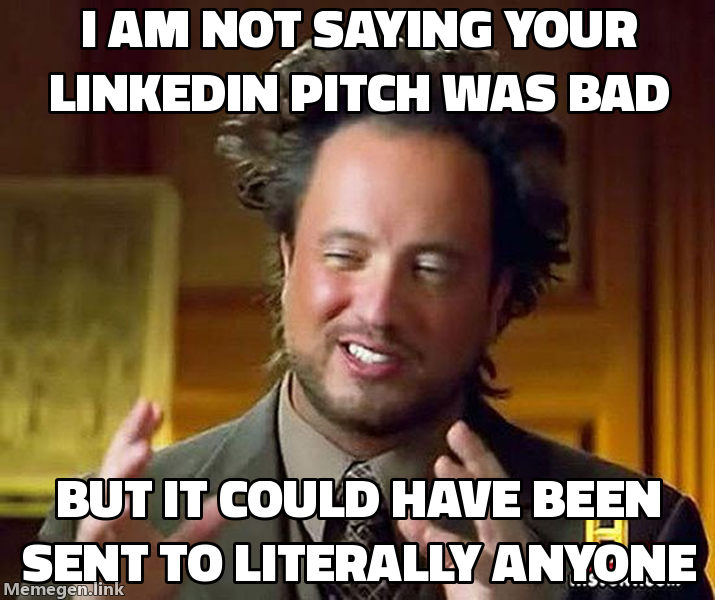 A pitch that fits every company converts at the rate of none of them.
Primary persona one is the talent leader: VP of Talent Acquisition, Head of Recruiting, Director of People. This person owns agency relationships and feels the pain of open reqs most directly. They respond well to messages that reference specific roles and time-to-fill problems.
Primary persona two is the executive at smaller companies: COO, CFO, or CEO at firms under 75 employees that have not yet hired a dedicated recruiter. These contacts often handle hiring personally and are highly motivated when a problem is visible (three roles open, no placements after 60 days).
Secondary is the hiring manager for the specific role type you fill. A VP of Sales who has had an AE role open for four months is sometimes easier to reach than the talent team and can push for an agency introduction from inside.
Avoid messaging HR generalists or entry-level recruiters. They rarely have budget authority or agency selection power.
Writing the Connection Request and Follow-Up
The connection request note (limited to 300 characters on LinkedIn) should do one thing: establish why you are reaching out today, not in general. A structure that works:
“Noticed [Company] has [X open roles / just raised / expanded to Y]. We place [specific role type] for [type of company]. Worth connecting?”
Keep it factual, specific, and short. Do not pitch. You are asking to connect, not asking for a meeting.
Once connected, send a short follow-up within 24 to 48 hours. This message can be slightly longer (three to five sentences). Reference the same signal again, offer one concrete outcome (a shortlist in two weeks, a retained search model with a guarantee), and close with a low-friction ask: a 20-minute call, a quick question, or a response with their current situation.
If you get no reply after two follow-up messages, a third touch after two weeks referencing a new signal (they posted another role, they announced an office opening) is appropriate. Beyond three touches on LinkedIn, move to email or drop the lead.
For email outreach built around the same signal layer, the cold email for recruiting agencies approach follows a nearly identical logic but with more flexibility on length and formatting.
Building a Repeatable System
One-off LinkedIn outreach is a time sink. A repeatable system looks like this: a filtered list of target companies refreshed weekly, a lead enrichment layer that pulls current open roles and headcount data, connection requests sent daily from one or two warmed profiles, and a short review step where a human checks each message before it goes out.
Tools like Clay handle the enrichment side, pulling open roles and funding signals into a spreadsheet you can act on. LinkedIn automation tools handle the sending layer, staying within platform rate limits while your team focuses on replies and conversations. This is the same infrastructure described in more detail in the Clay enrichment service and done-with-you outbound contexts, applied specifically to recruiting BD.
The human review step matters here. Automated LinkedIn messages that skip approval tend to send generic copy when the enrichment data is incomplete or stale. A 30-second review per message catches the cases where a company just paused hiring or a contact changed roles, and it keeps every send defensible.
What to Do With Replies
A LinkedIn reply from a prospect is not a closed deal. It is the start of a qualification conversation. The goal of your first reply is to understand the current state: how many roles are open, what have they tried so far, what is the timeline, and who makes the agency selection decision.
Keep your reply short and ask one clear question. Avoid sending a capability deck or a long overview. That material belongs after the first call, not before.
If the prospect asks about fees or process before agreeing to a call, give a one-sentence answer and redirect to the call. “We work on contingency for most searches, typically in the 18 to 22 percent range. Happy to walk through the details on a 20-minute call if that makes sense for you.”
The conversion from LinkedIn reply to booked call depends heavily on response speed. Reply within an hour if possible. Prospects who reach out to three agencies simultaneously will book the first one that replies with a clear, confident next step.
For agencies looking to run this kind of system without building it internally, the done-for-you cold email and b2b appointment setting service models cover the full build-and-run option across both LinkedIn and email channels.
Get the signal tier list in your inbox.
We rank signals from S to D to decide who gets a cold email and who does not. You get the list once. No follow-up emails.
Request received. The list lands in your inbox within 24 hours.
One more step: send the prepared request to [email protected]
FAQ
What is the best LinkedIn outreach strategy for a recruiting agency?
Target companies actively hiring in your niche, send connection requests with a short note referencing a specific open role or growth signal, and follow up with a message that positions your agency as a faster path to hire. Keep it under three touches. Relevance and timing beat volume.
Who should a recruiting agency message on LinkedIn?
Primary targets are VP of Talent, Head of Recruiting, and Chief People Officer at companies in your vertical. For smaller firms (under 100 employees), the COO or CEO owns hiring decisions and is often more reachable than a dedicated talent lead.
How do I write a LinkedIn connection message as a recruiting agency?
Reference a specific signal: a job posting, a funding announcement, or a recent expansion. One sentence on the signal, one sentence on what you do, and one question or CTA. Avoid listing your services. A message like 'I noticed you have three open SDR roles and no agency partner listed. We place mid-market sales reps in SaaS. Worth a quick call?' works better than a capability deck.
How many LinkedIn messages should a recruiting agency send per week?
LinkedIn restricts connection requests. A safe ceiling without automation tools is around 100 requests per week per account. With a tool like GetSales or HeyReach running on a warmed profile, you can scale to 200 or more while staying within LinkedIn's limits. Quality targeting matters more than raw volume.
Should recruiting agencies use InMail or connection requests on LinkedIn?
Connection requests with a short note outperform InMail for cold outreach in most tests. InMail works better for senior targets where a connection request may feel too casual. For most recruiting BD campaigns, lead with a connection request tied to a relevant signal, then move to message once connected.
How do I avoid LinkedIn bans when doing outreach at scale?
Use a dedicated LinkedIn account or a team seat, warm the profile over two to four weeks before scaling sends, and stay within daily limits. Avoid copy-pasting the same message to every contact. Tools like HeyReach and GetSales handle rate limiting and rotation automatically.

Ahmet Faruk Yilmaz
Founder of Asphia. He builds and runs signal-based B2B outbound engines for lean teams, and has booked meetings with teams at companies across five markets. Writes about cold email, Clay, deliverability, and GTM engineering.
Want this run for you?
Get a free GTM analysis. We show you the exact engine we would build.
Get your free GTM analysis →