New VP or C-Suite Hire? Here Is the Cold Outreach Playbook That Books the Meeting
April 13, 2026 · 5 min read · by Ahmet Faruk Yilmaz, Founder of Asphia
TL;DR
A new executive hire is your best cold outreach window. Reach out within two weeks of the announcement, lead with the problem they were hired to solve, and offer one concrete output. That combination books meetings because it arrives when they are actively building their vendor shortlist.
A new VP or C-suite hire is one of the clearest buying signals in B2B outbound. The person just walked into a role with a mandate to fix something, a fresh budget cycle, and zero loyalty to the incumbent vendors. Reach them in the first two weeks and you are talking to someone who is actively building a shortlist. Wait ninety days and you are pitching against relationships they have already formed.
Why the Hire Signal Works
Every executive hire is a public announcement of a problem. A new VP of Sales means the previous pipeline was not generating enough revenue. A new Head of Marketing means the demand engine needed rebuilding. A new CTO means the product org or infrastructure needed a reset.
That context is your brief. You do not need to guess what they care about. The job posting, the LinkedIn announcement, and sometimes the press release tell you exactly what the company expects them to solve. That is rare intelligence in cold outreach, where you usually have to infer pain from industry or company size alone.
This is why signal-based outbound consistently outperforms list-based spray. You are not interrupting someone. You are arriving at the exact moment they are looking for what you offer.
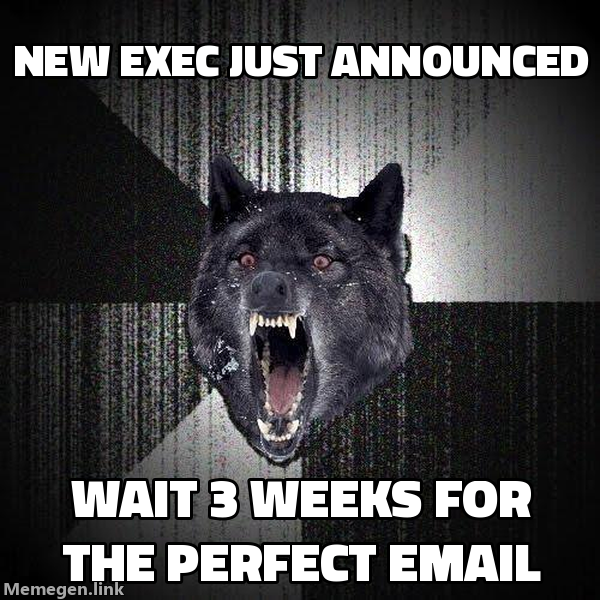 A good message sent fast beats a great message sent late.
The Timing Window
Move within ten to fourteen days of the hire becoming public. Before that, the exec may not have started yet. After thirty days, they are heads-down in internal meetings, the calendar is locked up, and they have already heard from your competitors who also run signal-based sequences.
Set up a LinkedIn job change alert for your target titles and company segments. Pair it with a data layer like Clay enrichment or Apollo to catch hires that are not publicly announced. Many VP-level moves happen quietly and only appear in a LinkedIn profile update weeks later.
When you spot a new hire, do not wait for a perfect message. A good message sent fast beats a great message sent late.
What to Say in the First Email
Structure the email around their mandate, not your product. This is where most cold outreach to new executives fails. Sellers lead with what they sell rather than what the exec was hired to fix.
A better structure:
Subject: one to five words naming the problem (not your solution)
Opening line: one sentence that names the specific challenge the role is known to own. Do not flatter. Do not congratulate. Get to the point.
Middle: one to two sentences on what you do, framed as a direct solution to that challenge. Concrete is better than comprehensive. Drop one specific output or outcome, not a feature list.
Close: one low-friction ask. A fifteen-minute call, a relevant case overview, or even a question that invites a reply without requiring a commitment.
Keep the whole email under ninety words. New execs are reading on mobile between back-to-back internal calls. Every extra sentence reduces reply rate.
If you are running this through a done-for-you cold email setup, this is also where you configure per-lead personalisation at the signal level, so every message reflects the specific hire, company context, and mandate rather than a generic template swapped with a first name.
The Sequence After the First Touch
Do not send one email and wait. Three to four touches over two to three weeks is the right cadence for this signal.
Email two (day five to seven): follow up with a different angle. If email one led with pipeline revenue, email two might lead with team ramp time or tech stack consolidation. Alternatively, share a genuinely useful resource, a framework, a relevant benchmark, something that gives them value whether or not they reply.
Email three (day twelve to fifteen): the short close. Acknowledge you have reached out a couple of times, make it easy to say no, and offer one final clear ask. This email often gets replies because it removes pressure. Executives respond when they feel in control of the next step.
LinkedIn runs in parallel. A connection request with a brief personal note, sent around the same time as email two, reinforces your name without adding noise. Keep the note under thirty words and do not pitch in the request.
Personalisation at Scale
The hire signal gives you the context. The challenge is running this motion across dozens of new hires per week without losing quality. That is where Clay-based enrichment and AI-assisted copy generation close the gap, pulling the hire announcement, the company’s recent news, and the exec’s previous role into a structured brief that feeds your email sequence.
Every send should still go through a human review gate. New execs are high-value contacts. A generic or poorly researched message to a new CMO does more damage than no message at all, because they remember who wasted their time in week one.
If you want to build this motion in your own stack, a done-with-you outbound build puts the signal detection, enrichment, and sequence logic inside your CRM rather than a black-box agency workflow. You own the system after the engagement ends.
What to Avoid
Do not congratulate them on the new role in the opening line. Every other seller does this. It signals template, not research.
Do not pitch the full product in email one. You are booking a conversation, not closing a deal.
Do not use the same sequence for a new CEO as for a new VP of Operations. The mandate differs completely. Segment by function, not just seniority.
For teams that want this motion running consistently across a defined ICP, the managed outbound service approach handles signal monitoring, enrichment, copy, and sequence management so your team only touches approved replies.
The new executive hire window is short. The playbook is straightforward. The teams that move fast and personalise to the mandate are the ones that book the meeting.
Get the signal tier list in your inbox.
We rank signals from S to D to decide who gets a cold email and who does not. You get the list once. No follow-up emails.
Request received. The list lands in your inbox within 24 hours.
One more step: send the prepared request to [email protected]
FAQ
How soon after a new executive hire should I send cold outreach?
Within ten to fourteen days of the public announcement is the sweet spot. The exec is still in listening mode, forming vendor opinions, and has not yet committed to existing contracts. Waiting longer means you are competing with relationships already built by faster-moving sellers.
What should a cold email to a new VP or C-suite hire say?
Lead with the specific problem the role is known to own, not a generic value pitch. One sentence naming their likely top priority, one sentence on how you have helped with that problem, and a low-friction ask like a short call or a relevant resource. Keep it under ninety words.
Does a new executive hire actually read cold email?
New execs read more cold outreach than tenured ones because they are actively evaluating tools and partners to build their function. The caveat is relevance: they delete generic pitches instantly but respond to messages that show you understand the mandate they were hired to execute.
How do I find out about new executive hires for outreach?
LinkedIn job change alerts, company newsroom press releases, and data providers like Apollo or Clay that surface recent role changes are the three main sources. Combining two sources reduces false positives and catches hires that are not announced publicly.
What is the ideal sequence length for new executive hire cold outreach?
Three to four touchpoints over two to three weeks works well for this signal. Email one arrives fast, email two follows up with a different angle or resource, and email three offers a clear no-pressure exit. Longer sequences lose relevance as the exec settles into existing vendor relationships.
Should I also send a LinkedIn message when targeting a new hire?
Yes. A LinkedIn connection request with a brief note, sent within the same window as your cold email, reinforces your name without being aggressive. Keep the LinkedIn note conversational, not pitch-heavy, since the platform is more personal and executives notice tone mismatches quickly.

Ahmet Faruk Yilmaz
Founder of Asphia. He builds and runs signal-based B2B outbound engines for lean teams, and has booked meetings with teams at companies across five markets. Writes about cold email, Clay, deliverability, and GTM engineering.
Want this run for you?
Get a free GTM analysis. We show you the exact engine we would build.
Get your free GTM analysis →