How to Write a LinkedIn Cold Message That Gets a Reply (B2B Formula)
November 9, 2025 · 5 min read · by Ahmet Faruk Yilmaz, Founder of Asphia
TL;DR
The formula: one specific, verifiable signal about the prospect, one sentence on what you do and for whom, one frictionless question. Keep it under 300 characters for connection requests and under 150 words for DMs. Personalization beats volume every time in B2B LinkedIn outreach.
The fastest way to kill a LinkedIn conversation before it starts is to open with who you are. Most B2B cold messages fail for one reason: they lead with the sender, not the recipient.
Here is the working formula: one signal, one sentence about what you do for whom, one frictionless question. That is the entire structure.
Why Most LinkedIn Cold Messages Get Ignored
Buyers on LinkedIn receive dozens of cold messages weekly. The ones that get deleted share a pattern: they are long, they open with a company description, and they ask for a call in the first message.
The cognitive cost of reading a wall of text from a stranger is high. The mental cost of agreeing to a 30-minute call with someone you have never spoken to is even higher. Both of these friction points kill replies before they happen.
The messages that do get replies are short, specific, and ask for almost nothing. They feel like a conversation starter, not a sales presentation.
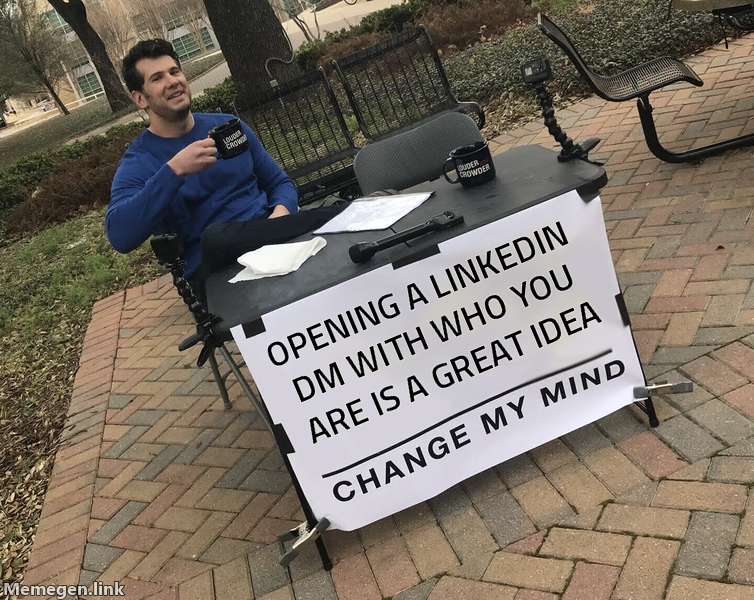 Lead with what you know about them. Not with what you want from them.
The Three-Part Formula for B2B LinkedIn Messages
Part 1: The signal. Open with one specific, verifiable observation about the prospect. Not a compliment (“Love what you’re building”) but a fact (“Saw you recently expanded into the German market”). Good signal sources include job postings, recent promotions, funding announcements, conference appearances, posts they published, or technology stack signals from tools like Apollo or Clay.
This single line does more work than any other sentence in your message. It tells the recipient you are not using a spray-and-pray template. It also gives you permission to continue.
Part 2: The relevance sentence. One sentence explaining what you do and, critically, for whom. Not a feature list, a customer description. “I help Series A SaaS companies book qualified demos without building a full SDR team” tells the reader immediately whether this is relevant to their world.
If they are not in that situation, they will self-select out quickly. That is fine. You want relevance, not volume.
Part 3: The frictionless question. The closing question must have a low cost to answer. “Worth a quick chat?” is too much commitment for a stranger. “Is that a priority for you right now?” is easy to answer in five seconds. “Would it be useful to share what we found for companies at your stage?” gives them something before asking for anything.
Connection Request vs. DM: Which Format to Use
LinkedIn connection notes have a 300-character limit. That constraint is useful. It forces discipline. A connection note should contain only the signal and one sentence of relevance. Save the question for the first DM after they accept.
First DMs after connecting have more room but should still stay under 150 words. The structure mirrors the formula above, with slightly more room to breathe. If you are using a managed outbound service that handles LinkedIn alongside cold email, the first DM is typically the channel test, with email as a fallback if there is no reply within five days.
For senior enterprise buyers, where connection acceptance rates are lower, HeyReach and similar LinkedIn automation tools can send connection requests at scale while keeping the personalization layer from data enrichment. The signal still needs to be real, even at volume.
Personalization at Scale Without Lying
The tension in B2B LinkedIn outreach is real: you need personalization to get replies, but you cannot manually research 500 prospects. The answer is structured data enrichment.
Tools like Clay pull signals from dozens of sources: job posts, LinkedIn activity, funding databases, news mentions, web scraping. When those signals are mapped to message templates with specific variable slots, each message looks researched even when it was generated programmatically. The key constraint is that every variable must be factually accurate. A wrong company name or a stale job title breaks trust immediately.
At Asphia, every send goes through a human approval step before it reaches a prospect. The machine generates, a person verifies, and nothing ships with a broken variable or an invented claim. If you are building this done with you, that approval gate is the part of the process worth protecting.
Follow-Up Sequence Structure
Most replies come after the second or third touch, not the first. A workable LinkedIn follow-up sequence looks like this:
Day 1: Connection request with a signal note. Day 3 (after accept): First DM with full formula. Day 7: Follow-up adding a new angle, a relevant resource, or a one-line case description. Day 12: Short close. “Happy to leave you alone if this is not the right moment. Worth a quick reply either way?”
After that, move the conversation to email or set a reminder to re-engage in 90 days when the situation may have changed. Persistent follow-up past three touches without a response reads as pressure, not persistence.
What Good LinkedIn Outreach Looks Like in Practice
The outbound we run for clients spans five markets and multiple languages. The pattern that consistently produces replies is the same across all of them: specific trigger, clear relevance, easy question. The language changes, the signal sources change, but the logic stays identical.
If you want to go further into the channel pairing strategy that combines LinkedIn with cold email, the framework for booking meetings without a full SDR covers how the two channels reinforce each other in a single sequence.
LinkedIn cold messaging in B2B is not complicated. It is just specific. Lead with what you know about them, not with what you want from them.
Get the signal tier list in your inbox.
We rank signals from S to D to decide who gets a cold email and who does not. You get the list once. No follow-up emails.
Request received. The list lands in your inbox within 24 hours.
One more step: send the prepared request to [email protected]
FAQ
How long should a LinkedIn cold message be for B2B?
Connection request notes must be under 300 characters. First DMs should stay under 150 words, ideally under 100. Shorter messages get read to the end. If you cannot say it in three sentences, you have not thought it through clearly enough yet.
What is the best opening line for a LinkedIn cold message?
Lead with something specific to them: a recent post they published, a role change, a funding round, or a technology they use. Generic openers like 'I came across your profile' are ignored instantly. One concrete observation signals you did actual research and separates you from every other message in their inbox.
Should I use connection requests or InMail for B2B outreach?
Connection requests with a short personalized note are the highest-leverage starting point. InMail costs credits and carries a promotional connotation. Once connected, a follow-up DM in the thread is the preferred channel. Reserve InMail for senior decision-makers you cannot reach any other way.
How many follow-ups should I send on LinkedIn?
Two follow-ups after the initial message is the practical ceiling. The first follow-up adds new context or a different angle rather than just asking if they saw the last message. The second is a short close. After that, move the prospect to email or mark them for a future touch.
What should I never do in a LinkedIn cold message?
Never pitch your product in the connection request. Never use templates that have visible merge fields from a broken variable. Never ask for a call in the opening message. Never paste a long paragraph about your company history. And never send the same note to 500 people and call it personalized.
Does signal-based LinkedIn outreach actually work better than volume outreach?
Yes, and by a significant margin in B2B. When a message references a real, verifiable trigger (a funding event, a new hire, a job post, a public statement), the prospect can see you paid attention. That credibility gap is what separates a reply from an archive. Volume without signal is noise.

Ahmet Faruk Yilmaz
Founder of Asphia. He builds and runs signal-based B2B outbound engines for lean teams, and has booked meetings with teams at companies across five markets. Writes about cold email, Clay, deliverability, and GTM engineering.
Want this run for you?
Get a free GTM analysis. We show you the exact engine we would build.
Get your free GTM analysis →