LinkedIn Outreach for Consulting Firms: How to Fill Your Pipeline Without Referrals
November 4, 2025 · 5 min read · by Ahmet Faruk Yilmaz, Founder of Asphia
TL;DR
Consulting firms can fill their pipeline via LinkedIn by targeting decision-makers with signal-based messaging (hiring moves, funding rounds, leadership changes), personalising at the sequence level rather than the template level, and running a consistent volume of well-timed touches. Referrals scale poorly; a structured LinkedIn outreach system does not.
Most consulting firms grow on referrals until they hit a ceiling. The ceiling arrives when the partner network is tapped, the warm intros slow down, and the next engagement is not in the pipeline yet. LinkedIn outreach is the most direct answer: it puts you in front of qualified decision-makers at the exact moment a signal suggests they have a problem you solve.
The key distinction is this: LinkedIn outreach for consulting firms is not volume spam. It is a structured, signal-triggered conversation that earns attention before making an ask.
Why Referrals Do Not Scale and LinkedIn Does
Referrals are high-converting but low-volume by nature. They depend on a finite set of relationships and on your clients having the right conversations at the right moments. You cannot control that timing.
LinkedIn gives you control. With Sales Navigator, you can identify CFOs, COOs, or Heads of Operations at companies that match your ideal client profile, filter by headcount, industry, and geography, and reach out the week a visible trigger occurs. That trigger might be a new executive hire, a job post signalling an operational gap, or a funding announcement. A message tied to that signal lands differently than a cold pitch with no context.
For professional services firms, this positions you as an observer of their business rather than a vendor looking for a logo.
The Anatomy of a High-Converting Sequence
A four-touch LinkedIn sequence for a consulting firm looks like this:
Touch 1: Connection request with a short personalised note. Reference the signal. “Noticed you recently brought on a VP of Operations at [Company]. We work with ops-heavy businesses navigating that scaling phase. Would love to connect.” Under 300 characters, no pitch, no CTA beyond the implied connection.
Touch 2: Value-add message on acceptance. Wait two to three days after they accept. Share a short, relevant insight or resource without asking for anything. This builds credibility before the ask arrives.
Touch 3: Direct, low-friction ask. A short message naming the problem you solve for businesses in their situation and asking for a 20-minute conversation. Specificity is everything here. “We help mid-market logistics companies reduce cost-per-order during headcount growth” converts better than “we do supply chain consulting.”
Touch 4 (optional): A different angle. Share a relevant article, reference a recent development at their company, or simply follow up with a single-sentence check-in. This fourth touch often catches people who were interested but distracted.
The entire sequence runs over two to three weeks. Spacing matters because consulting buyers make deliberate decisions and rarely respond to the first message.
Signal Sources Worth Using
The signals that consistently generate replies for consulting firms include:
Executive moves. A new C-level hire almost always means a review of existing vendors, processes, or strategies. This is an ideal opening for strategy, operations, or change management firms.
Job postings. A company hiring five project managers and a PMO director is advertising a scaling problem. A consulting firm that builds PMO infrastructure has a real and timely offer.
Funding or acquisition news. Growth events create complexity. Financial advisory, M&A integration, and HR consulting firms should monitor deal announcements and reach out within days, not weeks.
Leadership changes on LinkedIn itself. “Started new position” updates are public signals you can act on immediately with a tailored note.
Tools like Clay and Apollo make it possible to pull these signals at scale and route the right contacts into a LinkedIn sequence without manual research on every lead. If you want to see how enrichment feeds into outreach, the Clay enrichment service page covers how that data layer works.
What Consulting Firms Get Wrong
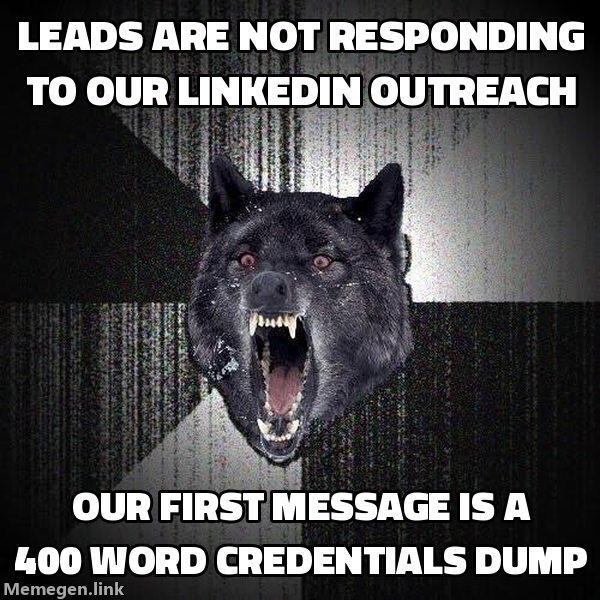 Your credentials belong on your website. Your LinkedIn message has one job: earn the next response.
The most common mistake is treating LinkedIn like a billboard rather than a conversation channel. Long first messages with credentials, logos, and case study summaries belong on a website, not in a connection request.
The second mistake is inconsistency. A firm sends 50 connection requests in January, gets two replies, and concludes the channel does not work. LinkedIn outreach compounds over time. Consistent weekly volume, a refined message based on what gets replies, and patience over 60 to 90 days produce a reliable pipeline.
The third mistake is messaging that is about the firm rather than about the prospect. Your credentials matter, but only after you have earned a few seconds of attention by demonstrating you understand their specific situation.
Running This at Scale Without Burning Out a Partner
A senior partner spending hours on LinkedIn every week is an expensive operation. The practical answer is to separate the research, personalisation, and sequencing from the partner’s calendar. Platforms designed for LinkedIn outreach for consulting and professional services can automate the sequence logistics while a human reviews and approves every message before it sends.
This is exactly the model Asphia runs: signal-based targeting, AI-assisted personalisation, and a human approval gate before any outreach goes live. The result is a pipeline system that runs without requiring partner time on prospecting, while keeping every message on-brand and on-target.
If you are also exploring cold email as a complementary channel, lead generation for consulting firms covers how LinkedIn and email sequences work together to reach the same buyer across multiple touchpoints.
LinkedIn outreach for consulting firms works when it is specific, signal-driven, and consistent. The firms that build this into a repeatable process stop depending on who they know and start controlling who they talk to next.
Get the signal tier list in your inbox.
We rank signals from S to D to decide who gets a cold email and who does not. You get the list once. No follow-up emails.
Request received. The list lands in your inbox within 24 hours.
One more step: send the prepared request to [email protected]
FAQ
Does LinkedIn outreach actually work for consulting firms?
Yes, when done with intent-based targeting rather than spray-and-pray blasting. Consulting buyers respond to outreach that reflects genuine research into their situation. A short, specific message tied to a visible trigger (a new hire, a recent press release, a job posting) outperforms a generic pitch every time.
How many LinkedIn connection requests should a consulting firm send per day?
A safe volume for a single Sales Navigator seat is roughly 20 to 30 connection requests per day. Exceeding that consistently risks account restrictions. Quality targeting and a warm connection message matter far more than raw volume.
What should a consulting firm say in a LinkedIn connection request?
Keep the note under 300 characters, name one specific observation about the prospect's business, and make no ask. Save the pitch for the follow-up message once they accept. Opening with curiosity rather than a proposal dramatically improves acceptance rates.
How long should a LinkedIn outreach sequence be for consulting firms?
Three to four touches over two to three weeks is usually sufficient. A connection request plus note, a value-add follow-up after acceptance, and a short direct ask. Adding a fourth touchpoint (a relevant article or insight) can lift reply rates without feeling aggressive.
Should consulting firms use LinkedIn outreach or cold email?
Both channels compound each other. LinkedIn builds name recognition before a cold email lands, and cold email gives a second path to the same person outside their crowded LinkedIn inbox. Running them in a coordinated sequence rather than in isolation produces the best results.
What is signal-based LinkedIn outreach for consulting firms?
Signal-based outreach means triggering your message from a real event in the prospect's world: a new VP hire, a funding round, a new office opening, a job post indicating a pain point. This makes your message feel timely rather than random, and it gives you a genuine opening line that earns attention.

Ahmet Faruk Yilmaz
Founder of Asphia. He builds and runs signal-based B2B outbound engines for lean teams, and has booked meetings with teams at companies across five markets. Writes about cold email, Clay, deliverability, and GTM engineering.
Want this run for you?
Get a free GTM analysis. We show you the exact engine we would build.
Get your free GTM analysis →