How to Build an AI SDR Workflow with Clay, Apollo, and Claude
September 24, 2025 · 5 min read · by Ahmet Faruk Yilmaz, Founder of Asphia
TL;DR
Build the workflow in four layers: Apollo or Clay to source and enrich leads, an LLM such as Claude to write signal-based copy, verification to catch bad email addresses, and human approval before any message goes out.
Build four layers in sequence. Source leads with Apollo, enrich them with Clay signals, generate copy with an LLM, verify emails before sending, and put a human approval gate between the AI and the inbox. The system handles repetitive SDR work. A person still makes the decisions that turn replies into meetings.
| Layer | Tool | What it does |
|---|---|---|
| 1. Lead Sourcing | Apollo | Pulls a tightly scoped list of contacts matching your ICP |
| 2. Signal Enrichment | Clay | Layers hiring signals, funding rounds, and tech-stack data on top |
| 3. Copy Generation + Audit | Claude (or any LLM) | Writes subject and body from signals, then audits for hallucinations |
| 4. Verify, Approve, Send | Verifier + Smartlead/Instantly | Checks email validity, routes to human review, then sends |
Layer 1: Lead Sourcing with Apollo
Most teams start with Apollo. Its contact database can be filtered by headcount, industry, geography, technology used, and recent growth signals.
Keep each Apollo pull narrow: one persona and one segment at a time. Test a few hundred well-matched contacts against a broader generic baseline; outcomes depend on data quality, offer and execution. A narrower pull can give the AI cleaner facts and a more measurable review set.
Export full name, title, company name, company domain, headcount range, and any relevant technology tags. These fields become the raw input for enrichment.
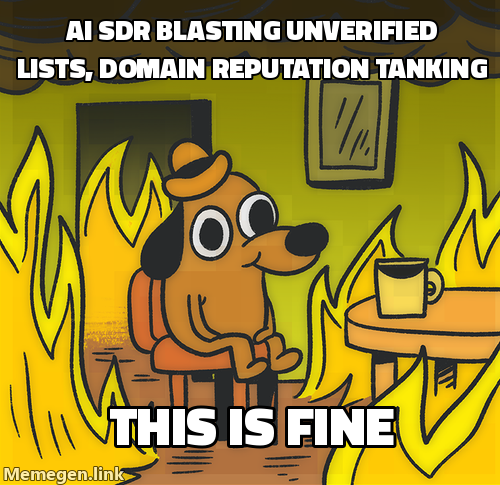 Every AI SDR workflow lives or dies by what happens before the send button.
If you are sourcing across Europe or want GDPR-native infrastructure built in from the start, the Clay enrichment service approach pairs well with Apollo for EU-market targeting.
Layer 2: Signal Enrichment with Clay
Clay adds public context that the copy can use. Useful signals include recent funding rounds, executive hires in roles related to your offer, job postings that reveal a pain point, and technology stack changes visible in public data.
Every signal is a possible hook. A company that just posted three SDR roles is trying to build outbound capacity, giving an outbound infrastructure offer a direct entry point. A company that raised a Series A six months ago is likely hiring and growing, with pipeline becoming a board-level topic.
Clay tables can run enrichment steps in sequence, feed the results into a prompt column, and generate an icebreaker or custom hook for each row. Treat that text as a draft, not finished copy.
Layer 3: LLM Copy Generation and Independent Audit
Use two separate LLM calls. Combining generation and quality control in one prompt lets hallucinations slip through as volume grows.
The first call generates the copy. Give the LLM the prospect’s name, title, company, and the strongest one or two signals from Clay. Constrain the tone, body length to under eighty words, subject line format, and offer framing. The LLM should use only the supplied facts and flag anything it cannot source.
The second call audits the result. Give a separate LLM only the source facts and generated copy, then ask it to find claims that cannot be traced to the input. It should flag invented revenue figures, pain points unsupported by the signals, and references to events that did not happen.
The audit call catches hallucinations before human review. The model that wrote the copy cannot reliably judge its own accuracy.
Teams building from scratch can use the done-with-you outbound model to test the architecture before edge cases reach production.
Layer 4: Verification, Approval Gate, and Send
Never skip email verification. Invalid addresses burn sender reputation, and contact data decays even from reputable databases.
Run every address through a verification API before copy is generated. Catch-all domains are a judgment call: treat them as lower-confidence and either verify with a second provider or send to them at reduced volume.
Most automation workflows skip the approval gate. Every draft that passes the audit goes to a human review queue. The reviewer sees:
- The signal that triggered the email
- The generated subject line and body
- The audit status (clean or flagged)
They approve, edit, or reject the draft. Only approved items enter the sending platform. This review catches cases the LLM missed: a prospect who is a former colleague, a company currently in the news for the wrong reason, or a subject line that looked good in the prompt but reads badly in an inbox.
Smartlead and Instantly handle sequencing, follow-up scheduling, and reply detection. Put verified, approved prospects into a dedicated campaign. Do not share one campaign across multiple lead sources or offers. Their deliverability signals and copy intent will conflict.
Tying It Together
The complete workflow is an Apollo export, Clay enrichment with two to three signals per contact, LLM copy generation, an independent audit for unsourced claims, email verification, human approval, and a dedicated campaign on a warmed domain.
Each layer has a clear input and output. When a campaign underperforms, you can isolate the constraint: sourcing quality, signal relevance, copy resonance, or targeting fit.
Teams that want to skip the build can use a managed outbound service that runs the workflow for them. Teams that want the system in their own stack can choose a builder-led engagement and take over the workflow at the end. In both models, signals go in, verified copy comes out, and a person checks it before sending.
GDPR-compliant outreach across European markets requires suppression logic, a clear opt-out path in every email, and lead sourcing that follows local data rules. Add these controls to the Clay table and sending platform configuration from the start. The GDPR-compliant cold email agency approach covers EU-specific implementation for teams targeting Germany, the Netherlands, or the UK.
Request the signal tier list.
A practical view of how we rank observable signals before outreach. We review each request for fit and may reply by email; delivery is not automatic.
By submitting, you agree to processing described in our Privacy Policy.
Your request was submitted. If it is a fit, we may follow up by email.
One more step: send the prepared request to [email protected]
FAQ
What tools do you need to build an AI SDR workflow?
The core stack is a data source (Apollo for company and contact discovery), an enrichment layer (Clay to pull signals like job changes or funding rounds), an LLM for copy generation, an email verifier, and a sending platform such as Smartlead or Instantly. Add a human approval gate before the send step to keep quality in check.
Can an AI SDR replace a human sales development rep?
No, but it removes most of the repetitive work. AI handles high-volume mechanical tasks: sourcing leads, researching signals, drafting copy, and managing follow-up sequences. A human still needs to approve sends, handle positive replies, and run discovery calls. The right framing is AI as leverage, not replacement.
How long does it take to set up an AI SDR system?
A basic workflow (Apollo list, Clay enrichment, LLM copy, one sending account) can be running in under two weeks. A production-grade system with verification, multi-persona copy, reply classification, and deliverability infrastructure typically takes three to five weeks to build and calibrate.
How do you make sure AI-generated cold emails are accurate?
Run a second LLM call as an independent auditor: give it only the source facts and the generated copy, and ask it to flag any claim that cannot be traced back to the source data. This may flag unsupported claims, but it can miss errors; retain source checks and human approval.
What is signal-based outreach in an AI SDR workflow?
Signal-based outreach means each email is triggered by a real event tied to the prospect: a new hire in a relevant role, a funding announcement, a job posting that signals pain, or a technology change. Signals can give the AI grounded facts to write from; measure factual errors and reply rates against a baseline rather than assuming an improvement.
Is an AI SDR workflow GDPR compliant?
It can be. Legitimate interest is the most common legal basis for B2B cold outreach under GDPR, provided you target decision-makers at companies with a plausible business interest in your offer, include a clear opt-out, and honour unsubscribe requests immediately. Building suppression logic and consent checks into the workflow from day one is much easier than retrofitting them later.

Ahmet Faruk Yilmaz
Founder of Asphia. He builds and runs signal-based B2B outbound engines for lean teams, and writes about cold email, Clay, deliverability, and GTM engineering.
Want this run for you?
Get a free GTM analysis. We show you the exact engine we would build.
Request the planning framework →