Cold Email Domain Setup: The Exact DNS, Mailbox, and Redirect Configuration We Use
August 13, 2025 · 4 min read · by Ahmet Faruk Yilmaz, Founder of Asphia
TL;DR
Buy separate sending domains (never your root domain), configure SPF, DKIM, and DMARC on each, set up a redirect to your main site, provision no more than two to three mailboxes per domain, and warm each mailbox for three to four weeks before sending a single cold email.
Cold email fails before the copy is read when the domain setup is wrong. Authentication, mailbox limits, redirects, and warmup all affect whether a message reaches the inbox.
The short answer: never send from your root domain. Configure all three DNS authentication records, redirect each sending domain to your main site, and warm every mailbox before emailing a real prospect.
Why Sending Domains Are Separate From Your Main Domain
Your root domain (yourcompany.com) is tied to your product emails, password resets, invoices, and customer communications. One spam complaint that triggers a blocklist can silence all of those overnight.
Sending domains are cheap insurance. You register variations (yourbrand-outreach.com, yourbrandco.com, yourbrand-hq.com) and point each one back to your website with a simple HTTP redirect. Prospects who check the URL see your real site. Receiving servers see a domain with a clean history. Your root domain stays untouched.
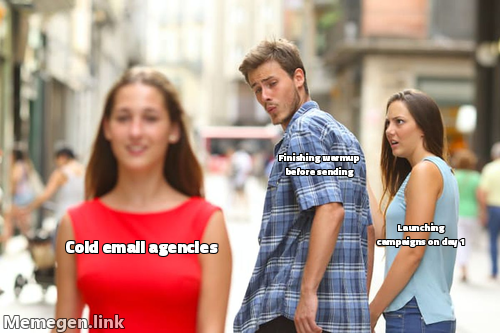 Warmup is not optional. Skipping it is the fastest way to burn a domain you spent three weeks configuring.
A sensible ratio at scale is one domain for every three mailboxes, spread across multiple providers. At five hundred emails per day, that means roughly eight to ten domains and fifteen to twenty mailboxes. Do not put twenty addresses on one domain.
The Three DNS Records You Cannot Skip
Every sending domain needs these three records before a single email goes out.
SPF (Sender Policy Framework) is a TXT record on your domain that lists which mail servers are allowed to send on its behalf. A typical SPF record for Google Workspace looks like v=spf1 include:_spf.google.com ~all. Your sending tool will provide the exact value. If you have multiple providers, include each one, but keep the lookup count under ten or SPF will fail silently.
DKIM (DomainKeys Identified Mail) is a cryptographic signature. Your sending platform generates a public and private key pair. You publish the public key as a TXT record under a specific selector subdomain (for example google._domainkey.yourdomain.com). Every outgoing message is signed with the private key. Receiving servers verify the signature against your public record. A mismatch or missing record is an immediate deliverability penalty.
DMARC is the policy that ties SPF and DKIM together and tells receiving servers what to do when either check fails. Start with v=DMARC1; p=none; rua=mailto:[email protected] to collect reports without rejecting mail, then tighten to p=quarantine or p=reject once you confirm both SPF and DKIM are passing cleanly. Google and Yahoo now enforce DMARC for bulk senders, so this is no longer optional. Google’s official sender guidelines at support.google.com cover the current requirements.
Mailbox Configuration and Provider Choice
Once DNS is clean, you provision mailboxes. Standard configuration:
- Two to three mailboxes per sending domain
- A real first and last name as the display name, not a generic “Sales Team” label
- A reply-to address that points to a monitored inbox
- Sending volume within the limits. Most tools cap each mailbox at thirty to fifty emails per day during warmup, then eighty to one hundred twenty at full volume
Google Workspace and Microsoft 365 are the two default providers. Microsoft inboxes often get slightly better placement when sending to Outlook, Hotmail, and corporate Exchange addresses. That matters because a large share of business email runs on Microsoft infrastructure. Split domains across both providers so a policy change at one does not take down the whole setup.
In a managed done-for-you cold email setup, provider selection and domain provisioning are usually part of onboarding. DNS verification finishes before any sequence goes live.
Warmup: The Step Most Teams Skip
A new mailbox with zero sending history looks suspicious to receiving servers. Warmup builds a reputation gradually by sending small volumes of mail that get opened and replied to.
Start at ten to twenty emails per day in week one. Increase volume by ten to twenty percent every two to three days, and run warmup tool traffic alongside real sends. Most sending platforms include this. By week three to four, a well-warmed mailbox can handle sixty to one hundred emails per day without triggering filters.
What kills warmup:
- Sending a campaign before warmup finishes
- Identical copy across all mailboxes on day one
- No real engagement signals during the warmup period
Infrastructure problems spread quickly as volume grows. With the outbound engine builder model, configuration, warmup, and launch are handled before you write a line of copy. A done-with-you outbound engagement builds the system inside your accounts so your team can own the stack afterward.
Connecting Infrastructure to Copy and Deliverability
A clean domain does not rescue bad email. High unsubscribe rates, spam complaints, and low engagement damage sending reputation even when the technical setup is correct.
Three things protect deliverability over time: copy that does not read like a template, suppression lists that remove unsubscribes and bounces immediately, and sending volume that stays within the limits earned during warmup.
Once the infrastructure is solid, our guide on cold email that avoids spam filters covers copy and timing. If you are deciding between an internal build and an external operator, the managed outbound service page shows what the managed setup includes.
Domain setup is not creative, and there is no shortcut. It is also where most campaigns fail before they start.
Get the signal tier list in your inbox.
We rank signals from S to D to decide who gets a cold email and who does not. You get the list once. No follow-up emails.
Request received. The list lands in your inbox within 24 hours.
One more step: send the prepared request to [email protected]
FAQ
Should I use my main domain for cold email?
No. Your root domain carries your brand reputation. One spam complaint or blocklist hit can kill transactional email for your whole company. Buy separate sending domains that redirect to your main site and reserve the root for product and marketing sends.
How many mailboxes should I put on one sending domain?
Two to three mailboxes per domain is the standard ceiling. More than that concentrates risk: if the domain gets flagged, all mailboxes on it go down at once. Spreading across multiple domains gives you redundancy and lets you scale volume safely.
What DNS records are required for cold email deliverability?
You need SPF (a TXT record listing authorized sending servers), DKIM (a public key published as a TXT record that your sending tool signs against), and DMARC (a policy TXT record that tells receiving servers what to do with failures). All three are required by major providers.
How long does cold email domain warmup take?
Plan for three to four weeks minimum. Start at ten to twenty emails per day per mailbox, increase by ten to twenty percent every two to three days, and mix in real replies during warmup. Skipping or rushing warmup is the single most common reason new domains land in spam.
What is a cold email domain redirect and why does it matter?
A redirect means your sending domain (outreach.yourcompany.com or a variation like yourbrand-hq.com) forwards visitors to your real website. Recipients who check the domain before replying see a real company page, which builds trust and reduces manual spam reports.
Does Google Workspace or Microsoft 365 matter for cold email?
Both work, but Microsoft 365 Business Basic inboxes have historically shown slightly better deliverability to Microsoft-hosted recipients (Outlook, Hotmail), which make up a large share of business inboxes. Many outbound teams split providers across domains for redundancy.

Ahmet Faruk Yilmaz
Founder of Asphia. He builds and runs signal-based B2B outbound engines for lean teams, and has booked meetings with teams at companies across five markets. Writes about cold email, Clay, deliverability, and GTM engineering.
Want this run for you?
Get a free GTM analysis. We show you the exact engine we would build.
Get your free GTM analysis →