How to A/B Test Cold Email Subject Lines and Improve Reply Rate
May 26, 2026 · 4 min read · by Ahmet Faruk Yilmaz, Founder of Asphia
TL;DR
Test one variable at a time, wait for at least 100 sends per variant, and measure reply rate instead of open rate. Winning subject lines are usually shorter, more specific, and closer to something a person would write than a marketing template.
Cold email subject line testing has three basic rules: test one variable at a time, send at least 100 emails per variant, and measure reply rate. Open rate is noise. Reply rate is signal.
Most teams change two things at once, call a winner after 30 sends, and optimize for opens. Those tests produce no reliable conclusion.
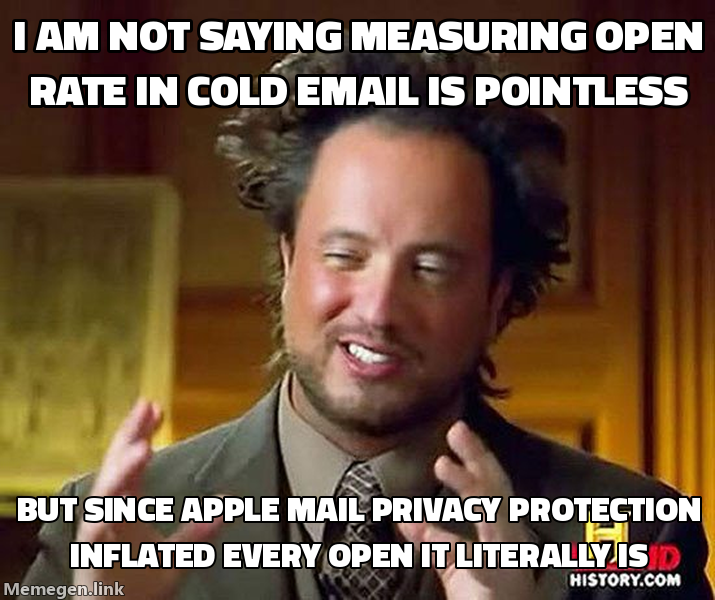 Your open rate went up 30%. Your reply rate stayed at 2%. Congrats on your invisible readers.
Why Open Rate Is the Wrong Metric
Start by discarding open rate as a primary metric.
Since Apple Mail Privacy Protection rolled out, a meaningful portion of opens are recorded automatically regardless of whether the recipient actually opened the message. Your ESP shows inflated open rates that do not correlate with engagement. A subject line that appears to lift opens by 15% may produce identical or worse reply rates.
Reply rate is harder for tracking systems to inflate. It measures real behavior and connects directly to pipeline. Base test decisions on reply rate, not open rate.
What to Actually Test
Run one variable at a time. The most productive variables to isolate in subject line testing are:
Length. Very short subjects (two to four words) often beat longer ones because they resemble direct messages rather than marketing emails. Test your current subject against a shorter version.
Personalization token presence. Does including the prospect’s company name or a role-specific phrase lift reply rate, or does it look forced? The answer varies by ICP. Test it explicitly rather than assuming personalization always helps.
Question vs statement. “Quick question about your hiring pipeline” vs “Outbound for hiring teams at scale.” Different readers respond differently. Some find questions manipulative. Some find statements presumptuous. Test the framing.
Topic angle. Are you leading with the problem, the outcome, or a specific signal? A subject line referencing something that changed recently at the prospect’s company (a funding round, a new job post, a product launch) will usually outperform a generic benefit statement. This is the core of signal-based outbound and it applies to subject lines just as much as body copy.
Do not start with capitalization, emojis, or sender name changes. Test framing and length before cosmetic details.
How to Structure the Test
Most cold email tools let you assign variants to a percentage of a campaign. Use this setup:
Split your send list evenly between variant A and variant B. Keep everything else identical: the body copy, the CTA, the sender, the send time, and the sequence. The only difference should be the subject line.
Send to at least 100 contacts per variant before reading results. Ideally 150 to 200 per variant if your list allows it. Anything less and you are reading noise.
Let the test run for at least a week. Day-of-week effects are real. Sends on Monday morning compete with a flooded inbox. Thursday afternoon in the prospect’s time zone tends to see better engagement. Running a test over multiple days smooths these effects.
After the test period, compare replies as a percentage of delivered emails. Pick the winner, record the variable you changed, and note why it may have mattered. Over time, this log shows how your ICP responds.
The Subject Lines That Consistently Win
Across Asphia’s B2B cold email campaigns, these patterns repeat across segments:
Short and lowercase. “question about your SDR stack” outperforms “A Question About Your Sales Development Stack.” The lowercase version reads like a direct message from a real person.
Specific beats clever. A subject line tied to the recipient’s situation, such as “saw you’re hiring AEs in Amsterdam,” will beat a clever phrase that applies to anyone.
No benefit claims in the subject. Saving the value proposition for the body keeps the subject line from sounding like an ad. The subject’s only job is to earn the open from someone who is already suspicious of cold email.
No manipulative patterns. False urgency, fake familiarity (“following up on our conversation” when there was none), and manufactured scarcity damage trust before the recipient even reads your message. These may lift opens briefly and destroy reply rates over any reasonable test window.
Running Tests at Scale Without a Large List
If your send volume per campaign is small, you cannot run statistically meaningful tests within a single campaign. The workaround is to pool data.
Run the same subject line variants across multiple campaigns targeting the same ICP and offer. Track results in a shared log. After three to four campaigns, you will have enough sends per variant to read results reliably.
This is why agencies running managed outbound across multiple clients can learn faster. More volume shortens test cycles. Patterns found across segments also transfer to new campaigns faster than a single sender could validate them.
With enough data, you stop guessing. You know what your ICP responds to and can improve a proven baseline instead of starting from scratch.
Before scaling a campaign, use the outbound engine builder approach to understand the infrastructure required for systematic testing at volume.
Get the signal tier list in your inbox.
We rank signals from S to D to decide who gets a cold email and who does not. You get the list once. No follow-up emails.
Request received. The list lands in your inbox within 24 hours.
One more step: send the prepared request to [email protected]
FAQ
How many emails do I need to send to get a valid cold email A/B test?
You need at least 100 sends per variant before results mean anything. With fewer sends, normal variance in reply rates will look like signal. Most outbound sequences are too small to run rigorous tests, which means you should pool data across campaigns targeting the same ICP.
Should I measure open rate or reply rate when testing subject lines?
Measure reply rate. Open rate data has been unreliable since Apple Mail Privacy Protection inflated open numbers in 2021. A subject line that gets more opens but the same or fewer replies tells you nothing useful. Reply rate is the only metric tied to pipeline.
What makes a cold email subject line work?
Short, specific, and human. The best performing subject lines read like something a real person would type in a direct message. No title case, no exclamation marks, no benefit claims in the subject. Specificity beats cleverness: referencing the prospect's industry, role, or a concrete signal outperforms generic hooks.
How long should I run a cold email A/B test?
Run until each variant has at least 100 sends and at least one week has passed. Reply rates are time-sensitive: sends on Monday morning perform differently from Thursday afternoon. A week of data smooths out day-of-week variance before you draw conclusions.
What variables should I test in cold email subject lines?
Test one thing at a time: length (under 4 words vs 6 to 8 words), question vs statement, personalization token present vs absent, or topic framing (outcome vs problem vs curiosity). Testing multiple variables at once makes it impossible to know what caused a change.
Does A/B testing subject lines help if my targeting is poor?
No. Subject line testing only compounds existing quality. If your list is wrong, your offer is vague, or your ICP is broad, optimizing the subject line will not fix reply rates. Fix targeting and offer first, then test copy variables once the fundamentals are solid.

Ahmet Faruk Yilmaz
Founder of Asphia. He builds and runs signal-based B2B outbound engines for lean teams, and has booked meetings with teams at companies across five markets. Writes about cold email, Clay, deliverability, and GTM engineering.
Want this run for you?
Get a free GTM analysis. We show you the exact engine we would build.
Get your free GTM analysis →