How to Scale Cold Outreach Without Adding SDR Headcount
May 5, 2026 · 4 min read · by Ahmet Faruk Yilmaz, Founder of Asphia
TL;DR
You can scale cold outreach without SDR headcount by replacing manual prospecting and personalization with signal-triggered automation: pull intent signals, enrich with Clay, generate context-aware copy, run it through a fact-check layer, and let one person approve sends before they go out.
You do not need more SDRs to send more outreach. You need better leverage at each step of the pipeline: smarter data, tighter signals, AI-assisted copy, and a human gate before anything sends.
That is the core shift. Headcount scales linearly. A well-built outbound system scales with your TAM.
Why Headcount Does Not Solve the Problem
Most companies hire another SDR when reply rates drop. The logic feels intuitive: more outreach, more replies. But the actual constraint is almost never volume. It is relevance.
A prospect ignores generic outreach regardless of how many people send it. The fix is not more senders. It is better context per message and tighter targeting. Adding SDR headcount multiplies the volume of bad outreach. Building a signal-triggered system multiplies the volume of relevant outreach.
The math works differently. One operator running a properly built system can touch far more prospects per week than a team of five doing manual personalization, and do it with higher contextual accuracy because the machine never skips enrichment steps.
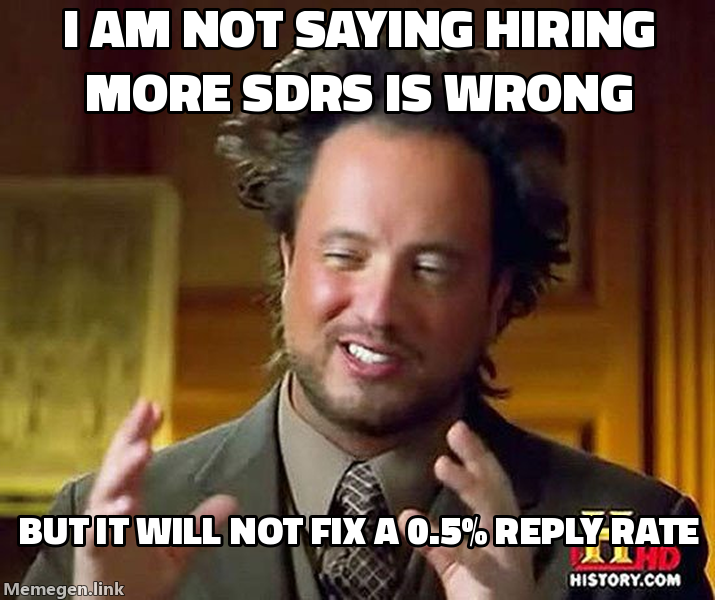 More senders multiplies the volume of bad outreach. Signals multiply the volume of relevant outreach.
What a Scalable Outbound System Actually Looks Like
A working automated outbound engine has four layers:
Signal capture. You define what a buying signal looks like for your ICP: a new Head of Sales hired, a funding round closed, a job post that signals a specific pain. Tools like Apollo surface these events. Clay pulls them into a structured workflow.
Enrichment. Raw signals are noisy. Before any copy is written, the contact gets enriched: verified email, current title, company size, tech stack, recent news. A Clay enrichment service does this in bulk, far faster than a human researcher.
Copy generation with a fact-check gate. An AI layer writes context-aware copy using the enriched signal as the raw material. The message references something real and specific about the prospect’s situation. Critically, every claim in the copy gets audited before it is staged. Hallucinated statistics or invented company details are flagged and dropped. Nothing moves forward unless the facts are clean.
Human approval before send. Every message a human has not reviewed is a reputation risk. A review gate, whether that is a Telegram card, a queue dashboard, or a simple approval CLI, means one person can greenlight dozens of sends per day without losing control of quality. This is not a bottleneck. It is the point of leverage that makes the rest trustworthy.
This is exactly what an outbound engine builder sets up in your stack, and what a managed outbound service runs on your behalf.
Where Most DIY Attempts Break
The failure mode is almost always the same: teams automate prospecting and volume, but skip the fact-check layer and the signal specificity. The result is fast, high-volume, irrelevant outreach. Deliverability degrades. Reply rates collapse. They conclude that automation does not work.
The actual problem was no signal triggering and no quality gate.
The other common break point is infrastructure. Warming domains correctly, managing sending limits, rotating mailboxes, and staying inside provider guidelines (see Google’s bulk sender guidance for reference) is operational work that sits outside the creative layer. Getting it wrong burns your domain before your copy even gets a fair test.
A done-for-you cold email setup handles this end to end. A done-with-you outbound engagement builds it inside your own infrastructure so you own the system after the engagement ends.
When to Use a Service vs. Build In-House
If your team is spending more than a few hours per week on manual prospecting and personalization, the opportunity cost of not automating is already significant.
The build-in-house path makes sense if you have a technical operator who can configure Clay, set up enrichment workflows, and manage sending infrastructure. The system is yours and compounds over time.
The agency or managed path makes sense if you want the system running in under two weeks without pulling engineering bandwidth. The machine still becomes yours. The difference is who builds and operates it during the growth phase.
For founders and small GTM teams specifically, the fractional SDR service model sits between the two: dedicated outreach execution without the full cost or complexity of hiring.
The Numbers That Actually Matter
Ignore raw send volume. The metrics that predict revenue are:
- Verified contact rate (emails that reach a real inbox)
- Signal-to-copy relevance (does the message reference something the prospect actually cares about)
- Reply-to-meeting conversion (of the replies that come in, how many become calls)
A system optimized for these three numbers will outperform a team of SDRs optimizing for activity metrics. And it scales without a hiring cycle.
If you are evaluating whether to scale cold outreach without an SDR, the question to ask is not how many people you need. It is what signals you are not capturing and what happens to a message before it sends.
Get the signal tier list in your inbox.
We rank signals from S to D to decide who gets a cold email and who does not. You get the list once. No follow-up emails.
Request received. The list lands in your inbox within 24 hours.
One more step: send the prepared request to [email protected]
FAQ
Can you do cold outreach without an SDR team?
Yes. Signal-based automation handles prospecting, enrichment, and copy generation. A single operator or founder can review and approve sends. The constraint is not headcount but having the right data signals and a reliable fact-check layer before anything goes out.
What replaces an SDR in an automated outbound system?
Clay or Apollo handle lead discovery and enrichment. An AI layer writes context-aware copy from signal data. A human approves each message before it sends. The SDR role becomes a QA and strategy function rather than a manual execution function.
How many meetings can an automated outbound system book?
Results depend on list quality, signal relevance, and offer-market fit, not on volume alone. A well-tuned signal-based system with strong copy and verified contacts typically outperforms a high-volume spray approach. Specific numbers vary by market and ICP.
Is signal-based cold outreach GDPR compliant?
It can be. Legitimate interest is the most common legal basis for B2B cold outreach under GDPR, but you need a documented basis, easy opt-out on every message, and no use of personal data beyond the outreach purpose. Working with a GDPR-native agency removes most of that operational burden.
What signals trigger cold outreach in an automated system?
Common triggers include job changes (new VP of Sales hired), funding announcements, tech stack additions (a prospect just adopted a tool your offer integrates with), hiring patterns that signal a pain point, and intent data from content consumption. Each signal maps to a specific message angle.
How long does it take to set up an automated outbound system?
A focused build takes roughly one to two weeks: ICP definition, data sourcing, Clay enrichment setup, copy templates, sending infrastructure, and a human review gate. Done With You engagements at Asphia typically go live within seven days.

Ahmet Faruk Yilmaz
Founder of Asphia. He builds and runs signal-based B2B outbound engines for lean teams, and has booked meetings with teams at companies across five markets. Writes about cold email, Clay, deliverability, and GTM engineering.
Want this run for you?
Get a free GTM analysis. We show you the exact engine we would build.
Get your free GTM analysis →