How Many Domains Do You Need for Cold Email Outbound in 2026?
August 10, 2025 · 5 min read · by Ahmet Faruk Yilmaz, Founder of Asphia
TL;DR
For most B2B outbound programs, plan on one sending domain per 2-3 mailboxes, with each mailbox capped at 40-50 emails per day. A team sending 500 emails daily needs roughly 4-5 domains and 10-12 mailboxes. Always keep your primary domain off the sending rotation entirely.
The quick answer: one sending domain per 2-3 mailboxes, each mailbox capped at 40-50 emails per day, and your primary domain never in the sending rotation. If you need 500 daily sends, you are looking at roughly 10-12 mailboxes across 4-5 dedicated domains.
That is the floor. The right number for your program depends on volume, warmup age, bounce tolerance, and how aggressively you are splitting audiences. Here is how to think through it.
Why You Need Multiple Domains at All
Email providers (Google, Microsoft, and the major ISPs) score sender reputation at the domain level. Every hard bounce, spam report, or low-engagement pattern chips away at the reputation of the sending domain. Once a domain’s reputation drops below a certain threshold, your emails start routing to spam across the board, and recovery takes weeks.
Distributing your sending across several domains means a reputation problem on one domain damages only a fraction of your capacity. You pause that domain, let it recover, and the rest of your program keeps running.
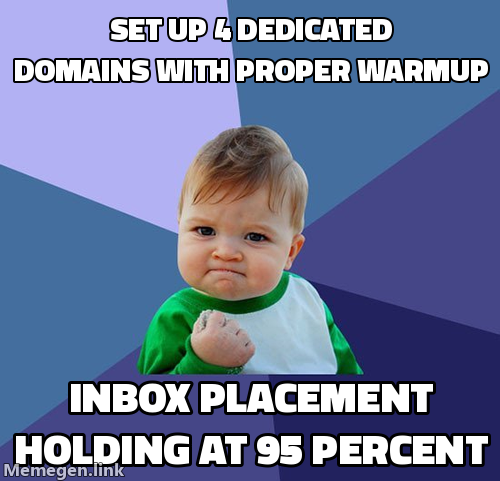 Get the infrastructure math right and deliverability takes care of itself.
This is the same logic that applies to mailbox limits. Sending 200 emails per day from a single mailbox on a three-month-old domain is the fastest way to get that domain flagged. Spreading the same 200 sends across five mailboxes on two or three domains gives each mailbox a light, sustainable load.
The Math Behind the Numbers
A practical B2B cold email infrastructure in 2026 looks like this:
- 40-50 emails per mailbox per day (hard ceiling, not a target)
- 2-3 mailboxes per sending domain
- One dedicated domain kept as a backup or rotation spare
So if you need 300 emails per day in steady state:
- 300 / 45 (average per mailbox) = about 7 mailboxes
- 7 mailboxes / 2.5 (average per domain) = about 3 domains
Add a fourth domain if you want a spare in rotation or if you plan to scale within the quarter.
For agencies or founders running sequences across multiple ICPs or geographies, the number grows. A done-for-you cold email program covering three markets at real volume can comfortably run 10-15 sending domains, each contributing a clean slice of daily capacity.
Warmup: The Step That Determines Your Real Timeline
New domains cannot send volume on day one. Skipping warmup is the single most common reason cold email programs underperform.
A realistic warmup schedule:
- Week 1-2: 5-15 emails per day, mostly warmup tool traffic (inbox-to-inbox exchanges that build engagement signals)
- Week 3-4: ramp to 25-30 per day, mix in a small number of real prospect emails
- Week 5 onward: push toward the 40-50 ceiling if open rates and bounce rates look clean
Modern tools like Smartlead, Instantly, and Lemlist include automated warmup pools. They help, but they do not compress the timeline. Plan your domain provisioning 4-6 weeks ahead of your target launch date.
If you are working with an AI cold email setup built for deliverability, the warmup schedule is built into the onboarding flow. Rushing it is still a mistake.
DMARC, SPF, and DKIM: Non-Negotiable
Every sending domain needs three DNS records configured correctly before a single email goes out:
- SPF: tells receiving servers which IPs are allowed to send on behalf of your domain
- DKIM: cryptographically signs outgoing messages so receivers can verify authenticity
- DMARC: instructs receivers what to do with mail that fails SPF or DKIM, and gives you a reporting mechanism
Since February 2024, Google and Yahoo have enforced these requirements for bulk senders. Microsoft followed. If these records are missing or misconfigured, your emails either get rejected outright or sorted to spam without appeal. There is no workaround.
Google’s sender guidelines are publicly documented and worth reading before you provision your first domain.
Domain Naming and Regional Considerations
Sending domains should look credible but should not impersonate your brand too aggressively. Common patterns include variations of your company name (getcompanyname.com, companyname-hq.com, trycompanyname.com) or descriptive names tied to your service.
If you run multilingual or multi-region outbound, consider region-specific domains. A cold email program targeting the Netherlands sends more convincingly from a .nl or at least a domain that fits the regional context. The same principle applies to German-language sequences via outbound programs in the DACH market.
GDPR adds one more layer: your sending domains and the lists attached to them need to fit within a legitimate interest or equivalent legal basis. This is not just a compliance checkbox. It affects how you structure your opt-out handling, your suppression lists, and your documentation. A GDPR-compliant cold email setup addresses this at the infrastructure level, not as an afterthought.
When to Add More Domains
Your infrastructure is showing strain when:
- Bounce rates on any single domain climb above 2-3%
- Spam placement rates increase (visible in Google Postmaster Tools or seed testing)
- Reply rates drop without a clear copy or targeting explanation
- You want to test a new audience segment without risking existing reputation
Adding a domain is cheap. Recovering a burned domain is expensive in time and lost pipeline. The right move is always to provision new sending capacity before you need it, not after.
If you are building this out from scratch or want a system your team owns permanently, a done-with-you outbound build covers infrastructure setup including domain provisioning, warmup, DNS configuration, and the sending sequences on top.
Get the signal tier list in your inbox.
We rank signals from S to D to decide who gets a cold email and who does not. You get the list once. No follow-up emails.
Request received. The list lands in your inbox within 24 hours.
One more step: send the prepared request to [email protected]
FAQ
How many domains do you need for cold email outbound?
The standard rule is one domain per 2-3 mailboxes. If you plan to send 500 emails a day at 40-50 per mailbox, you need roughly 10-12 mailboxes across 4-5 dedicated sending domains. Your primary brand domain should never be on the sending list.
Can I send cold email from my main domain?
You can, but it is a serious risk. If a sending domain gets flagged or lands on a blocklist, recovery is painful. If your primary domain gets flagged, your transactional email, sales replies, and internal mail all suffer. Use dedicated sending domains and keep your main domain clean.
How long should I warm up a new cold email domain?
Expect a minimum of 3-4 weeks of warmup before you send any real prospects. Start at 5-10 emails per day and increase gradually. Most modern sending tools include automated warmup, but you still need to respect the timeline before pushing volume.
How many emails per day can I send per mailbox safely?
Google Workspace and Microsoft 365 mailboxes used for cold outreach should stay at 40-50 emails per day. The technical limits are much higher, but exceeding 50 per day from a relatively new domain accelerates spam-rate accumulation and triggers sender reputation damage faster than you can recover.
What is the difference between domains and mailboxes in cold email infrastructure?
A domain is the part after the @ sign (yoursendingdomain.com). A mailbox is a specific email address on that domain ([email protected]). One domain can host multiple mailboxes. For deliverability, you spread mailboxes across several domains so that if one domain gets flagged, only a fraction of your sending capacity goes down.
Do I need separate domains for different target markets or languages?
Not strictly required, but it is a good practice if you run campaigns in multiple languages or regions. A German-language campaign sending from a .com domain with an American-sounding name looks off. Country-code domains (yourbrand.de, yourbrand.nl) improve authenticity and can lift reply rates on regionally focused sequences.

Ahmet Faruk Yilmaz
Founder of Asphia. He builds and runs signal-based B2B outbound engines for lean teams, and has booked meetings with teams at companies across five markets. Writes about cold email, Clay, deliverability, and GTM engineering.
Want this run for you?
Get a free GTM analysis. We show you the exact engine we would build.
Get your free GTM analysis →