37 Cold Email Subject Lines That Get Opened (2026 Patterns)
December 14, 2025 · 6 min read · by Ahmet Faruk Yilmaz, Founder of Asphia
TL;DR
Useful cold email subject lines are short (under 6 words), specific to the recipient, and avoid spam triggers. Test prediction openings, bare facts, and question formats against generic benefit claims; personalization tied to a real signal is a candidate, not a guarantee.
The subject line is one influence on whether your email gets opened or deleted, alongside sender recognition, inbox placement, timing, and relevance. If it is weak, the rest of your copy may receive less attention.
The best cold email subject lines are short, signal relevance, and do not look like mass outreach.
Why Most Subject Lines Fail
Generic subject lines can look like marketing. When a senior buyer sees “Increase your revenue with AI” or “Quick question for you,” they may recognise a familiar pattern and overlook it. That audience response is a hypothesis to test, not a universal rule.
The fix is specificity, not creativity. Tie the subject line to a recent announcement, a hiring signal, a technology they use, or another fact from the recipient’s business. That gives them a concrete reason to open it.
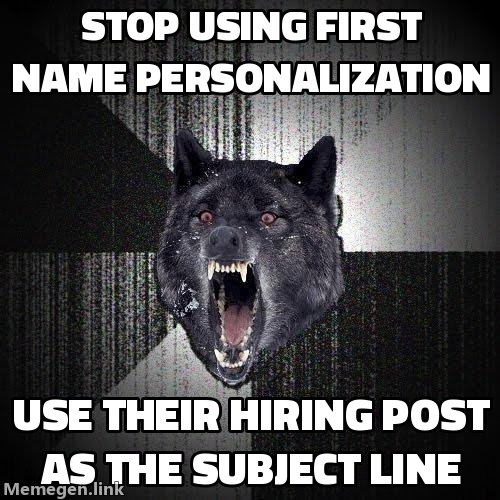 Stop filling in the first name field. Pull their actual hiring post and quote it back at them.
Here are six subject line formulas to test against your audience’s baseline.
The 6 Formulas (With Examples)
1. The Prediction
Use what you know about their situation to predict what happens next. The prediction shows knowledge without announcing that you did research.
Examples:
- “Your next SDR hire will take 90 days to ramp”
- “Series B companies usually hit this pipeline gap”
- “Your inbound volume will drop in Q1”
2. The Bold Fact
Open with a single concrete fact about their industry, company type, or a pattern you have observed. Do not soften it.
Examples:
- “Most {industry} teams are buying lists from the same 3 sources”
- “Outbound at agencies breaks after 3 reps”
- “Most cold email is never read”
3. The Counter-Intuitive
Challenge something the recipient probably believes. They have to open the email to see the explanation.
Examples:
- “More personalization is hurting your reply rate”
- “The best SDRs are not sending more emails”
- “Clay is not a data problem, it is a sequencing problem”
4. The Direct Question
Ask a specific question about their situation. Avoid vague openers. The question should be answerable in one word and relevant enough to merit a response.
Examples:
- “Still manually pulling LinkedIn data?”
- “Who owns outbound on your team right now?”
- “Running outbound in-house or outsourced?”
5. The Bare Fact
State something observable about the recipient or company with no framing. It reads like a note from someone who did the research.
Examples:
- “Saw you just opened a London office”
- “Noticed you switched from HubSpot to Salesforce”
- “{Company} is hiring 3 AEs”
6. Their Own Words
Quote something the prospect or company said publicly, such as a LinkedIn post, press release, or podcast quote. When you have a real signal, this is the highest-performing format.
Examples:
- “Re: your post on SDR productivity”
- “You mentioned Q3 pipeline in your last earnings call”
- “Saw your comment on outbound being broken”
Here is how each formula stacks up at a glance:
| Formula | Example | Why it works |
|---|---|---|
| Prediction | ”Series B companies usually hit this pipeline gap” | Shows pattern knowledge specific to their stage |
| Bold Fact | ”Most cold email is never read” | Disarms the reader, creates curiosity to know more |
| Counter-Intuitive | ”More personalization is hurting your reply rate” | Challenges a belief they hold, demands the explanation |
| Direct Question | ”Still manually pulling LinkedIn data?” | Specific self-reflection, one-word answer in their head |
| Bare Fact | ”{Company} is hiring 3 AEs” | Proves you did research, not just mail merge |
| Their Own Words | ”Re: your post on SDR productivity” | Hardest to fake, highest trust signal |
The highest-performing subject lines are not clever. They are specific. One real signal beats any wordplay.
The Full List: 37 Subject Lines Organized by Pattern
Prediction (7)
- “Your next SDR hire will take 90 days to ramp”
- “Series B companies usually hit this pipeline gap”
- “Outbound at {company size} usually stalls here”
- “This is why your open rates will drop in Q1”
- “What happens when your agency hits 10 clients”
- “Most PLG teams hit this outbound wall”
- “Your inbound will slow down before you notice”
Bold Fact (6) 8. “Most cold email is never read” 9. “Most outbound teams are buying the same list” 10. “Cold emails get very little attention” 11. “Agencies lose outbound momentum at scale” 12. “B2B buyers ignore most cold emails” 13. “Your ICP is smaller than your list suggests”
Counter-Intuitive (6) 14. “More personalization is hurting your reply rate” 15. “The best SDRs are sending fewer emails” 16. “Clay is not a data problem” 17. “Hiring an SDR will slow you down first” 18. “Your open rate is lying to you” 19. “Good copy is not what’s killing your outbound”
Direct Question (6) 20. “Still pulling LinkedIn data manually?” 21. “Who owns outbound right now?” 22. “Running outbound in-house or outsourced?” 23. “What does your current reply rate look like?” 24. “How long does it take to get a campaign live?” 25. “Do you have a signal layer in your stack?”
Bare Fact (6) 26. “Saw you just opened a Berlin office” 27. “{Company} is hiring 3 AEs” 28. “Noticed you switched CRMs” 29. “You just raised a Series A” 30. “Your team has grown quickly this year” 31. “Looks like you are expanding into DACH”
Their Own Words (6) 32. “Re: your post on SDR burn” 33. “Your comment on outbound ROI” 34. “From your LinkedIn: ‘pipeline is the problem’” 35. “You mentioned Q3 hiring plans” 36. “Re: what you said about cold email being dead” 37. “Your take on AI replacing SDRs”
What to Avoid
All-caps words, excessive punctuation, and phrases like “free,” “guaranteed,” “limited time,” and “just checking in” may affect recipient response or filtering in some contexts. Assess wording alongside sender reputation, placement, sending patterns, list quality, and message content; no phrase alone proves that future sends will land in spam.
Fake familiarity causes the same problem. Openers like “Hey, quick question,” and “Thought you might like this” tell the recipient what follows. The message should look like it came from someone with a real reason to reach out, not from a broadcast campaign.
The done-for-you cold email and outbound engine builder pages show how we use signal-based copy across a full sequence instead of a one-off message. In regulated or multilingual markets, GDPR-compliant cold email rules change what you can reference in the subject line and body copy.
How to Test Subject Lines Without Burning Your List
Small-batch A/B sends are the most reliable testing method. Split a segment into two equal groups and send one variant to each. Measure open rate after 48 hours, then use the winner. Test only one variable at a time. Changing the sender name, sending time, or body copy at the same time invalidates the subject line test.
Do not test on your highest-value contacts. Send them proven variants only.
These 37 formulas are starting points. A fintech founder reaching CFOs needs different details from a recruiting agency targeting HR directors. The pattern stays the same, but the specifics must come from your signal layer. If you are building that layer from scratch, the clay enrichment service page explains how we structure the data pipeline that produces these subject lines at scale.
Subject lines do not close deals. An unopened email never gets the chance.
Request the signal tier list.
A practical view of how we rank observable signals before outreach. We review each request for fit and may reply by email; delivery is not automatic.
By submitting, you agree to processing described in our Privacy Policy.
Your request was submitted. If it is a fit, we may follow up by email.
One more step: send the prepared request to [email protected]
FAQ
How long should a cold email subject line be?
Under 6 words, or roughly 40 characters. Mobile inboxes truncate around 40 characters, and shorter subject lines feel more personal and less like a broadcast campaign. The goal is to look like a message from a real person, not a template.
Do personalized subject lines really make a difference?
It can, but results depend on the audience and execution. Compare mechanical first-name or company-name insertion with a verified, specific detail such as a recent hire, funding round, or product launch. Treat the company detail as a test candidate, not a universal winner.
Should I use the recipient's name in a cold email subject line?
Occasionally, but not as a default. Name insertion can look automated in some contexts. Compare it with a specific, verified detail about the company or role and measure replies, opt-outs and placement rather than assuming one approach is more effective.
What subject lines get cold emails marked as spam?
All-caps words, excessive punctuation, and phrases like 'free,' 'guaranteed,' 'limited time,' and 'just checking in' may affect recipient response or filtering in some contexts. Gmail and Outlook also evaluate domain reputation, sending patterns, placement, and message content; assess wording with current provider guidance and campaign data rather than treating it as a fixed processing order.
Is asking a question in a cold email subject line effective?
It depends on the question and the audience. Vague openers like 'Quick question?' may signal cold outreach, while a specific question tied to a verified problem can be a relevant variant to test. Compare it with a neutral subject line rather than assuming self-reflection or higher opens.
What is the best subject line format for cold emails targeting senior decision-makers?
Direct, low-pressure, and specific is a testable starting point. Senior buyers receive many cold emails, but results vary by audience, sender, placement, and timing. Test a factual or predictive subject tied to a verified business signal against a relevant baseline; do not assume internal-looking or benefit-led wording will perform better.

Ahmet Faruk Yilmaz
Founder of Asphia. He builds and runs signal-based B2B outbound engines for lean teams, and writes about cold email, Clay, deliverability, and GTM engineering.
Want this run for you?
Get a free GTM analysis. We show you the exact engine we would build.
Request the planning framework →