Cold Email Open Rate Benchmarks: What Good Actually Looks Like in 2026
May 21, 2026 · 5 min read · by Ahmet Faruk Yilmaz, Founder of Asphia
TL;DR
A healthy cold email open rate in 2026 is commonly cited as 40 to 60 percent for well-targeted, single-mailbox campaigns with warmed infrastructure. Generic blasts tend to land well below 30 percent. Open rate alone is a weak proxy for success. Reply rate and meeting booked rate are the numbers that actually matter.
Cold email open rate benchmarks get shared constantly, but most of them are close to meaningless without context. The number you see in a blog post telling you the average open rate is 37 percent or 52 percent rarely tells you what kind of campaign produced it, what tracking methodology was used, or whether those opens translated into anything.
Based on what is generally observed across the industry: a properly run cold email campaign with warmed infrastructure and a tightly targeted list tends to produce open rates between 40 and 60 percent. If you are consistently below 30 percent, something in your deliverability or subject line is likely broken. But open rate is not the metric you should be optimizing for.
Why Open Rate Benchmarks Are Harder to Read Than They Look
Two things make open rate benchmarks unreliable as a standalone number.
First, Apple Mail Privacy Protection. Since 2021, Apple Mail pre-fetches email content on behalf of recipients, which triggers tracking pixels even when no human actually opened the email. For many B2B audiences, especially at companies using Apple devices heavily, this inflates reported open rates by a meaningful margin. Campaigns can show inflation of 20 to 30 percentage points in reported opens versus actual human opens.
Second, most published benchmarks pool together very different types of outreach. A 300-email hyper-targeted campaign to VP-level contacts at companies showing a specific buying signal will perform completely differently from a 50,000-contact broadcast. Averaging those two together produces a number that describes neither.
The benchmark that matters is your own historical baseline, measured consistently with the same tooling and list type over time.
 Open rate tells you the inbox let it through. Reply rate tells you whether the message was worth opening.
What Actually Separates Good from Bad Cold Email Performance
Open rate is a signal of two things only: whether your email reached the inbox, and whether your subject line prompted a click. That is it.
The metrics that tell you whether outbound is working are:
Positive reply rate. A real response from someone interested in continuing the conversation. Not out-of-office replies, not bounces, not unsubscribes. For signal-based campaigns targeting accounts that fit tightly, a positive reply rate of 2 to 5 percent is typically considered strong. Generic campaigns rarely exceed 0.5 percent.
Meeting booked rate. The conversion from send to calendar invite. This depends on your ICP fit, offer clarity, and follow-up sequence more than anything in the email itself.
Bounce rate. Keep hard bounces below 2 percent. Above that, you are burning sender reputation. This is a data quality problem, not a copy problem.
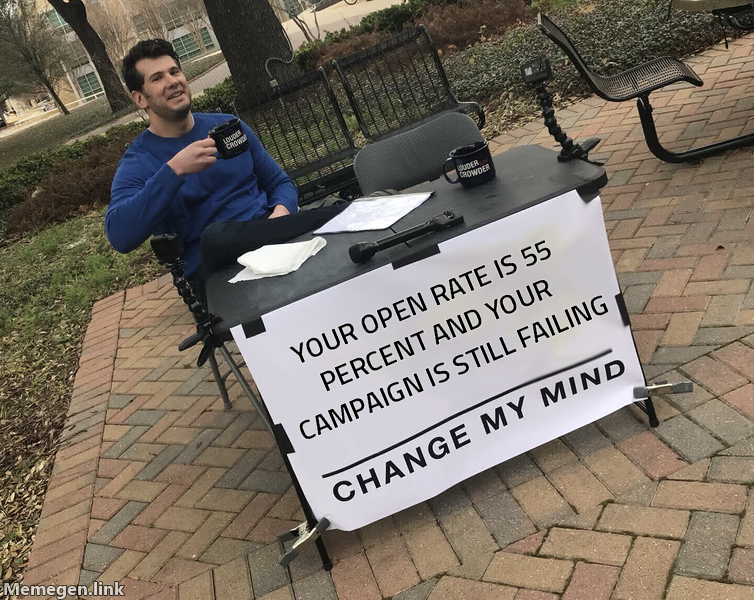
If your open rate is around 55 percent but your positive reply rate is below 0.5 percent, your deliverability is fine but your message is off. If your open rate is below 20 percent and your reply rate is also low, start with infrastructure.
The Deliverability Layer Most Teams Skip
A large portion of campaigns that underperform on open rate have an infrastructure problem, not a copy problem.
Sending from a domain that was registered last week, without email warm-up, across dozens of mailboxes simultaneously is a reliable way to land in spam. Gmail and Outlook have both tightened their spam detection significantly. Sending volume ramps, domain age, and sender reputation all feed into inbox placement before a single human ever decides whether to open your email.
The practical checklist: use a subdomain separate from your main domain, warm mailboxes over three to four weeks before reaching volume, set SPF, DKIM, and DMARC correctly, and keep daily send volume per mailbox conservative. If you are not sure your deliverability is healthy, tools like Google Postmaster can show you domain reputation signals for Gmail traffic.
For a deeper look at how to structure compliant outbound infrastructure, the GDPR-compliant cold email agency guide covers how to handle suppression lists, unsubscribes, and lawful basis alongside the technical setup.
Signal-Based Outreach and How It Changes the Math
The campaigns that consistently outperform benchmarks are not the ones with the best subject line formulas. They are the ones that reach the right person at the right moment with a message that is relevant to something happening in their world right now.
Signals can be job changes, funding rounds, new product launches, hiring patterns, technology installs, or content that shows someone is actively thinking about a problem you solve. When your outreach references something real and timely, open rates improve because subject lines can be specific rather than generic. Reply rates improve because the message lands with context.
This is the core mechanic behind signal-based cold email that avoids spam filters: relevance at the inbox level, not just personalization tokens.
If you are building this capability in-house, the done-with-you outbound model gives you the stack and the process without handing the system off entirely.
What to Actually Track and Report
Rather than benchmarking against industry averages, build your own baseline. Track these numbers per campaign cohort:
Open rate (with a note on whether Apple MPP affects your audience), positive reply rate, meeting booked rate, bounce rate, and unsubscribe rate. After five to ten campaigns, your own data tells you more than any published benchmark.
If open rate is high but replies are low, the problem is in the body copy or the offer. If open rate is low, check deliverability first, then subject lines. If bounce rate is creeping up, clean the list before sending further.
The teams that run outbound well treat these numbers as a diagnostic system, not a scoreboard. The goal is not to maximize open rate. The goal is a calendar with qualified meetings on it.
For context on how a B2B cold email agency structures reporting and what healthy campaign metrics look like across different verticals, that page walks through how Asphia approaches measurement for clients across five markets.
Get the signal tier list in your inbox.
We rank signals from S to D to decide who gets a cold email and who does not. You get the list once. No follow-up emails.
Request received. The list lands in your inbox within 24 hours.
One more step: send the prepared request to [email protected]
FAQ
What is a good cold email open rate in 2026?
For a tightly targeted B2B campaign with warmed mailboxes and clean data, open rates of 40 to 60 percent are generally considered achievable. Anything above 30 percent with proper tracking attribution is typically regarded as solid. Below 20 percent usually signals deliverability problems, a weak subject line, or a poorly matched list.
What is the average cold email open rate across industries?
Industry averages vary widely and are often distorted by Apple Mail Privacy Protection, which auto-loads tracking pixels. Reported averages are commonly cited as ranging from 20 to 50 percent depending on the source and how opens are tracked. Treat any single benchmark figure with skepticism unless you know the methodology.
Does a high open rate mean my cold email campaign is working?
Not necessarily. Open rate tells you whether the subject line and sender reputation got someone to look. It says nothing about whether your message resonated. Positive reply rate and meetings booked are the metrics that confirm the campaign is actually working.
Why are my cold email open rates low?
The most common causes are poor deliverability (landing in spam or promotions), a subject line that signals sales at first glance, sending from a cold mailbox that has not been warmed, or reaching a list that has bad data and low engagement. Fix infrastructure first, then optimize copy.
How does Apple Mail Privacy Protection affect open rate tracking?
Apple MPP, launched in 2021 and now widespread, pre-fetches email content including tracking pixels. This artificially inflates open rates for campaigns reaching Apple Mail users. Campaigns to audiences with heavy Apple device usage can show inflation of 20 to 30 percentage points in reported opens.
What reply rate should I expect from cold email?
For well-researched, signal-based cold email, a positive reply rate of 2 to 5 percent is typically considered strong. Generic spray-and-pray campaigns are commonly reported to sit below 0.5 percent. The gap between those two ranges is almost entirely explained by targeting precision and message relevance, not volume.

Ahmet Faruk Yilmaz
Founder of Asphia. He builds and runs signal-based B2B outbound engines for lean teams, and has booked meetings with teams at companies across five markets. Writes about cold email, Clay, deliverability, and GTM engineering.
Want this run for you?
Get a free GTM analysis. We show you the exact engine we would build.
Get your free GTM analysis →