How Long Should a Cold Email Be? What Actually Works
January 4, 2026 · 4 min read · by Ahmet Faruk Yilmaz, Founder of Asphia
TL;DR
Keep cold emails between 50 and 125 words. Shorter emails consistently get higher reply rates because they respect the reader's time, signal confidence, and leave less room for objections. One clear ask per email, no preamble, no company bio in the opening line.
Keep your cold email under 125 words. In most B2B cold outreach, shorter emails consistently outperform longer ones because they respect attention, signal confidence, and reduce the surface area for objections.
That is not a hunch. Across cold email campaigns at scale, reply rates drop noticeably once an email crosses roughly 150 words, and the steepest decline happens after 200 words. The reason is simple: every extra sentence is another chance for the reader to disengage.
Why Short Wins
A cold email has one job: earn a reply. It is not a landing page, a capability deck, or a product tour. The moment you treat it like any of those, you lose.
Short emails signal that you know what you want and you respect the other person’s time. Long emails signal uncertainty. When a founder or sales leader opens a long cold email, the subconscious read is “this person could not figure out what to say, so they said everything.”
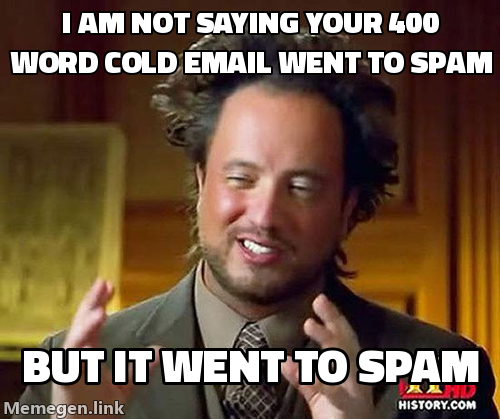 Your 400 word cold email went to spam.
Aim for 50 to 125 words on a first touch. Follow-ups can be even shorter, sometimes a single sentence referencing the first email.
The Structure That Works
Three blocks, each as tight as possible.
The opener. One sentence tied to a specific, observable signal about the prospect or their company. A recent hire, a product launch, a job posting, a funding round. Not “I came across your profile,” which signals nothing. The opener is your only chance to show you did real homework.
The pitch. One to two sentences on what you do and why it is relevant to them given that signal. No feature lists. No “we help companies like yours.” Be specific: what changes for them if this works?
The ask. One question, low friction. “Worth a 20-minute call this week?” or “Would it make sense to show you how we do it?” One ask, no alternatives, no calendar links in the first email if your domain is new.
This structure works in B2B cold email across industries. If you want to see how it applies specifically to SaaS outreach, the cold email for SaaS companies guide covers vertical-specific variations. For agencies selling outbound services, cold email for agencies walks through positioning nuances.
What to Cut
Most cold emails are too long because writers cannot bring themselves to delete. Here is what almost always comes out when you edit ruthlessly.
The company intro. “We are a [city]-based [category] company founded in [year]” earns nothing. Cut it entirely.
The feature list. “Our platform offers X, Y, Z, and integrates with A, B, C” reads like a brochure. Pick the one thing most relevant to this specific prospect and say only that.
The pre-ask hedge. “I know you are probably very busy, but…” Delete it. Everyone is busy. Acknowledging it does not help.
The double CTA. “We could do a call, or I could send a case study, or you could check out our website.” Pick one. Multiple asks produce no action.
Length Across Channels
Cold email length rules do not map directly to LinkedIn. LinkedIn connection requests cap at 300 characters, so brevity is forced. LinkedIn direct messages have more room but the same principle applies: shorter, signal-based, one ask.
For email specifically, plain text consistently outperforms HTML templates in deliverability and reply rate. One or zero links. No images in the first email. These choices also happen to push you toward shorter copy, which is the goal.
If you want a full look at how AI cold email avoids spam filters, the technical side (authentication, sending infrastructure, warmup) matters as much as the copy length.
How to Test Your Own Length
Split your next campaign into two variants: your default length versus a version cut by roughly a third. Same signal, same ask, shorter body. Run enough sends per variant before drawing conclusions.
Almost every team that runs this test ends up sending shorter emails. The difference usually becomes clear within a few days.
If you want an outbound system that applies these principles at scale, with signal-based personalization, human approval on every send, and clean deliverability infrastructure, that is exactly what we build at Asphia. Whether you want us to run it for you or build it in your own stack, the copy principles are the same.
Get the signal tier list in your inbox.
We rank signals from S to D to decide who gets a cold email and who does not. You get the list once. No follow-up emails.
Request received. The list lands in your inbox within 24 hours.
One more step: send the prepared request to [email protected]
FAQ
What is the ideal length for a cold email?
Between 50 and 125 words for most B2B cold emails. Under 80 words tends to perform best for first-touch outreach, where your only job is to earn a reply, not close a deal.
Does a longer cold email perform better if I have more context?
Rarely. More context usually means more objections and more time for the reader to decide to ignore you. Lead with the most compelling signal, leave the detail for the call.
Should I include company background in a cold email?
No, not in the opening. Prospects do not care about your founding story or team size before they know why you are reaching out. Open with relevance to them, not information about you.
How many paragraphs should a cold email have?
Three short blocks works well: a one-sentence opener tied to a specific signal, one to two sentences on what you do and why it matters to them, and a single low-friction call to action.
Does cold email length affect spam filtering?
Yes, indirectly. Very long emails with lots of links and HTML formatting trigger spam filters more often. Plain-text emails under 150 words with one or zero links have a cleaner deliverability profile.
What is the biggest mistake people make with cold email length?
Writing the email for themselves instead of the reader. Long introductions, feature lists, and social proof paragraphs all serve the sender's anxiety, not the prospect's interest. Cut everything that does not make the reader more likely to reply.

Ahmet Faruk Yilmaz
Founder of Asphia. He builds and runs signal-based B2B outbound engines for lean teams, and has booked meetings with teams at companies across five markets. Writes about cold email, Clay, deliverability, and GTM engineering.
Want this run for you?
Get a free GTM analysis. We show you the exact engine we would build.
Get your free GTM analysis →