Cold Email Copywriting for Consulting Firms: Templates, Angles, and What Not to Say
December 30, 2025 · 5 min read · by Ahmet Faruk Yilmaz, Founder of Asphia
TL;DR
Consulting cold email works when it leads with a specific, observable problem the prospect already has, not with your credentials. Keep it under 80 words, use one concrete signal, and make the CTA a question, not a pitch. Skip the capability summary.
Consulting cold email has one overriding rule: start with the prospect’s situation. Your credentials come last, if they appear at all. Firms that book meetings open with something the prospect recognises from their own business. They do not lead with a methodology pitch.
The Core Structure That Works
A good consulting cold email has four parts, in this order:
- A signal or observation about the prospect’s situation
- A specific problem that situation tends to create
- A brief statement of what you do about it
- One low-friction question
The opening observation carries the message. It shows that you did the research and gives the next sentence context. “I help consulting firms scale their revenue” could go to anyone, so it is easy to ignore. “I noticed your firm just expanded into the German market” tells the reader why you contacted them.
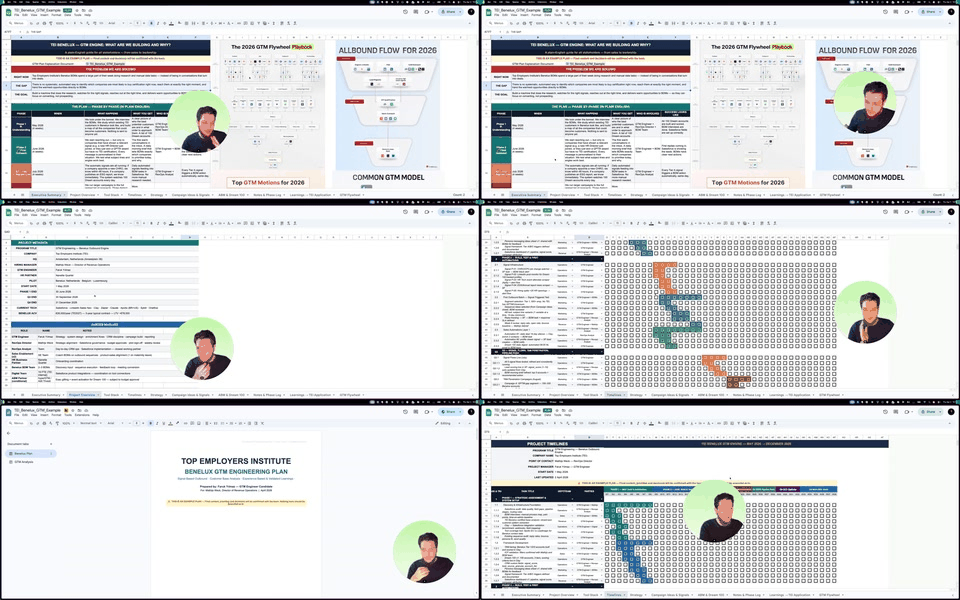
Source signals from LinkedIn posts, hiring activity, funding announcements, leadership changes, and recent press. Clay and Apollo can collect them without separate manual research for every contact. We explain the approach in our piece on done-with-you outbound.
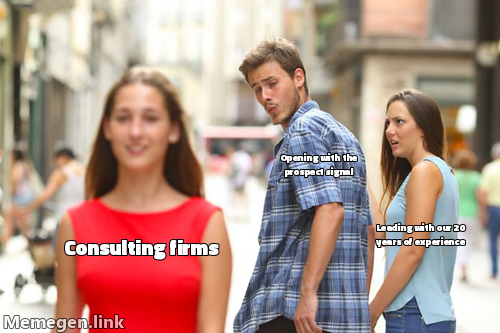 Consulting firms, every time they sit down to write a cold email.
What Consulting Firms Write vs. What They Should Write
Here is the most common pattern we see from consulting firms writing their own outreach:
Common version: “Hi [Name], I am the founder of XYZ Consulting. We specialize in operational efficiency for mid-market professional services firms. We have helped dozens of companies reduce costs and improve margins. Would you be open to a call?”
This version leads with the seller. Nothing tells the prospect why the message is relevant to them.
A sharper version: “Hi [Name], Saw that your team has grown from 12 to 40 people in the past 18 months. That kind of growth usually creates process gaps before the systems catch up. We help firms at that stage build the operational infrastructure that keeps delivery quality consistent. Is that a pressure point for you right now?”
The service is the same. The framing is not. The second version shows awareness of the situation, names a real problem, and ends with a genuine question.
Creativity is not the difference. Order is. Start with them, not you.
Angles That Work for Consulting Verticals
Consulting cold emails should not all use the same angle. Choose one based on the work your firm does and the trigger that creates demand for it:
For strategy and transformation consulting: Open with funding, M&A, a leadership change, or entry into a new market. Companies are more open to an outside perspective during a change.
For operational or process consulting: Name a familiar bottleneck such as delivery speed, rework rates, or handoff friction. The problem is already felt, even if it has not become a priority.
For financial advisory and CFO-level consulting: Credibility matters more. Briefly name the situations you work on, without listing clients, then ask directly about the company’s current exposure. That gives the reader more to respond to than a vague benefit statement.
For technical or specialist consulting: Specificity is the angle. Name the technology, regulation, or methodology. It signals expertise faster than a credentials line.
For firms working across European markets, GDPR-compliant cold email practices are worth building into your process from the start rather than retrofitting later.
What to Cut From Every Draft
Before you send, remove:
The credentials paragraph. “We have 20 years of combined experience” and “we have worked with Fortune 500 companies” belong on your website, not in an opening email. The prospect cannot verify these claims and they add length without adding relevance.
The solution dump. Describing your full methodology leaves the prospect with little to respond to. Save the how for the conversation.
Weak social proof. Invented statistics, vague claims like “our clients see 3x results,” or unnamed case studies hurt credibility more than they help. If you cannot point to something specific and verifiable, speak qualitatively. “Teams we work with typically reduce rework within the first quarter” is more believable than a percentage pulled from nowhere.
The heavy CTA. Asking for a 45-minute discovery call in the first email demands too much commitment. At this stage, a conversational question such as “Does this resonate?” is easier to answer than a calendar link.
Sequence Design for Consulting Outreach
A single email rarely books a meeting. A three to four message sequence creates enough contact without wearing out the reader.
Email 1: signal-based opener, one clear problem, one question. Email 2: a different angle or a piece of proof (a framework you use, a problem you have seen repeatedly). Email 3: a low-pressure bump (“Wanted to make sure this reached you”). Email 4 (optional): a graceful close (“If the timing is off, happy to reconnect later”).
Each email should be able to stand alone. A prospect who reads only email three should still understand what you do and why it might be relevant to them.
For firms that want the system built properly rather than running it through trial and error, outbound for professional services covers how agencies like Asphia structure this for consulting clients across multiple markets.
Copy is only one part of the system. Deliverability, sequencing, and data quality matter just as much. Get the copy right first so the rest of the outreach system has a fair chance to work.
Get the signal tier list in your inbox.
We rank signals from S to D to decide who gets a cold email and who does not. You get the list once. No follow-up emails.
Request received. The list lands in your inbox within 24 hours.
One more step: send the prepared request to [email protected]
FAQ
How long should a cold email be for a consulting firm?
Aim for 60 to 90 words in the body. Consultants often overwrite to establish credibility. Credibility comes from understanding the prospect's situation, not listing your background. Keep the message short, specific, and relevant.
What subject lines work best for consulting cold email?
Subject lines that reference something specific to the prospect outperform generic ones. A company name, a recent trigger (funding, new hire, product launch), or a direct question about a known challenge all work well. Avoid benefit-heavy subject lines like 'Grow your revenue' because they read as promotional.
Should consultants personalise every cold email?
Yes, but not at the expense of speed. The minimum viable personalisation is one signal: a recent event, a role change, a public statement, or a visible business challenge. Everything else in the email can be templated. One genuine signal is worth more than three generic compliments.
What is the biggest copywriting mistake consulting firms make in cold outreach?
Leading with their own story. Emails that open with 'We are a boutique consulting firm that...' put the prospect in reading mode immediately. The strongest openers reference something about the prospect's world, then connect it to a problem you can solve. Flip the order.
How do you write a cold email CTA for a consulting engagement?
Ask a yes-or-no question rather than proposing a call. Something like 'Would it be worth a quick exchange?' or 'Is this a priority for your team right now?' reduces friction and gets a faster response. Hard asks like 'Book 30 minutes with me' create commitment before the prospect sees your value.
Can GDPR-compliant cold email work for consulting firms targeting European clients?
Yes. B2B cold email to professional contacts at companies is generally permitted under GDPR's legitimate interest basis when it is relevant to the recipient's role. The key requirements are a clear opt-out in every message, no personal data beyond what is publicly available, and relevance to the recipient's professional function.

Ahmet Faruk Yilmaz
Founder of Asphia. He builds and runs signal-based B2B outbound engines for lean teams, and has booked meetings with teams at companies across five markets. Writes about cold email, Clay, deliverability, and GTM engineering.
Want this run for you?
Get a free GTM analysis. We show you the exact engine we would build.
Get your free GTM analysis →