Cold Email First Line Formula: 12 Openers That Beat Generic Personalization
January 7, 2026 · 5 min read · by Ahmet Faruk Yilmaz, Founder of Asphia
TL;DR
The best cold email first lines are specific without being sycophantic. They reference a real signal (a hire, a round, a post, a product change), frame why it matters to the recipient, and stop before they can see the ask coming. Generic 'I noticed you're in X industry' openers get deleted. Signal-based openers get read.
The first line gets more attention than any other part of a cold email. If the opener lands, the reader continues. If it misses, the rest of the copy does not matter.
The best cold email first lines are specific without being sycophantic. They reference a real signal, frame why it matters to the recipient, and stop before the ask is visible.
Why Generic Openers Fail
“I came across your profile and was impressed by your background” is not a first line. It is a rejection trigger.
Buyers receive dozens of cold emails every week. They recognize openers that do not reference anything real. The moment a line sounds templated, the email gets closed. Generic personalization (“I noticed you’re in the SaaS space”) is worse than none because it proves the sender did not look.
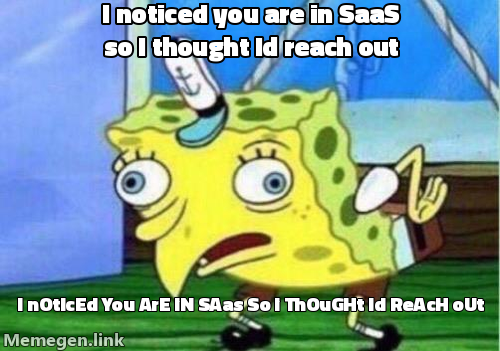 The opener that has been deleted 10,000 times and counting.
The first line should not flatter. It should prove that you noticed something relevant.
The 6 Signal Types That Power Real Openers
Before you write the opener, identify the signal. Your first line is only as good as the trigger behind it.
1. Hiring signal. A job post reveals a pain point in real time. If a company is posting for a Head of Revenue Operations, they are building or fixing revenue process right now.
2. Funding signal. A recent round means budget has moved and priorities are shifting. The window for relevant outreach is short (weeks, not months).
3. Expansion signal. A new market, a new office, a new product line. Growth creates new gaps.
4. Leadership change. New executives need wins quickly and are more open to outside ideas than incumbents who own existing processes.
5. Content signal. A post, podcast appearance, or published piece where the prospect stated a belief or problem. Referencing a public statement proves you paid attention.
6. Tech stack signal. Job posts and vendor pages can reveal the tools a company uses. That shows where it has invested and where the stack may still have gaps.
These signals feed into Clay enrichment pipelines. Each contact gets matched to a trigger before the email is written.
12 Cold Email First Line Examples by Type
Each example below follows a format: signal plus implication. No greeting. No preamble.
Hiring signals:
- “You posted for a VP of Sales last week, which usually means the current pipeline motion is not scaling the way leadership wants.”
- “Three SDR roles open at once is either a strong signal of growth or a sign the current team is churning faster than it fills.”
Funding signals: 3. “Congrats on the Series B. The 18 months after a round are usually when outbound infrastructure either gets built properly or improvised under pressure.” 4. “After a raise, most ops teams find they have more budget than bandwidth. Worth a conversation about where that hits you.”
Expansion signals: 5. “Entering the German market next quarter and running outbound in a language your team does not speak natively is a specific problem. We handle that.” 6. “Adding a second vertical is exciting until you realize your current messaging was written for one ICP.”
Leadership change: 7. “You joined as CRO three months ago. New leaders usually have about a quarter before the board wants to see pipeline movement.” 8. “First 90 days in a new revenue role and you are probably mapping what you inherited versus what you want to build.”
Content signals: 9. “Your post about SDRs burning out before they hit quota matched what we see when the activity model does not fit the market.” 10. “You said in the Pavilion podcast that PLG and outbound have to coexist. That is the specific problem we built our motion around.”
Tech stack / intent signals: 11. “Your team is using Instantly and Apollo based on the job post. That combination covers volume but usually leaves personalization as a manual bottleneck.” 12. “Switching from HubSpot sequences to a dedicated sequencer is a signal that you are taking outbound seriously. Curious what triggered it.”
For agencies and consulting firms, content and leadership change signals tend to produce the highest reply rates. See how we apply them in cold email for agencies and outbound for professional services.
How to Combine Signal and Frame
An opener has two parts: the signal (what you noticed) and the frame (why it matters). Neither works alone.
Signal without frame: “I saw you raised a Series B.” (So what?) Frame without signal: “Most growing companies struggle with outbound.” (Generic.) Signal plus frame: “You raised a Series B last month. Growth rounds usually mean the pipeline expectation doubles before the team does.” (Specific, relevant, creates tension.)
Do not explain the product in the frame. Name a consequence or tension the reader already feels. The product can come later.
Every email in our done-for-you cold email build uses this structure. We pull a real signal from structured data, match it to the recipient’s likely priority, and stop before the ask.
What to Avoid in the First Line
These patterns consistently underperform:
Fake specificity. “I noticed your company recently…” with nothing specific after it. Readers see through vague references immediately.
Compliments. “I love what you’re doing at…” reads as a preamble to a pitch, not a genuine observation. Skip it.
Long openers. If your first line runs past 25 words, cut it. Brevity signals confidence. Length signals uncertainty.
Questions that assume too much. “Are you struggling with pipeline?” is presumptuous and easy to dismiss with “no.” Observations are harder to dismiss than questions.
Overused hooks. “Quick question” and “I’ll be brief” have been in every playbook for five years. They are invisible.
The opener does not close the deal. It earns the second sentence.
Across multiple markets, the data and signal infrastructure matters as much as the copy. Signal-based outbound changes which openers you can credibly write.
Get the signal tier list in your inbox.
We rank signals from S to D to decide who gets a cold email and who does not. You get the list once. No follow-up emails.
Request received. The list lands in your inbox within 24 hours.
One more step: send the prepared request to [email protected]
FAQ
What makes a cold email first line effective?
An effective first line is short, specific, and relevant to the reader right now. It references something real about the person or business instead of making a generic industry observation. Its only job is to earn the second sentence.
Should I start a cold email with a compliment?
No. Compliments feel transactional and are immediately recognizable as openers. They create distance, not rapport. Start with a signal, an observation, or a direct question that frames your point of view instead.
How long should the first line of a cold email be?
Keep it to one sentence, ideally under 20 words. Mobile preview panes show roughly the first 90 characters. If the hook does not land inside that window, most recipients will not open. Short copy respects their time.
Can I use the same first line for everyone on a list?
Only if that line is genuinely relevant to every person on the list at the segment level, such as a shared trigger or role. Broad lists need segment-specific openers, not one template. True personalization at scale uses signal-based variables inserted per row.
What signals work best for cold email openers?
The strongest signals are recent and high-intent: a new hire in a relevant role, a funding announcement, a product launch, a job posting that reveals a pain point, or a public comment the prospect made. Signals decay fast. Use them within days, not weeks.
Is personalization in the first line actually worth the effort?
Signal-based personalization consistently outperforms generic outreach in reply rates. The effort is manageable when signals are pulled from structured data sources like Clay or Apollo and mapped to templates. The key is matching signal type to the right opening formula.

Ahmet Faruk Yilmaz
Founder of Asphia. He builds and runs signal-based B2B outbound engines for lean teams, and has booked meetings with teams at companies across five markets. Writes about cold email, Clay, deliverability, and GTM engineering.
Want this run for you?
Get a free GTM analysis. We show you the exact engine we would build.
Get your free GTM analysis →