5 Cold Email CTAs That Book Meetings
December 19, 2025 · 4 min read · by Ahmet Faruk Yilmaz, Founder of Asphia
TL;DR
Good cold email CTAs are specific and easy to answer. Ask for one thing: a yes/no, a 15-minute call, or an answer to one short question. Five useful formats are the permission ask, specific-time offer, one-question close, referral pivot, and soft opt-out.
The CTA is where most cold emails die. The copy is solid, the subject line got the open, the first line earned the read, and then the final sentence asks for a 30-minute intro call with a Calendly link attached. Reply rate: zero.
Fixing the CTA is one of the quickest ways to improve cold outreach. Here are five formats we use, why they work, and the mistakes that cost replies.
Why Most Cold Email CTAs Fail
Most CTAs fail for one of three reasons. They ask for too much commitment too early. They are vague and give the prospect nothing concrete to respond to. Or they feel copy-pasted and have nothing to do with why you reached out.
A cold prospect owes you nothing. Keep the ask small and make the answer obvious. That is what separates CTAs that get replies from those that get archived.
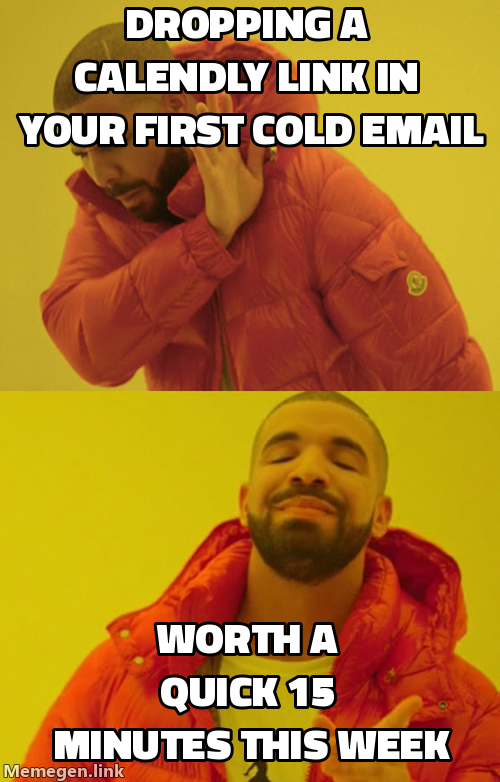 Dropping a scheduling link cold is asking a stranger to manage your calendar. A yes or no question costs them nothing.
The 5 Cold Email CTAs That Book Meetings
1. The Permission Ask
This is the easiest cold outreach CTA to answer.
“Worth a quick 15-minute call this week?”
That is it. The prospect can reply in two words. There is no calendar link, long request, or implied commitment beyond one reply. You are a stranger, so the first step stays small.
Use this on your first touch, especially to senior buyers who receive high volumes of outreach.
2. The Specific-Time Offer
Once you are past the first touch or you have a warm signal (a job change, a funding round, content engagement), you can raise the specificity without raising the friction.
“I have Tuesday at 2pm or Thursday at 10am free. Either work?”
The next step is concrete, and the prospect does not have to search for a slot. They pick one of two options. That removes much of the scheduling work between a positive reply and a booked call.
For done-for-you cold email sequences, this format works especially well on follow-up steps two and three.
3. The One-Question Close
Sometimes the smartest move is not to ask for a call at all. Ask a question that only they can answer, and that naturally leads to a call if the answer is interesting.
“Quick question: are you building that pipeline in-house right now or looking at outside support?”
The question gives you useful information without immediately pushing for a meeting. If the answer is “we’re actually exploring options,” you now have a concrete reason to suggest a call.
This is especially effective in cold email for SaaS companies where the prospect’s current setup matters a lot to whether the conversation is relevant.
4. The Referral Pivot
If the prospect is not the right person, most emails just die. The referral pivot rescues them.
“If you’re not the right person for this, who on your team handles outbound?”
It is polite, specific, and easy to answer. You may get a warm referral to the actual decision-maker, even when the original targeting was wrong.
5. The Soft Opt-Out
This works well near the end of a long sequence.
“If this isn’t a fit right now, no worries at all. Just let me know and I’ll stop sending.”
It removes pressure and gives silent prospects an easy way to close the conversation. You also clean your list faster and stop unnecessary sends. Use it on the last step of a sequence.
If you want to see how this fits into a full sequence structure, how to book meetings without an SDR walks through the full cadence logic.
What to Avoid
A few patterns consistently lower reply rates.
Generic asks like “let me know your thoughts” or “happy to chat anytime” give the prospect nothing to respond to. They require the prospect to create the next step, which most will not do.
Asking for too much too soon is the other common failure. A 45-minute product walkthrough in a first touch email is asking a stranger to invest almost an hour with someone they do not know yet. Match the size of your ask to the size of the relationship you have actually built.
Stacking multiple CTAs in one email (“You can book a call, reply to this, or check out our case studies”) splits attention and usually gets none of them answered.
Matching the CTA to the Signal
Signal-based outreach should change your CTA, not just your opening line. If someone posted about a hiring problem on LinkedIn, your one-question close can address it directly. If a company just raised a round, your specific-time offer can acknowledge the timing. A CTA tied to the signal gives the prospect a clearer reason to answer than a generic ask.
This is why clay enrichment service data changes what CTAs you can credibly write. When you know what a prospect actually published or did last week, your ask can be specific in a way that a list of names and titles never allows.
The goal of a cold email is not to close a deal. It is to start a conversation. Make the CTA specific, easy to answer, and relevant to the signal.
Get the signal tier list in your inbox.
We rank signals from S to D to decide who gets a cold email and who does not. You get the list once. No follow-up emails.
Request received. The list lands in your inbox within 24 hours.
One more step: send the prepared request to [email protected]
FAQ
What is a CTA in a cold email?
A CTA (call to action) is the single request at the end of a cold email. It tells the prospect exactly what to do next. The best ones are low-friction: a yes/no question, a specific time slot, or a single question rather than a calendar link dropped cold.
Should I include a Calendly link in my cold email?
Rarely in the first touch. Dropping a scheduling link before rapport is built feels presumptuous and raises the friction for a reply. Offer a time slot in plain text first and only send the calendar link once they say yes.
How long should a cold email CTA be?
One sentence, two at most. A CTA that runs three or four lines is actually multiple asks. Pick the single most important action and write only that. Longer CTAs split attention and reduce reply rates.
What cold email CTA gets the highest reply rate?
The yes/no permission ask consistently outperforms direct meeting requests on a first touch. Something like 'Worth a 15-minute call this week?' requires almost no commitment to answer and keeps the conversation moving without pressure.
Why do cold email CTAs fail?
Most CTAs fail because they ask for too much too soon (a full demo, a 45-minute call), are too vague ('let me know your thoughts'), or feel copy-pasted. A CTA that matches the prospect's buying stage and the signal that triggered outreach performs far better.
Can I use the same CTA across all my cold email sequences?
No. The right CTA depends on the prospect's seniority, the stage of the sequence, and what triggered the outreach. A permission ask works well on a cold first touch. A specific-time offer works better on a warm follow-up. Match the ask to the moment.

Ahmet Faruk Yilmaz
Founder of Asphia. He builds and runs signal-based B2B outbound engines for lean teams, and has booked meetings with teams at companies across five markets. Writes about cold email, Clay, deliverability, and GTM engineering.
Want this run for you?
Get a free GTM analysis. We show you the exact engine we would build.
Get your free GTM analysis →