LinkedIn URL to Verified Email: The Tools That Actually Work in 2026
September 19, 2025 · 5 min read · by Ahmet Faruk Yilmaz, Founder of Asphia
TL;DR
The tools that consistently turn a LinkedIn URL into a verified work email are Prospeo, LeadMagic, and Apollo for broad coverage, with BetterContact and Clay as waterfall layers. No single provider finds every email: stack two providers and always run a deliverability check before sending.
The short answer: no single tool converts a LinkedIn URL to a verified work email with reliable coverage. The teams that do this well run two providers in sequence, keep a verification cache, and accept that enrichment is a probabilistic step, not a guarantee. Here is how to build that flow correctly.
Why LinkedIn Email Enrichment Is Hard
LinkedIn does not sell email data. Every enrichment provider builds its database independently, through web crawls, email header analysis, data partnerships, and user-contributed records. That means the same LinkedIn URL can return a confident match from one provider and nothing from another, depending on how recently their data was refreshed and whether that person’s email appeared in any of their sources.
The result is that coverage varies widely by region, seniority, and company size. North American enterprise contacts at recognizable brands are well-covered. A regional sales director at a 30-person software company in the Netherlands is much harder to find. Any vendor claiming consistently high hit rates across all segments should be read with skepticism.
The Providers Worth Testing
Prospeo is purpose-built for LinkedIn-to-email enrichment. You pass a profile URL and get back a work email with a confidence score. Their waterfall logic queries multiple sources internally, which gives better coverage than single-database tools. The API is straightforward and integrates cleanly into custom data pipelines. Use their /enrich-person endpoint (not older, deprecated paths).
LeadMagic returns email status alongside the address itself, which saves a separate verification call for many records. The API is fast and the email validate endpoint classifies results as valid, invalid, catch-all, or unknown. Coverage for European B2B is reasonable for mid-market, weaker for smaller firms.
Apollo has broad coverage because its database is large and actively maintained by its user base. The tradeoff is that Apollo is a full prospecting platform, not just an enrichment API, so the per-record cost structure is different and the data is also used across Apollo’s own network. For teams already using Apollo for prospecting, the enrichment path is convenient. For pure enrichment use cases, the overhead of the full platform may not be worth it.
BetterContact is worth including as a third layer. It queries multiple enrichment vendors under the hood and returns the result with a source attribution. The async nature of some requests means you build for polling rather than synchronous response, but the hit rate on hard-to-find contacts is meaningfully higher than any single provider.
For teams that want to orchestrate this without building a custom script, Clay enrichment service is the standard workflow tool. Clay lets you chain Prospeo, LeadMagic, and BetterContact in a waterfall so that each provider only runs if the previous one returned nothing. This keeps costs proportional to difficulty: easy-to-find contacts cost one API call; hard ones cost three.
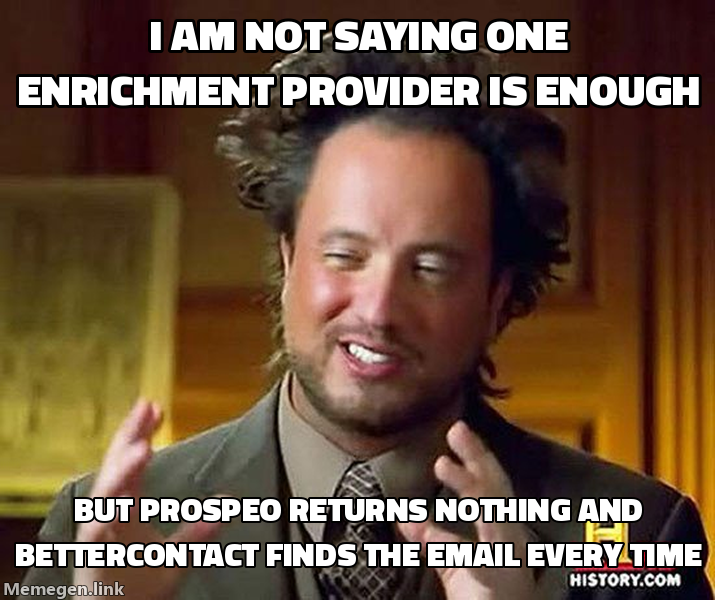 Coverage gaps are not tool failures. They are why you stack two providers and always verify.
Verification Is Non-Negotiable
Finding an email address is not the same as knowing it will deliver. Enrichment databases age. People change jobs. Domains expire. Sending to a list that has not been verified is a fast path to bounce rates that damage your sender reputation and land you in spam.
Before any cold email campaign, run a separate verification pass. The check pings the receiving mail server to confirm the mailbox exists. For catch-all domains (where the server accepts everything), a second-opinion provider corroboration helps filter addresses that look valid but are likely inactive. For outbound we run across European and North American markets, we run verification on every address regardless of the confidence score the enrichment tool returned.
This matters especially for GDPR compliant cold email in Europe. Sending to outdated or role-based addresses is not just a deliverability problem: it can indicate that the data sourcing process does not meet the accuracy requirements under data protection law.
Building the Enrichment Pipeline
A practical pipeline for a B2B outbound team looks like this. Start with a list of LinkedIn URLs sourced from a tool like Apollo or Sales Navigator. Pass each URL to your primary enrichment provider (Prospeo or LeadMagic). For records that return no email, pass to a secondary provider (BetterContact). Run all returned emails through a deliverability check before they enter any sequence. Cache the results so you do not pay to enrich the same contact twice.
If you want to connect this to cold email execution, the enriched and verified records feed directly into your sending tool. The done-with-you outbound model Asphia offers includes building this data layer inside your own stack so the machine and the data are yours after the engagement ends.
For teams that want this running without managing the toolchain themselves, the done-for-you cold email path handles enrichment, verification, copy, and sending as a managed service.
What to Expect From Coverage
Set realistic expectations before you start. A well-run enrichment waterfall across two providers will typically return a valid or high-confidence email for a meaningful portion of your list, but not all of it. The portion that comes back empty is not a tool failure. It reflects how that person’s contact data has or has not appeared in sources the providers can access.
For the records that do return an email, the goal is to send something worth reading. Data quality is the entry ticket. Copy quality and timing are what turn an enriched contact into a conversation. LinkedIn enrichment solves the first problem. Signal-based cold email strategy solves the second.
Get the signal tier list in your inbox.
We rank signals from S to D to decide who gets a cold email and who does not. You get the list once. No follow-up emails.
Request received. The list lands in your inbox within 24 hours.
One more step: send the prepared request to [email protected]
FAQ
Can you get someone's email from their LinkedIn URL?
Yes. LinkedIn does not expose emails directly, but enrichment tools match the profile URL against proprietary databases of work emails built from public sources, web crawls, and user-contributed data. Coverage varies by provider and is strongest for decision-makers at mid-market companies in English-speaking markets.
How accurate are LinkedIn to email enrichment tools?
Accuracy depends on the provider and the segment. The best tools return a verified or high-confidence email on a meaningful share of profiles, with coverage dropping materially for niche industries, smaller companies, and non-English-speaking markets. Always run a separate deliverability check before sending cold email.
Is LinkedIn email enrichment legal and GDPR compliant?
Using publicly available professional contact data for B2B cold email can be lawful under legitimate interest in GDPR Article 6(1)(f), but only if the outreach is relevant to the recipient's professional role and you honor opt-outs immediately. Sourcing method matters: some providers aggregate data in ways that do not meet GDPR standards. If you operate in Europe, verify the provider's data processing agreement before using their data.
What is the difference between email enrichment and email verification?
Enrichment finds an email address from an identifier like a LinkedIn URL or a name plus company. Verification checks whether that address can receive mail: it pings the mail server without sending a message and classifies the result as valid, invalid, or catch-all. You need both steps before cold outreach.
Which LinkedIn enrichment tool has the best coverage in Europe?
Coverage for European markets, especially Germany, the Netherlands, and the Nordics, is weaker across all providers compared to North America. LeadMagic and Prospeo have decent European coverage for mid-market B2B. For multilingual European campaigns, running two providers in a waterfall and accepting a lower hit rate is more realistic than expecting US-level coverage.
Do I need a Clay subscription to enrich LinkedIn profiles?
No. Clay is a workflow layer that orchestrates multiple enrichment providers, not a data source itself. You can call Prospeo, LeadMagic, or Apollo directly via their APIs without Clay. Clay adds value when you want to chain enrichment steps, apply logic, and push clean records into your CRM or sending tool without writing code.

Ahmet Faruk Yilmaz
Founder of Asphia. He builds and runs signal-based B2B outbound engines for lean teams, and has booked meetings with teams at companies across five markets. Writes about cold email, Clay, deliverability, and GTM engineering.
Want this run for you?
Get a free GTM analysis. We show you the exact engine we would build.
Get your free GTM analysis →