GDPR-Safe B2B Data Sourcing with Apollo and Clay: What You Must Check Before You Scrape
March 20, 2026 · 5 min read · by Ahmet Faruk Yilmaz, Founder of Asphia
TL;DR
Apollo and Clay are GDPR-compliant data vendors, but the compliance responsibility shifts to you the moment you export a contact. You need a documented legitimate interest basis, a working opt-out flow, and suppression list management before you send a single email.
Apollo and Clay are GDPR-compliant data vendors. That statement is true and also beside the point, because the moment you export a contact list and load it into a sending tool, you become the data controller. The compliance obligation is yours.
Here is what you must verify before you scrape, enrich, or send.
Lawful Basis Comes First, Not Last
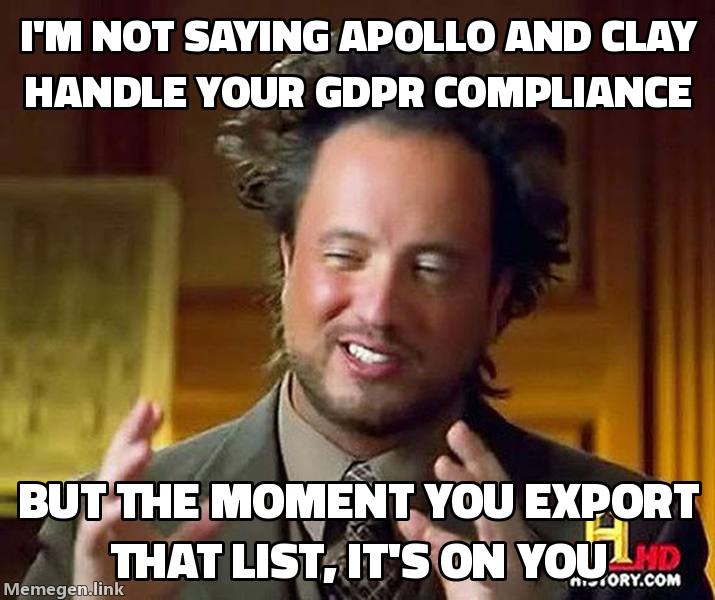 Both platforms are compliant vendors. You become the data controller the second you hit export.
GDPR requires every piece of personal data processing to rest on a documented lawful basis. For B2B outbound, that basis is almost always legitimate interest. To rely on it you must pass three tests: you have a genuine business interest in reaching this person, the outreach is reasonably necessary to pursue that interest, and the contact’s right to privacy does not clearly override your interest.
Relevance is the strongest signal you have. A CTO at a 50-person SaaS company receiving an email about developer tooling has a reasonable professional expectation that vendors will contact them. A finance director receiving the same email has no such expectation. Apollo and Clay both allow you to filter tightly by role, industry, and company size. Use those filters to build relevance in before you ever enrich a name.
One practical step many teams skip: write down your legitimate interest assessment before you run a campaign, not after a complaint arrives. It does not need to be long. A short document that says who you are targeting, why their role is relevant to your offer, and why you believe the contact would reasonably expect this kind of outreach is usually sufficient.
What Apollo and Clay Actually Cover
Apollo publishes a Privacy Policy and processes opt-out requests. Contacts can remove themselves from Apollo’s database. Clay acts as an enrichment orchestrator that pulls from multiple providers, each with their own data agreements.
Neither platform guarantees that every contact in an export is currently opted in for your specific outreach. They handle their own obligations as data processors. Your obligation as the controller is separate.
Practically, this means you should treat Apollo and Clay exports as starting points that require your own GDPR layer, not as pre-approved outreach lists. See how this fits into a broader GDPR-compliant cold email agency approach.
The Suppression List Is Not Optional
Every European outreach campaign needs a suppression list that is consulted before every send. When someone opts out, their email address goes on that list and never leaves it. This is not a best practice. It is a legal requirement under GDPR’s right to erasure and the right to object.
The operational failure point is usually integration. Teams maintain suppression lists in one tool but source leads from Apollo and enrich via Clay without pulling that suppression data into the export step. The result is opted-out contacts re-entering campaigns from fresh Apollo exports weeks later.
Build the suppression check into your Clay workflow, not just into your sending tool. If you use a sending platform like Smartlead or Instantly, their internal unsubscribe lists are a last line of defense, not the whole system. For a deeper look at how enrichment pipelines connect to sending, the Clay enrichment service breakdown covers the operational structure.
Data Minimisation and Retention
GDPR’s data minimisation principle means you should collect only the fields you will actually use. If your email sequence does not personalise on company revenue, do not pull company revenue. Clay makes it easy to enrich twenty fields at once. Resist that temptation unless each field has a clear use in your workflow.
Retention matters too. Contact records pulled for a campaign that ran and closed should not sit in a spreadsheet indefinitely. Set a review date for your lead databases and purge or refresh records that are no longer relevant to active campaigns.
Practical Checklist Before You Launch
Before any European outbound campaign using Apollo or Clay data, confirm:
- You have written documentation of your legitimate interest basis for this specific audience.
- Every email in your sequence contains a functional, one-click opt-out link.
- Your suppression list is checked against your contact export before import into your sending tool.
- The data you pulled is limited to fields your sequence actually uses.
- You have a process to handle Subject Access Requests if a contact asks what data you hold.
Points five often gets overlooked. If someone in the EU emails you asking what data you hold about them, GDPR gives them the right to receive that information within 30 days. Knowing which Apollo or Clay fields you enriched and where that data currently lives is the minimum you need to respond.
Where Asphia Fits
At Asphia, every campaign we build includes the GDPR layer at the architecture stage, not as an afterthought. Signal-based targeting, tight role and industry filters, suppression list integration, and a human approval gate before any email leaves the system are standard. We work with teams across the UK, Netherlands, Germany, and broader Europe where these obligations are active.
If you are evaluating whether your current data sourcing process is defensible, the b2b lead generation agency europe page explains how we structure compliant pipelines. For teams building this in their own stack, the done-with-you outbound model covers how we transfer the system to you.
GDPR does not make B2B outbound impossible. It makes sloppy outbound impossible, which is a useful forcing function toward higher quality targeting and more relevant messaging, both of which improve reply rates regardless of regulatory requirements.
Get the signal tier list in your inbox.
We rank signals from S to D to decide who gets a cold email and who does not. You get the list once. No follow-up emails.
Request received. The list lands in your inbox within 24 hours.
One more step: send the prepared request to [email protected]
FAQ
Is Apollo GDPR compliant for B2B prospecting?
Apollo maintains a GDPR-compliant data infrastructure and allows opt-out requests. However, sourcing data from Apollo does not make your outreach automatically compliant. You remain the data controller and must document your lawful basis, typically legitimate interest, and provide a clear opt-out mechanism in every email you send.
Can you use Clay for B2B lead generation in Europe under GDPR?
Yes, Clay can be used for European B2B lead generation if you apply GDPR controls at the workflow level. That means enriching only the data points you genuinely need, suppressing opted-out contacts before any campaign, and keeping your enrichment audit trail so you can demonstrate a lawful basis if challenged.
What is legitimate interest and does it apply to B2B cold email?
Legitimate interest is the most commonly cited lawful basis for B2B cold email under GDPR. To rely on it you must pass a three-part test: identify a real business interest, show the outreach is necessary to pursue it, and confirm the contact's privacy interests do not override yours. Relevance of the message to the recipient's professional role strengthens the case considerably.
Do I need consent to email a business contact in Europe?
For B2B outreach under GDPR, consent is not usually required. Legitimate interest is the typical lawful basis, provided the message is genuinely relevant to the recipient's job function. However, countries like Germany add national ePrivacy rules on top of GDPR that can require prior consent in some contexts, so check local law for each target market.
How should I handle opt-outs from Apollo or Clay sourced contacts?
Every outbound email must contain a clear, functional opt-out link. When a contact unsubscribes, remove them from your active lists immediately and add the email address to a suppression list that persists across all future campaigns. Never re-add a suppressed contact, even from a freshly pulled Apollo export.
What data points from Apollo or Clay are safe to use under GDPR?
Professional data that is directly relevant to a contact's business role, such as work email, job title, company name, and industry, generally falls within the scope of legitimate interest for B2B outreach. Personal data that goes beyond professional context, such as personal mobile numbers or home addresses, carries a higher burden and is best avoided unless you have a clear documented reason.

Ahmet Faruk Yilmaz
Founder of Asphia. He builds and runs signal-based B2B outbound engines for lean teams, and has booked meetings with teams at companies across five markets. Writes about cold email, Clay, deliverability, and GTM engineering.
Want this run for you?
Get a free GTM analysis. We show you the exact engine we would build.
Get your free GTM analysis →