Cold Email in the Netherlands: B2B Rules, GDPR Nuances, and What Actually Works
March 2, 2026 · 5 min read · by Ahmet Faruk Yilmaz, Founder of Asphia
TL;DR
B2B cold email to Dutch companies is legal under GDPR's legitimate interest basis, provided you use business emails, state a clear reason to contact, and make opting out easy. The Netherlands has no additional opt-in law for business-to-business email. Relevance and timing matter more here than volume.
B2B cold email in the Netherlands is legal, widely practiced, and genuinely effective when done with specificity. The legal basis is GDPR legitimate interest. The practical requirement is relevance.
Here is what you actually need to know before running outbound into the Dutch market.
What GDPR Actually Allows for B2B Cold Email
GDPR does not ban cold email. Article 6(1)(f) permits processing personal data, including sending a first outreach email, when there is a legitimate interest that is not overridden by the recipient’s rights. For B2B contexts, courts and regulators across the EU have consistently held that contacting a professional at a business email address about a relevant business topic satisfies this test.
The Netherlands follows the same framework. There is no Dutch national law that adds an opt-in requirement on top of GDPR for business-to-business email. The rules that do apply are straightforward:
- Use only professional contact details (business email addresses, not personal addresses)
- State who you are and why you are reaching out
- Include a simple, functional way to opt out
- Honor opt-out requests promptly and permanently
- Do not retain personal data longer than needed for the outreach purpose
If you operate a GDPR compliant cold email agency model, these are not obstacles. They are the baseline.
One common mistake: treating B2B cold email rules the same as B2C. Consumer email marketing in the Netherlands requires prior consent under the Dutch Telecommunications Act (Telecommunicatiewet). Business email does not. The distinction between a professional address tied to a company role and a personal inbox matters legally and practically.
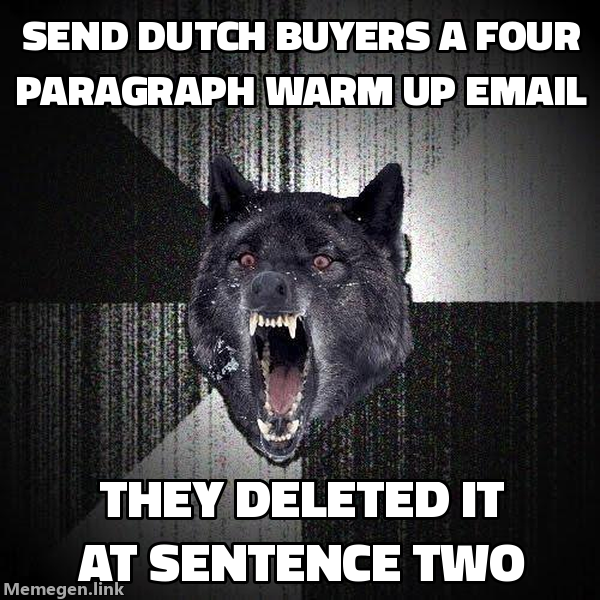 Dutch buyers are the most direct in Europe. Lead with the point or lose them in the opener.
How the Dutch B2B Buyer Actually Reads Email
Understanding the legal floor is step one. Understanding the cultural context is step two.
Dutch professionals are among the most direct in Europe. They dislike filler language, inflated claims, and messages that waste their time. A four-paragraph cold email that builds slowly to a pitch will be deleted before the second paragraph is finished.
What works:
A single clear reason to reach out, stated in the first sentence. Not “I came across your company and thought there might be synergy.” Something specific: a hiring signal, a product launch, a market condition that creates a live problem your offer addresses.
Short copy. Two to three short paragraphs. The goal is to earn a reply, not to close a deal in the email.
No vague social proof. Saying you work with “leading companies in the sector” without naming them reads as noise. If you cannot be specific, leave it out entirely.
English is widely accepted in the Netherlands, especially for tech, SaaS, logistics, and professional services. For Dutch-language SME targets, localized copy improves engagement noticeably.
The Signal-Based Approach for Netherlands Outbound
The highest-performing outbound campaigns into the Dutch market use external signals to determine when and why to reach out, rather than sending to a static list on a fixed schedule.
Signals that work for Netherlands B2B:
A company posting a VP Sales or Head of Revenue role is building commercial infrastructure. That is a moment when an outbound system, a fractional SDR, or a lead generation agency in Europe becomes immediately relevant.
A recent funding announcement creates both budget and urgency to grow pipeline fast. Dutch startups and scale-ups receive significant funding from EU and US sources, and these are publicly announced.
A job change at the contact level, where a decision-maker moves from one company to a new role, is a strong trigger. They are evaluating vendors, building a new team, and have influence without legacy commitments.
These signals turn a cold email into a well-timed message. The difference in reply rates between a signal-triggered sequence and a static list blast is not marginal.
Tools like Clay enrichment and Apollo allow you to layer these signals on top of your ICP filters before a single email goes out. The result is a list that is already warm before contact.
Setting Up a Compliant Netherlands Outbound System
A GDPR-native outbound system for the Dutch market has a few non-negotiable components.
Email verification before sending. Dutch company domains have variable catch-all configurations. Sending to unverified addresses risks bounces that damage deliverability and domain reputation. Verify every address before it enters a sequence.
Suppression list management. Every opt-out must be captured and applied across all campaigns and future sends. This is both a legal requirement and a practical deliverability measure.
Warm sending infrastructure. Sending from a fresh domain with no warmup history to a tight ICP list in the Netherlands will land in spam. Domain warmup over several weeks, with gradual volume increases, is not optional.
Human review at the send stage. Automated personalization at scale is valuable, but sending without any human checkpoint introduces factual errors and tone problems that damage brand credibility with a market that notices details. At Asphia, every send goes through a human approval step before it leaves the queue.
For companies that want this built in their own stack, the done-with-you outbound model covers the full setup: ICP definition, data sourcing, signal layer, copy, infrastructure, and compliance documentation. The system stays in your accounts.
For companies that want the machine run for them, done-for-you cold email covers the same infrastructure with Asphia operating it on an ongoing basis.
What to Expect From Netherlands B2B Outbound
The Netherlands is a competitive market with a small addressable population compared to Germany or the UK. This means volume alone will not drive results. A list of five hundred highly qualified contacts with a clear signal and specific copy will outperform a list of five thousand generic leads every time.
The companies that book meetings consistently in this market are not the ones sending the most email. They are the ones sending the most relevant email at the right moment.
For a cold email agency in the Netherlands context, or any team building outbound into the Dutch market, the investment in proper data sourcing, signal detection, and GDPR-compliant infrastructure pays back in both reply rates and sustainable deliverability over time.
See gdpr.eu for the full text of GDPR Articles 6 and 13, which govern the legitimate interest basis and transparency requirements relevant to B2B cold outreach.
Get the signal tier list in your inbox.
We rank signals from S to D to decide who gets a cold email and who does not. You get the list once. No follow-up emails.
Request received. The list lands in your inbox within 24 hours.
One more step: send the prepared request to [email protected]
FAQ
Is cold email legal in the Netherlands for B2B?
Yes. B2B cold email to business contacts is permitted under GDPR's legitimate interest basis. The Netherlands does not require prior consent for business-to-business email the way it does for consumer marketing. You need a legitimate purpose, a clear opt-out, and to use professional contact details only.
Do I need consent to send cold emails to Dutch prospects?
No explicit consent is required for B2B cold email in the Netherlands. GDPR Article 6(1)(f) allows processing personal data when there is a legitimate interest that is not overridden by the individual's rights. Use business emails, keep messages relevant, and honor unsubscribe requests immediately.
What makes cold email to Netherlands companies different from other markets?
Dutch buyers tend to be direct and skeptical of over-engineered messaging. Short emails with a specific reason to reach out perform better than long multi-benefit pitches. The market is highly international, so English-language outreach is widely accepted, though Dutch copy can improve reply rates for SME targets.
How should I handle GDPR for a Netherlands outbound campaign?
Document your legitimate interest basis before sending. Use only professional email addresses sourced from business profiles or company websites. Never send to personal Gmail or Hotmail addresses. Suppress unsubscribes within 24 hours, keep records of opt-outs, and do not retain prospect data longer than necessary.
What data sources work for finding Dutch B2B contacts?
Apollo and LinkedIn are the primary sources for Netherlands B2B contacts. Clay can layer company signals on top. For email verification, always validate before sending to avoid bounces that damage domain reputation. Dutch company registry (KVK) data is public and can supplement firmographic targeting.
What response rates should I expect from cold email in the Netherlands?
Response rates vary by ICP fit, signal quality, and copy. Expecting a specific percentage would be misleading. What consistently moves numbers is sending to a tightly defined segment, using a relevant signal as the reason to reach out, and writing a message that proves you understand their situation before making any ask.

Ahmet Faruk Yilmaz
Founder of Asphia. He builds and runs signal-based B2B outbound engines for lean teams, and has booked meetings with teams at companies across five markets. Writes about cold email, Clay, deliverability, and GTM engineering.
Want this run for you?
Get a free GTM analysis. We show you the exact engine we would build.
Get your free GTM analysis →