Cold Outreach for Private Equity Portfolio Companies: What Works at Scale
December 6, 2025 · 6 min read · by Ahmet Faruk Yilmaz, Founder of Asphia

TL;DR
PE portfolio companies need outbound that scales fast without bloating headcount. Signal-based cold email using hiring data, funding signals, and enriched contact lists built on Clay and Apollo gives portcos a repeatable pipeline engine. A human approval step keeps quality and deliverability intact. Most portcos can be live in under two weeks.
Cold email for private equity portfolio companies works when it is built for speed, precision, and scale from day one. Portfolio companies do not have two quarters to test and iterate the way a bootstrapped startup might. PE timelines demand pipeline, and they demand it now.
The short answer: a signal-based outbound system using enriched contact data, tight ICP definition, and a human approval step is the fastest path to repeatable meetings for most portcos.
Why Standard Outbound Fails PE Portfolio Companies
Most portcos inherit either nothing (if they are pre-revenue) or a loose collection of manual sales motions. The PE sponsor wants growth metrics quickly. The instinct is to hire SDRs. The problem is that SDR ramp time, tool setup, and ICP discovery can eat three to six months before a single qualified meeting is booked.
The alternative is to build the outbound system first and staff into it later. When the system defines what works, an SDR hired into it is immediately productive rather than spending months figuring out the playbook.
Generic cold email to bought lists does not work for portcos either. The buyers at mid-market and enterprise companies have seen every templated opener. What cuts through is a message that arrives at the right moment, references something real about their situation, and gets to the point fast. That requires signal data, not just contact data.
For portcos that need to move across multiple markets simultaneously, a managed outbound service gives you the infrastructure and expertise without building from scratch inside each operating company.
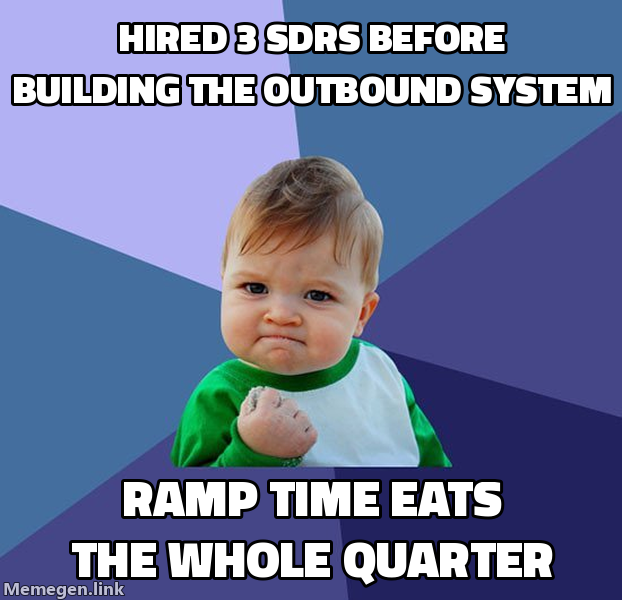 Build the system first. Then staff into it.
The Outbound Stack That Scales for Portcos
A working outbound system for a PE portfolio company has a few non-negotiable layers.
ICP definition first. Before any tool is touched, the portco needs a clear answer to: what company size, what vertical, what job title, and what business problem. This is where many portcos underinvest. Vague ICP definition means every downstream effort is misdirected. The PE sponsor’s thesis often provides the clearest starting point: if they bought because the business solves a specific problem for a specific buyer, that problem and buyer is where outbound starts.
Signal-based targeting. Static Apollo lists generate noise. What generates response is reaching a prospect when they have an active problem. Hiring signals (a company posting revenue or growth roles) indicate they are scaling and need help. Tech stack additions indicate vendor evaluation activity. Job changes at the contact level indicate new budget authority. Clay enrichment pulls these signals alongside verified email addresses and LinkedIn URLs, giving the outbound system a reason to reach out rather than just a name and email.
Persona-specific copy. A CFO and a VP of Sales at the same company need completely different messages even for the same product. The copy layer generates short, direct emails that reference the specific signal and the specific role’s likely priority. The email arrives feeling relevant rather than blasted. For portcos operating across multiple languages and markets, multilingual sequencing (English, Dutch, German, or others) can run in parallel without separate teams.
Fact-checked and human-approved sends. AI-generated copy needs an independent audit before it goes out. Hallucinated claims, wrong company details, or signals that no longer apply all damage deliverability and relationships. Every send should pass through a human approval step. This is not optional at any volume. It also gives the revenue lead visibility into what is going out and catches tone or positioning issues before they reach buyers.
Deliverability infrastructure. Dedicated sending domains, warmed mailboxes, and suppression management are table stakes. The portco’s primary domain should never be used for cold outreach. If it gets flagged, it takes the entire company’s email with it.
What Multi-Portfolio Outbound Looks Like
PE firms with multiple portfolio companies face a version of this at the fund level. Running a separate outbound build for each portco from scratch is expensive and slow. A better model is a shared infrastructure layer (enrichment, signal sources, sending tools, compliance guardrails) with portco-specific ICP definitions and copy prompts layered on top.
This is also how done-with-you outbound builds value for PE-backed companies: the system is built in the portco’s own stack, the team is trained, and the asset stays with the company rather than disappearing when the agency relationship ends. The outbound capability becomes a company asset, not a rented service.
For portcos targeting buyers across Europe, GDPR-compliant cold email is not an afterthought. It is part of the build from the start. Business emails, verified lists, immediate suppression on opt-out, and documented legitimate interest bases are standard practice and not difficult to implement when the system is built correctly.
Timing, Signals, and What Portcos Get Wrong
The most common mistake PE portfolio companies make in outbound is treating it as a volume game. More emails, lower thresholds, faster automation. The result is high bounce rates, poor sender reputation, and zero meetings.
The portcos that book consistent meetings run fewer emails with higher precision. They use signals to identify the 20 percent of their list that has an active problem today. They write copy for that specific moment. They send from warm domains at sustainable volume. They suppress everyone who opts out immediately and never re-contact them.
Speed comes from process clarity and system design, not from removing quality controls. An outbound engine built correctly can go from zero to booked meetings in under two weeks for most portcos. The outbound engine builder model is specifically designed for this: build once, run continuously, hand the asset to the team.
For portcos that are considering hiring a fractional SDR rather than building a full system, it is worth reading how the fractional SDR service model compares to a systemized approach. In most cases, the system produces more volume, more consistency, and a lower cost per meeting than a single fractional rep working without the right infrastructure behind them.
Getting a Portco Outbound System Live Quickly
The fastest path:
- Lock ICP to one segment and two job titles.
- Pull 300 to 500 companies from Apollo matching that ICP. Run them through Clay for signal enrichment and verified contacts.
- Write two persona-specific email sequences. Short subject lines, direct openers, one clear ask.
- Set up sending infrastructure on warmed domains. Do not touch the primary domain.
- Build a simple approval queue. Review every draft before it goes out.
- Run the first two weeks as a test. What books meetings in week one tells you what to scale in week two.
Portfolio companies with the sharpest ICP definition and the tightest signal layer outperform everyone else in outbound, regardless of how much budget is behind the effort. The system is the leverage. Build it right from the start.
Get the signal tier list in your inbox.
We rank signals from S to D to decide who gets a cold email and who does not. You get the list once. No follow-up emails.
Request received. The list lands in your inbox within 24 hours.
One more step: send the prepared request to [email protected]
FAQ
What makes cold email for private equity portfolio companies different from standard B2B outreach?
Portcos operate under PE timeline pressure: they need pipeline now, not in six months. This means ICPs must be locked quickly, signal sources need to surface buying intent rather than cold lists, and outreach should be sequenced across email and LinkedIn simultaneously. Speed to market and message precision matter more than volume alone.
How should a portco define its ICP for outbound when it is still early-stage?
Start with the company size range, vertical, and job title that maps to your current best-fit customers or your PE sponsor's thesis. Use your first 5 to 10 closed deals as anchors. Build a signal layer around that profile rather than sending to a generic Apollo export. Specificity at the ICP stage multiplies every downstream effort.
Which outbound signals work best for PE-backed B2B companies?
Hiring signals (a company posting SDR or growth roles), tech stack additions, new funding rounds, and executive job changes are the highest-intent triggers. Each signal tells you the prospect has an active business problem right now. For portcos with enterprise targets, add firmographic growth markers like headcount expansion or office openings.
Can PE portfolio companies run outbound without a full SDR team?
Yes. AI-driven outbound systems handle prospecting, data enrichment, copy generation, and sequencing. A single revenue lead can manage a pipeline engine that would previously require two or three SDRs. The system does the volume work. The human handles approvals and live replies. This is the standard operating model for portcos that need speed without headcount risk.
How do you keep cold email deliverability clean at PE portco scale?
Use dedicated sending domains (not your primary domain), warm them before launch, keep daily send volume per mailbox to reasonable levels, and run every email through a human approval gate before it goes out. Suppress unsubscribes immediately. Verify every email address before sending. These steps protect sender reputation and keep response rates sustainable.
Is cold email outreach GDPR compliant for EU-based portfolio companies?
It can be, when built correctly. GDPR allows cold email to business contacts under legitimate interest, provided you use verified business emails, include a clear opt-out, suppress unsubscribes immediately, and do not retain personal data beyond what is operationally needed. Many PE portcos operating across Europe run fully GDPR-native outbound without legal friction when these conditions are met.

Ahmet Faruk Yilmaz
Founder of Asphia. He builds and runs signal-based B2B outbound engines for lean teams, and has booked meetings with teams at companies across five markets. Writes about cold email, Clay, deliverability, and GTM engineering.
Want this run for you?
Get a free GTM analysis. We show you the exact engine we would build.
Get your free GTM analysis →