Is AI cold email personalization dead? Diagnosis beats {{firstName}}
June 15, 2026 · 6 min read · by Ahmet Faruk Yilmaz, Founder of Asphia
TL;DR
Token personalization like first name and company name is dead weight. What works in 2026 is diagnosis: AI that reads a prospect's situation and names a specific problem before the ask.
AI cold email personalization is not dead. The {{firstName}} version of it is. Buyers learned to spot merge tags and “I loved your recent post” openers in 2024, and reply rates for that style have been falling ever since. What still works is diagnosis: AI that reads a prospect’s actual situation and names a specific problem before you ask for anything. Here is the difference, and exactly how we run it.
The merge-tag era is over
For years “personalization” meant injecting variables. Hi {{firstName}}, I saw {{companyName}} is in {{industry}}. Then it got slightly smarter: an AI line about a LinkedIn post or a funding round. Buyers now pattern-match all of it as automated outreach in under two seconds.
Three reasons this style is dead:
- It proves nothing. Knowing someone’s name and company is table stakes. It signals a mail merge, not research.
- Everyone runs it. When most of your prospect’s inbox uses the same “congrats on the round” opener, the opener becomes a spam signal.
- It flatters, it does not diagnose. Complimenting a post does not tell the buyer you understand their problem. It tells them you scraped their feed.
The reply-rate decline is not a personalization problem. It is a depth problem. The market raised the bar from “do you know who I am” to “do you understand what I am dealing with.”
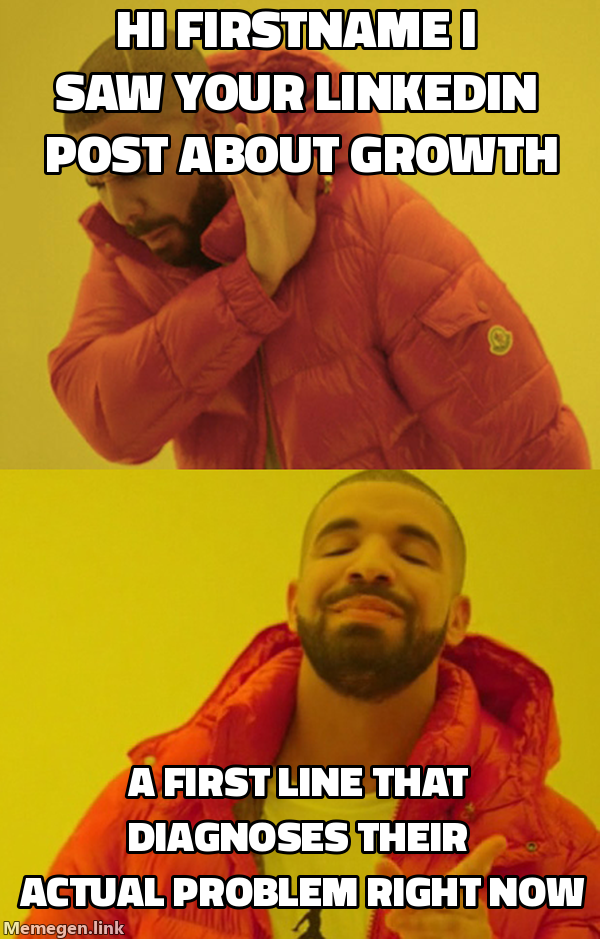 Buyers stopped reading at the merge tag. They still read a line that understands their problem.
What diagnosis-based personalization actually is
Diagnosis means the first line states something specific about the prospect’s situation and the problem it implies. It is the difference between a doctor saying “hello Mr. Yilmaz” and a doctor saying “that cough plus the travel you mentioned points to something specific.”
A token line: “Hi Sarah, saw Acme is scaling fast, congrats.”
A diagnosis line: “You are hiring three SDRs this quarter but still routing inbound through one shared inbox. That combination usually breaks response time before the new reps even ramp.”
The second line does three things the first cannot. It shows you looked. It names a consequence the buyer feels. It earns the right to the next sentence. The name is irrelevant. The problem is everything.
Diagnosis vs token personalization
| Dimension | Token personalization | Diagnosis personalization |
|---|---|---|
| What it references | Name, company, industry, recent post | A specific situation and its likely consequence |
| Signal to buyer | ”You ran a mail merge" | "You understand my problem” |
| Research depth | One scraped field | Multiple signals combined into a hypothesis |
| Defensibility | Anyone can copy it | Hard to fake without real research |
| Reply driver | Mild curiosity, fades fast | Recognition, “how did they know that” |
| Scales with AI? | Yes, and that is the problem | Yes, and that is the advantage |
The irony: AI made token personalization worthless because AI made it free. The same AI makes diagnosis personalization possible at scale, which is where the edge moved.
How we run AI personalization at scale
We do not let AI write the whole email. AI does the research and drafts one part: the diagnosis line. The offer, the structure, and the proof are set by a human and stay fixed across the campaign. AI personalizes the hook, not the pitch.
The pipeline:
- Enrich first, write second. We pull raw data from Apollo and enrich in Clay via our Clay enrichment service: tech stack, headcount trend, hiring signals, job titles, recent triggers. No copy gets written before the data is clean.
- Combine signals into a hypothesis. One data point is trivia. Two or three combined is a diagnosis. Hiring SDRs plus no CRM plus a generic contact form is a story. AI is good at spotting these combinations across thousands of rows.
- Draft the diagnosis line per prospect. AI writes one to two sentences that name the situation and the implied problem, using the enriched fields as evidence, not as merge tags.
- Human sets the rest. The offer, the proof, and the call to action are written once and locked. They do not change per prospect.
- Native review per language. We run TR, EN, NL, DE, and AR. A diagnosis line that lands in English can read as presumptuous in German. Native operators review before send.
The rule we enforce: if the diagnosis line could be sent to any other company on the list without changing a word, it is not personalization. It is decoration. Delete it.
Where AI personalization still fails
Diagnosis works, but only inside guardrails. The failure modes are predictable, and most “AI personalization is dead” complaints come from hitting one of them.
- Hallucinated specifics. AI will confidently invent a detail that is wrong. A wrong diagnosis is worse than no diagnosis, because it proves you did not actually look. Every AI claim has to trace back to a real enriched field.
- Creepy precision. There is a line between “I researched your business” and “I have been watching you.” Personal details from someone’s social feed cross it. Stick to business signals.
- Personalizing the wrong thing. A perfect first line on a weak offer still fails. Personalization is a multiplier, not the engine. If the offer is wrong, no amount of diagnosis saves it.
- Volume over relevance. AI lets you send 10,000 diagnosis emails. That does not mean you should. A narrow list of 800 right-fit accounts with real diagnosis beats 8,000 shallow ones, every time, and it keeps you out of the spam folder.
- GDPR drift. In Europe, the diagnosis has to come from legitimate, business-relevant data and the email needs a real opt-out and sender identity. Relevance is both the conversion lever and the legal basis. The GDPR regulation text sets out what legitimate interest requires for outbound email.
What this means for your reply rates
Stop measuring personalization by how many variables you inject. Measure it by one question: does the first line prove you understand the buyer’s problem?
Directionally, here is the pattern we see when teams switch from token to diagnosis personalization on the same list and offer:
- Token openers plateau and decay as the inbox saturates with the same style.
- Diagnosis openers hold up because the research is genuinely hard to fake, which keeps them rare.
- The lift is in positive replies, not open rates. Diagnosis does not always raise opens. It raises the quality of who replies, which is the only number that turns into meetings.
We get paid for booked meetings, not for activity, so we only count diagnosis as working when it moves meetings per thousand sent. A clever first line that does not book a call is a clever first line that lost. Our AI cold email service runs this diagnosis pipeline across every campaign we manage.
AI cold email personalization is not dead. The lazy version died, the diagnosis version took its place, and the gap between them is the gap between a deleted email and a booked meeting.
Get the signal tier list in your inbox.
We rank signals from S to D to decide who gets a cold email and who does not. You get the list once. No follow-up emails.
Request received. The list lands in your inbox within 24 hours.
One more step: send the prepared request to [email protected]
FAQ
Is AI cold email personalization dead in 2026?
No. Surface-level merge-tag personalization is dead. Diagnosis-based personalization, where AI names a prospect-specific problem, still lifts reply rates.
What is diagnosis-based personalization?
It is a first line that states something specific about the prospect's situation and the problem it implies, instead of just mentioning their name, company, or a recent post.
Does AI write the whole cold email?
No. AI does the research and drafts a diagnosis line at scale. A human sets the offer, the structure, and the proof. AI personalizes one part, not the whole email.
How many lines of personalization should a cold email have?
One to two lines, at the top. The diagnosis line states a specific situation and the problem it implies. Everything after that is your offer and proof, which stays the same across the segment. More personalization beyond the first line adds length without adding relevance.
What data signals make the best diagnosis lines?
Signals that point to a gap or tension work best: hiring for a role while lacking the infrastructure to support it, growing headcount without a visible outbound system, or switching tools mid-quarter. A single signal is trivia. Two or three signals combined into a hypothesis is a diagnosis.
Is AI cold email legal in Europe under GDPR?
B2B cold email to business addresses is permitted under GDPR when you have a legitimate interest basis, the message is relevant to the recipient's professional role, and you include a real opt-out and sender identity. Personal email addresses, consumer data, and emails with no clear business relevance require explicit consent.

Ahmet Faruk Yilmaz
Founder of Asphia. He builds and runs signal-based B2B outbound engines for lean teams, and has booked meetings with teams at companies across five markets. Writes about cold email, Clay, deliverability, and GTM engineering.
Want this run for you?
Get a free GTM analysis. We show you the exact engine we would build.
Get your free GTM analysis →